

Key Takeaways
- Needs, wants, and wishes exist on a spectrum - context determines where any expense falls.
- Rigid need/want thinking often causes people to abandon budgets by making them feel punishing.
- A three-tier framework gives you room to fund quality of life without losing spending discipline.
- Labeling an expense honestly doesn't mean eliminating it - it means choosing it deliberately.
- Small, recurring wants often drain more money over time than large, occasional purchases.
Needs vs. Wants vs. Wishes
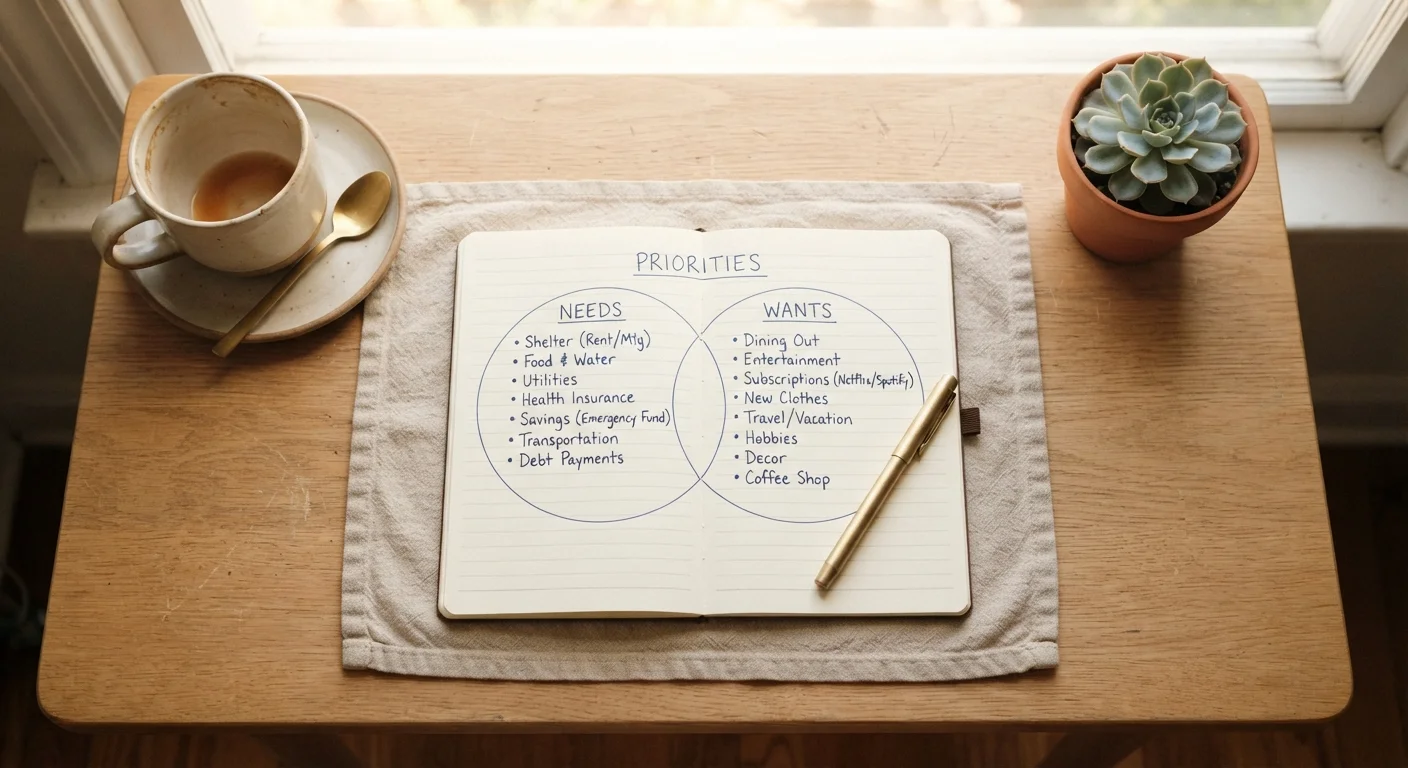
A "need" is something required for basic safety, health, and function - like housing, food, and transportation to work. A "want" is something that meaningfully improves your quality of life but isn't strictly required for survival. A "wish" is a discretionary aspiration - something you'd enjoy but can defer without real consequence. These three categories form a spending hierarchy that helps you make intentional trade-offs with your money.
In personal finance frameworks like the 50/30/20 rule, "needs" and "wants" are often treated as binary, but many real expenses fall on a spectrum, making context and household circumstances essential to any honest categorization.
Why the Binary Framing Breaks Down
Most introductory budgeting advice draws a clean line: needs are non-negotiable, wants are optional, and discipline means cutting the wants. That framing is appealing in its simplicity - but it tends to collapse quickly when applied to real life.
Consider a streaming subscription. Is it a need? Almost certainly not. Is it a want that provides genuine daily value and costs less than one restaurant meal per month? For many households, yes. Categorizing it alongside an impulse purchase treats very different spending decisions as equivalent - and that's where rigid need/want thinking makes budgets feel punitive enough to abandon.
A more durable approach introduces a third tier: wishes. Needs are non-deferrable. Wants meaningfully support your current quality of life. Wishes are aspirational and future-facing - things you'd love but can plan toward rather than spend toward today. This three-tier model gives you the vocabulary to make intentional decisions instead of guilt-driven ones. See key budgeting terms explained for definitions that support this kind of structured thinking.
How to Categorize Honestly - Without Judgment
Honest categorization isn't about labeling yourself irresponsible. It's about seeing your spending clearly so you can align it with what actually matters to you. A useful test: ask whether removing this expense would meaningfully harm your ability to work, stay healthy, or maintain household stability. If yes, it's likely a need. If no, the next question is whether it adds consistent, real value to your daily life - or whether it's a habit you've stopped noticing.
The habit-but-forgotten category is where most budget leaks live. A frugal mindset doesn't mean eliminating enjoyment - it means stopping payment for things that no longer deliver it. Unused subscriptions, duplicate services, and convenience spending on items you could easily prepare yourself are prime examples.
Rank Your Wants Before Cutting Them
Before trimming your wants list, score each item on a simple 1-5 scale based on how much genuine enjoyment or value it delivers. Cut from the bottom of the list first. This method preserves the spending that matters most to you and eliminates the spending you barely notice - making your budget feel chosen rather than imposed.
Once you've categorized, look at your wants list and rank items by the enjoyment they actually deliver per dollar. Cutting low-ranked wants before touching high-ranked ones preserves quality of life while reducing waste - a far better outcome than blanket restriction.
The Spectrum Problem: When Context Shifts the Category
Many expenses don't sit cleanly in one tier. A car is a need for a rural worker with no transit alternatives and a want - or even a wish - for someone with a reliable subway line to their office. High-speed internet is a luxury in some households and a professional necessity in others. These aren't edge cases; they're the norm.
This is why personal finance frameworks like the 50/30/20 rule work best as benchmarks, not mandates. If housing consumes 40% of your take-home pay - a reality for many Americans in higher-cost cities - forcing the remaining "needs" into 10% isn't a discipline problem, it's a math problem. Adjusting the percentages to fit your income and location is more useful than straining to match a ratio designed for average conditions.
Categories Change as Life Does
An expense that's a clear want today may become a need after a health change, a move, or a career shift. Build a habit of reviewing your need/want/wish categories at least once a year - or whenever your income or life circumstances change significantly. A budget that reflects your current reality is far more useful than one built on outdated assumptions.
Context also shifts over time. A gym membership might be a want at 30 and a health-management need at 55. Reviewing your categories annually - or after any major life change - keeps your budget honest rather than stale.
For a structured approach to allocating your paycheck across these tiers, splitting your paycheck strategically walks through several proven frameworks.
Budgeting for Wishes Without Derailing Your Finances
Wishes - the aspirational tier - are where many budgets fail silently. Because they feel unaffordable or far-off, people either ignore them entirely (and then spend impulsively when temptation strikes) or overspend on them in moments of optimism without a plan to absorb the cost.
The practical solution is a sinking fund: a dedicated savings bucket where you deposit a fixed amount each month toward a specific goal. If you want a $1,200 vacation in twelve months, $100 per month gets you there without borrowing or guilt. The wish becomes a budgeted line item - which transforms it from a temptation into a plan.
35%
Average share of income spent on housing
According to the U.S. Bureau of Labor Statistics Consumer Expenditure Survey, housing consistently accounts for roughly a third of American household spending, well above the 30% threshold in common budgeting frameworks.
$219/month
Average US household subscription spend
Research from C+R Research has found that Americans tend to significantly underestimate their monthly subscription costs, often spending well above what they recall committing to.
60%
People who say budgets feel too restrictive
Surveys on budgeting behavior consistently find that feelings of deprivation - not lack of income - are among the most cited reasons people abandon their budgets within the first few months.
Applying this logic broadly means your budget has three functional zones: a needs zone that covers your non-negotiables, a wants zone with a defined monthly ceiling, and a wishes zone funded by consistent small contributions. This structure doesn't require constant willpower - it requires an upfront design decision. See how to build a spending system that reduces decision fatigue for a deeper look at that approach.
This article is for general informational and educational purposes only and does not constitute personalized financial advice. Consider consulting a qualified financial professional for guidance specific to your situation.