

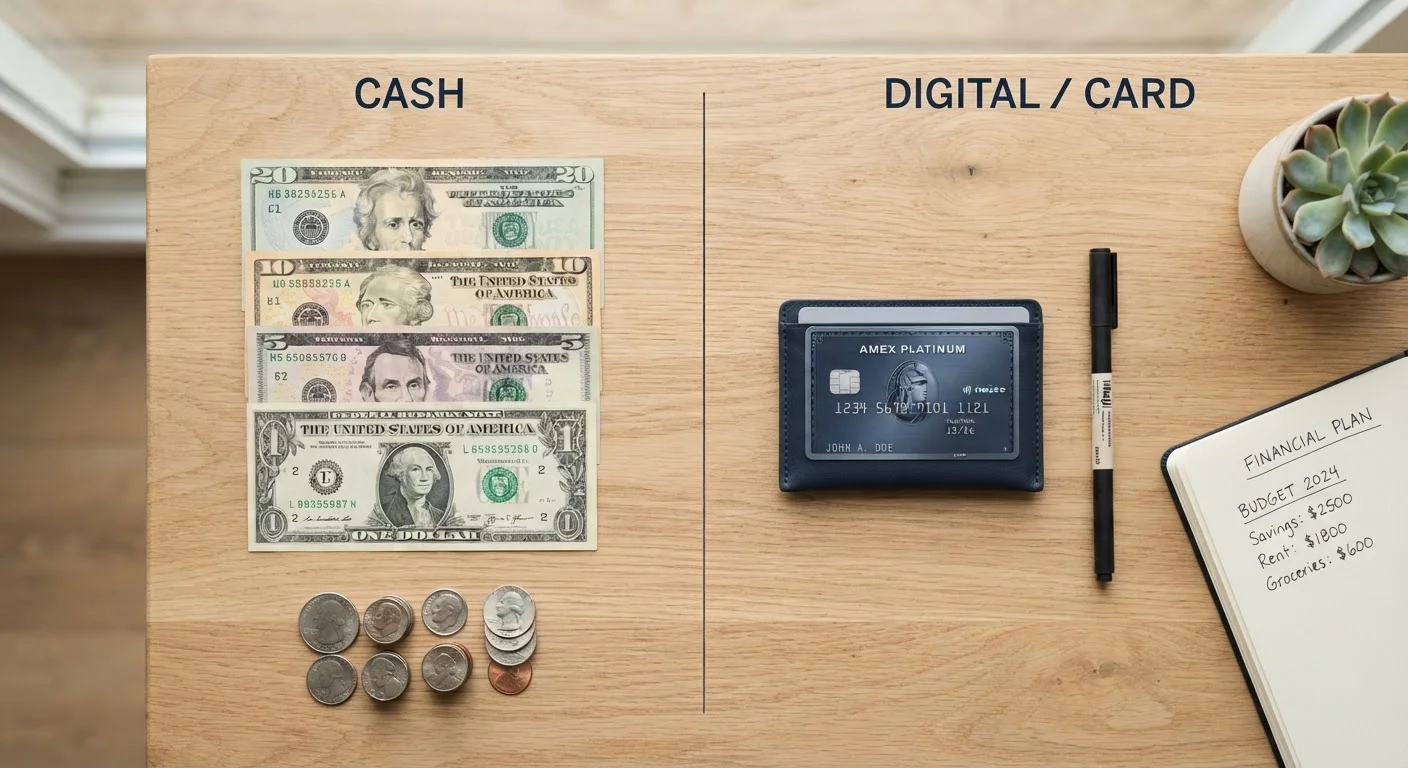
Key Takeaways
- Cash creates a physical spending limit that can reduce overspending for some consumers.
- Credit cards offer purchase protections, fraud liability limits, and potential rewards that cash cannot match.
- Carrying credit card debt negates most financial benefits of rewards or convenience.
- Your spending behavior - not the payment method itself - determines which option serves you best.
- A hybrid strategy, using cash for discretionary categories and credit for fixed expenses, can combine the strengths of both.
Option A
Paying with Cash
The tangible, spend-what-you-have approach.
Best for: Consumers who want a built-in spending limit and fewer opportunities for impulse overspending.
Option B
Using a Credit Card
The flexible, rewards-eligible modern method.
Best for: Disciplined spenders who pay their balance in full monthly and want to leverage perks and purchase protections.
If you regularly carry a credit card balance month to month
Paying with Cash
Interest charges on unpaid balances quickly erase any rewards earned and increase the true cost of every purchase. Cash keeps spending within hard limits.
If you pay your full statement balance every month without fail
Using a Credit Card
Consistent full payment means you pay no interest while benefiting from fraud protections, purchase coverage, and possible rewards on spending you would do anyway.
If you are working to curb impulse or emotional spending
Paying with Cash
Research in behavioral economics suggests spending cash feels more immediate and painful than swiping a card, which can naturally slow discretionary purchases.
If you frequently shop online or travel
Using a Credit Card
Credit cards provide chargeback rights, zero-liability fraud protection, and broad acceptance that cash simply cannot offer in digital or international environments.
If you want a simple hybrid system that suits most situations
Paying with Cash
Earmarking cash envelopes for discretionary categories like dining and entertainment, while using a credit card for fixed, predictable bills, pairs accountability with flexibility.
How Each Payment Method Actually Works Against Your Budget
On the surface, paying with cash and paying with a credit card both move money from your pocket to a merchant. In practice, they engage your brain - and your bank account - in meaningfully different ways.
When you hand over physical bills, the money is gone immediately. There is no float period, no minimum payment, and no statement date. This immediacy is a feature for budget-conscious consumers: once the cash in your wallet runs out, spending stops. Behavioral economists often describe this as the "pain of paying" - physical currency produces a stronger emotional response to loss than abstract card swipes, which can act as a natural brake on discretionary spending.
Credit cards work on a short-term loan model. You make purchases throughout a billing cycle, receive a statement, and owe the full balance (or a minimum) by the due date. If you pay in full, no interest accrues and the card essentially functions as a free float. If you carry a balance, interest - typically expressed as an annual percentage rate, or APR - compounds against the unpaid amount. At prevailing APRs, even modest balances can grow meaningfully over time, turning a convenience into a liability.
Understanding this structural difference is the starting point for deciding which method - or combination - fits your financial habits. See our paycheck allocation guide for a framework that can help you decide how much discretionary spending you can realistically afford before choosing a payment method.
| Criterion | Paying with Cash | Using a Credit Card |
|---|---|---|
| Spending limit | Hard limit - what you carry | Soft limit - your credit limit |
| Interest risk | None | High if balance is carried |
| Fraud protection | None - stolen cash is lost | Strong - dispute and zero-liability rights |
| Purchase protections | None | Extended warranty, chargeback rights |
| Rewards potential | None | Cash back or points (if paid in full) |
| Impact on credit history | None | Positive with responsible use |
| Impulse spending control | Strong - physical payment friction | Weaker - abstract transaction |
| Online usability | Not accepted | Universally accepted |
The Real Benefits and Hidden Costs on Both Sides
Neither payment method is cost-free, but the costs look very different depending on your habits.
Where Cash Wins
- Hard spending limits: You cannot spend money you do not physically have, which eliminates the risk of accumulating card debt on everyday items.
- No interest risk: Cash purchases are final. There is no billing cycle, no interest rate, and no minimum payment trap.
- Privacy: Cash transactions leave no data trail with financial institutions, which some consumers value.
Where Credit Cards Win
- Fraud protection: Under the Fair Credit Billing Act, cardholders can dispute unauthorized charges, and most major networks cap consumer liability at zero for reported fraud. Cash stolen is typically gone.
- Purchase protections: Many credit cards extend warranties, offer purchase protection against damage or theft, and provide chargeback rights when a merchant fails to deliver goods or services.
- Potential rewards: Cash back or points programs can return a percentage of eligible spending - but only if the balance is paid in full. Rewards do not offset interest charges mathematically.
- Credit history: Responsible credit card use - on-time payments, low utilization - contributes positively to your credit report, which affects borrowing costs on major purchases like auto loans or mortgages.
For consumers who shop frequently online, a credit card's dispute and fraud resolution infrastructure is especially valuable. The comparison of digital wallets and card-on-file payment methods explores how these protections extend into digital shopping environments.
82%
US adults with at least one credit card
According to the Federal Reserve's 2023 Report on the Economic Well-Being of US Households, a large majority of American adults hold at least one credit card.
~$6,500
Average US credit card balance per cardholder
The Federal Reserve Bank of New York's consumer credit data has consistently tracked average revolving balances in this range for households carrying month-to-month debt.
20%+
Typical credit card APR range
Federal Reserve consumer credit data shows average credit card interest rates have exceeded 20% annually in recent reporting periods, making carried balances costly.
Building a Payment Strategy That Matches Your Habits
Rather than declaring one method universally superior, the most effective approach is honest self-assessment. Ask yourself two questions: Do I typically pay my credit card balance in full each month? And do I have categories of spending where I consistently go over budget?
If the answer to the first question is yes and the second is no, a credit card used responsibly is likely the more financially efficient tool. If you carry balances or struggle with discretionary overspending, cash - or a card paired with strict pre-set category limits - may serve you better.
A common middle-ground strategy is the category envelope method: withdraw a set amount of cash at the start of each week or month for spending categories that tend to creep up (groceries, dining out, entertainment), while keeping a credit card for fixed, predictable expenses like subscription services, utilities, or travel - categories where the fraud protection and record-keeping are most useful.
This approach is also compatible with broader paycheck frameworks. If you are already allocating income across needs, savings, and debt, layering in a deliberate payment-method rule by category adds another layer of behavioral guardrails without restricting what you spend on. For additional perspective on responsible credit use in travel contexts, the comparison of travel rewards and cash back cards offers a useful parallel example of evaluating card features against your actual habits.
This article is for general informational and educational purposes only and does not constitute personalized financial advice. Consider consulting a licensed financial professional for guidance specific to your situation.