

Key Takeaways
- Dealer financing is convenient but may include a markup over the lender's actual rate.
- Banks and credit unions let you shop and compare rates before you set foot in a showroom.
- Credit unions frequently offer lower rates to members than dealerships or commercial banks.
- Manufacturer-subsidized dealer rates can sometimes beat outside financing - compare both.
- Pre-approval from a bank or credit union strengthens your negotiating position at the dealership.
Option A
Dealership Financing
The convenient, one-stop option - with strings attached.
Best for: Buyers who qualify for manufacturer-subsidized rates or want to finalize everything in a single visit.
Option B
Bank or Credit Union Financing
The independent route that often puts you in control.
Best for: Buyers who want to shop rates in advance and arrive at the dealership with negotiating leverage.
If you have excellent credit and qualify for a manufacturer promotion
Dealership Financing
Manufacturer-backed rates (sometimes 0% APR) can be genuinely hard to beat and are only available through the dealer's financing arm.
If you want the lowest possible interest rate and are willing to do some legwork
Bank or Credit Union Financing
Shopping multiple lenders before visiting the dealership typically yields competitive rates, and credit unions in particular often undercut dealer markups.
If you are buying a used vehicle from a private seller
Bank or Credit Union Financing
Dealer financing is only available at dealerships; a bank or credit union personal auto loan is the only institutional option for private-party purchases.
If you want a single, streamlined transaction with minimal preparation
Dealership Financing
Dealers handle the paperwork and can close the loan the same day, reducing the time and effort required from the buyer.
How Each Financing Path Works
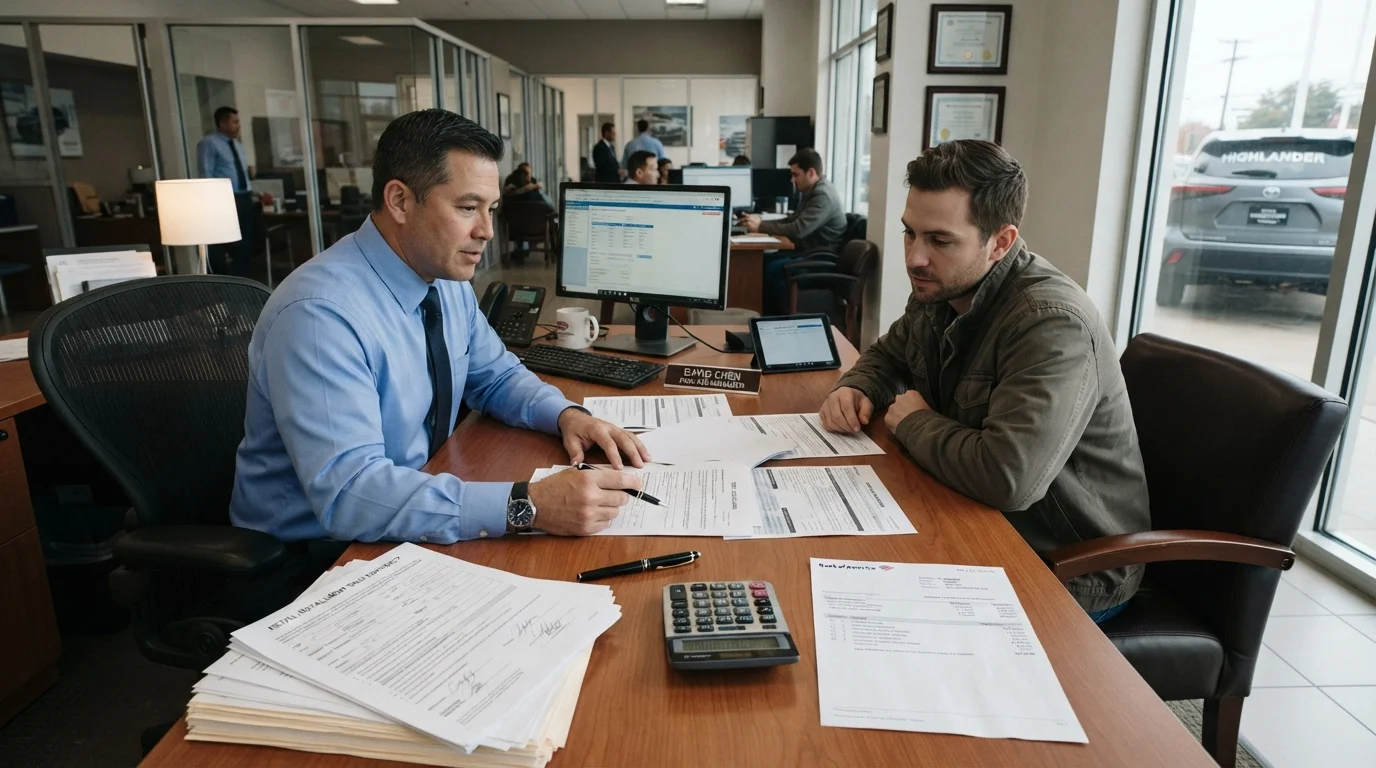
When you finance through a dealership, you fill out a credit application on-site. The dealer's finance department submits that application to one or more lenders - often a bank or the automaker's own financing subsidiary - and presents you with a loan offer. The catch is that dealers are frequently permitted to mark up the interest rate above what the lender actually approved, pocketing the difference as additional profit.
When you finance through a bank or credit union, you apply directly with the lender before or after choosing a vehicle. The lender issues a check or approval letter for a set amount, and you bring that to the dealership as a cash buyer - even though you're borrowing. Credit unions are member-owned nonprofits, which is one reason they often post lower rates than commercial banks or dealer finance offices.
Understanding how APR and total interest interact is essential before comparing any two loan offers. A dealer quoting a slightly lower monthly payment may actually be offering a longer term or higher rate - costing more overall.
| Criterion | Dealership Financing | Bank or Credit Union Financing |
|---|---|---|
| Convenience | High - one location, same day | Moderate - requires separate application |
| Rate transparency | Lower - markup possible | Higher - rate is what lender set |
| Promotional rates | Yes, for eligible buyers/vehicles | No manufacturer promotions |
| Negotiating leverage | Lower without outside offer | Higher with pre-approval in hand |
| Available for private-party sales | No | Yes |
| Typical rate advantage | Varies; can be low with promos | Credit unions often post lower rates |
The Rate Markup Problem - and When Dealer Rates Actually Win
Dealer rate markups - sometimes called "dealer reserve" - are a legal but often misunderstood practice. The lender approves you at, say, 6.5% APR, but the dealer presents the loan at 8.5%. The extra 2% flows back to the dealership. Regulations around this practice vary by state, so buyers can't always know the spread.
That said, dealer financing is not always the more expensive option. Automakers regularly run subsidized financing promotions - low or zero percent APR deals - that are exclusively available through their captive finance arms. These promotional rates are typically reserved for buyers with strong credit and are time-limited. If you qualify and the vehicle is eligible, manufacturer-backed financing can genuinely be the lowest rate available anywhere.
1-3%
Typical dealer rate markup range
The Consumer Financial Protection Bureau has noted that dealer interest rate markups commonly range from 1 to 3 percentage points above the lender's buy rate.
~$1,000+
Added cost from a 2% rate markup
On a $25,000 loan over 60 months, a 2-percentage-point rate increase can add roughly $1,300 or more in total interest paid, depending on the base rate.
Your credit profile shapes what either source will offer you. Even a modest difference in your credit score can shift the rate you receive by several percentage points, affecting hundreds or thousands of dollars over the life of a loan.
Getting Pre-Approved: Why It Changes the Negotiation
Arriving at a dealership with a pre-approval letter from a bank or credit union fundamentally changes the dynamic. You know your ceiling rate, and the dealer must beat or match it to earn your financing business. Without that benchmark, it is harder to evaluate whether the dealer's offer is genuinely competitive.
Pre-approval also separates two negotiations that dealers often intentionally combine: the vehicle price and the financing terms. When a salesperson asks, "What monthly payment are you comfortable with?" they are blending both variables into one figure that can obscure the true cost of each. Keeping them separate - negotiating the vehicle price first, then discussing financing - helps you see both numbers clearly.
Before you sign anything, review our guide to questions to ask before signing a car financing agreement, including whether the loan has prepayment penalties or bundled add-ons that inflate the cost.
Also be aware that dealerships are known for other cost-inflating tactics beyond financing. Documentation fees and dealer add-ons can add hundreds to a transaction independent of your loan rate.
Multiple Credit Inquiries and Your Score
When shopping for auto loan rates, multiple hard inquiries from different lenders within a short window - typically 14 to 45 days depending on the scoring model - are generally counted as a single inquiry. This means rate shopping does not have to hurt your credit score as much as applying for several unrelated credit accounts would. Check with each lender about how they report inquiries before applying.