

Key Takeaways
- Lenders assign interest rates based on credit score tiers - better scores generally earn lower rates.
- A single percentage point difference in APR can add hundreds of dollars to your total loan cost.
- Auto lenders may use a specialized auto credit score, not just your standard score.
- Improving your score before applying can meaningfully reduce what you pay over the loan term.
- Shopping multiple lenders lets you compare rates without your score being penalized excessively.
Credit Score & Auto Loan Rate
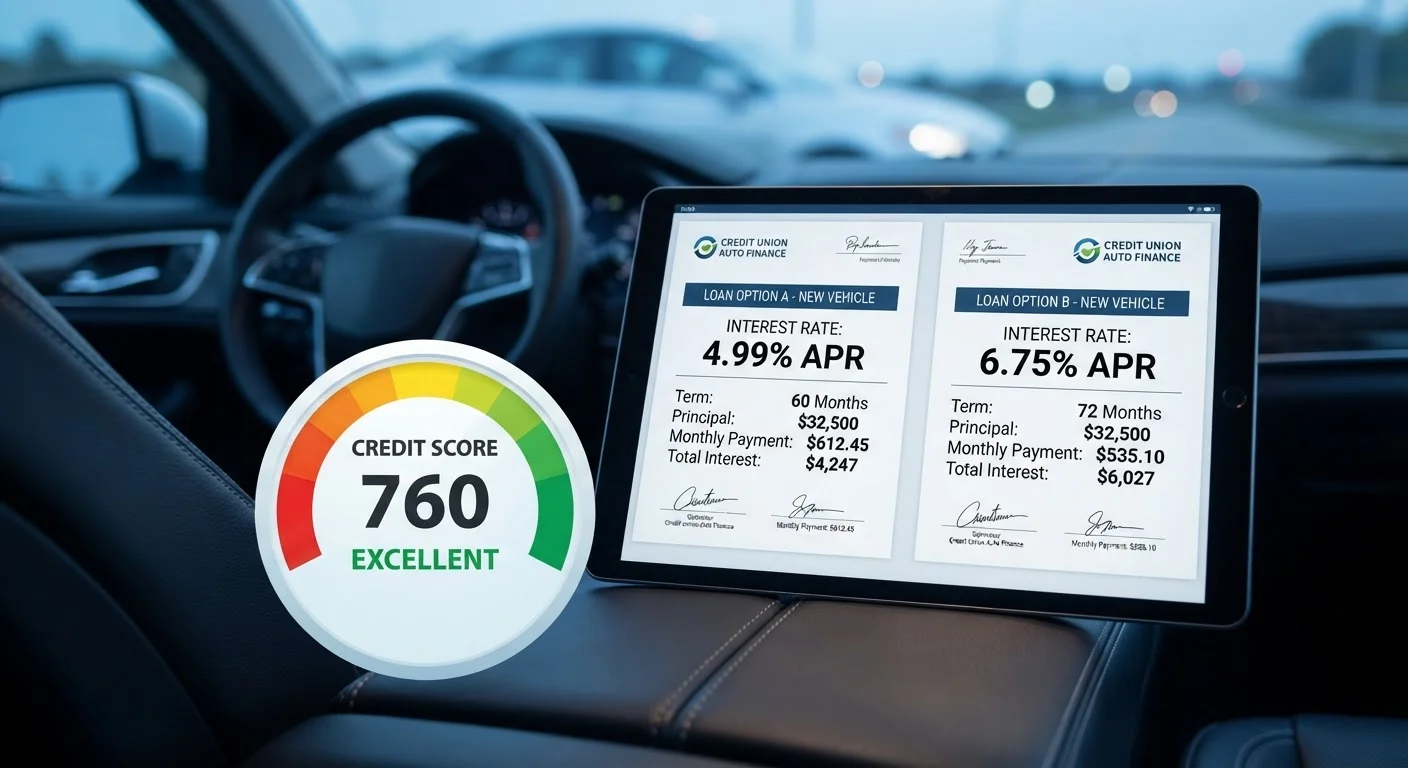
Lenders use your credit score - a three-digit number that summarizes your borrowing history - to decide how much interest to charge on an auto loan. A higher score signals lower risk to the lender, which typically results in a lower interest rate and less money paid over the life of the loan. Even a small difference in your score can shift you into a different rate tier, changing your total cost by hundreds or thousands of dollars.
Auto lenders often use specialized credit scores - such as the FICO Auto Score - which weight your history with vehicle loans more heavily than a standard FICO score. The rate tiers lenders use vary by institution and are not publicly standardized.
How Lenders Use Your Credit Score
When you apply for an auto loan, a lender's first question isn't how much car you want - it's how reliably you've repaid debt in the past. Your credit score condenses that history into a single number, and lenders use it to sort applicants into rate tiers.
Each tier comes with a corresponding annual percentage rate (APR). Borrowers in the highest tier - often called "super prime" - qualify for the lowest rates. As scores drop through prime, non-prime, subprime, and deep subprime categories, the APR climbs. The lender is compensating for the increased likelihood that some loans in that tier will default.
Understanding what APR actually means is critical here: it's not just an abstract percentage. It determines how much of every monthly payment goes toward interest versus principal, and ultimately how much you spend to borrow that money.
~5-15%
Typical APR range across credit tiers
Industry data consistently shows auto loan rates spanning a wide band depending on borrower credit profile, with subprime borrowers often paying two to three times the rate of prime borrowers.
$8,000+
Potential extra interest on a mid-size loan
On a $28,000 60-month loan, the gap between a prime-tier rate and a subprime rate can exceed $8,000 in additional interest over the loan term.
720+
Score often associated with prime auto rates
While thresholds vary by lender, scores above 720 are frequently cited as qualifying for near-top-tier auto loan rates at many banks and credit unions.
The Real Dollar Difference Between Rate Tiers
Consider a $28,000 loan with a 60-month term. At a 6% APR, a borrower pays roughly $5,440 in total interest. At 14% APR - a rate commonly offered to subprime borrowers - that same loan costs about $13,900 in interest. That's a difference of over $8,000 for the identical vehicle.
Monthly payments tell only part of the story. A lender might structure a subprime loan with a slightly longer term to make the monthly figure look manageable, while the total cost balloons. This is why APR matters more than the monthly payment - it's the most accurate way to compare financing offers.
Steps to Strengthen Your Score Before Financing
If your score places you in a higher-rate tier, a few targeted steps can help move you into a better one before you apply. None of these are quick fixes, but they are effective over a three-to-twelve-month window.
- Pay down revolving balances. Credit utilization - how much of your available credit you're using - is one of the most responsive factors in your score. Reducing balances below 30% of each card limit can produce noticeable improvement.
- Avoid opening new accounts. Each new application adds a hard inquiry and lowers the average age of your accounts, both of which can temporarily reduce your score.
- Dispute errors on your credit report. Errors are more common than many consumers realize. You're entitled to a free report from each bureau annually through AnnualCreditReport.com. Incorrect derogatory marks can drag your score down unfairly.
- Keep existing accounts open. Closing old credit cards reduces available credit and can raise your utilization ratio, potentially lowering your score.
Car ownership costs extend well beyond the loan itself. See the real cost of owning a car beyond the monthly payment to account for insurance, fuel, and maintenance when planning your total budget.
Get Pre-Approved Before You Shop
Securing a pre-approval letter from a bank or credit union before visiting dealerships puts you in a much stronger negotiating position. You'll know exactly what rate you qualify for independently, making it easier to evaluate whether dealer-arranged financing is genuinely competitive. Pre-approvals typically don't obligate you to borrow - they just give you a benchmark.
Shopping for Rates Without Damaging Your Score
One of the most practical moves a car buyer can make is applying to multiple lenders before settling on financing. Many consumers avoid this out of concern that each application will hurt their credit - but major credit scoring models recognize rate shopping and cluster auto loan inquiries made within a short window (generally 14 to 45 days) into a single inquiry.
Getting pre-approved through a bank or credit union before visiting a dealership is particularly useful. It establishes a baseline rate you can actually compare against the dealer's financing offer. Dealer-arranged financing can be competitive, but it can also carry a markup built in as dealer compensation - knowing your alternative gives you leverage.
Your credit score is one variable, but lenders also weigh your debt-to-income ratio, employment stability, and the loan-to-value ratio of the vehicle. A strong down payment, for instance, can partially offset a lower credit score by reducing the lender's exposure.
This article is for general informational and educational purposes only and does not constitute financial or legal advice. Consult a qualified financial professional for guidance specific to your situation.