

Key Takeaways
- A maintenance log creates a documented history that supports warranty claims and resale negotiations.
- Mechanics can diagnose problems faster when they have a clear service timeline to reference.
- Keeping records requires only a few minutes per service visit but delivers long-term financial benefits.
- Both paper notebooks and digital apps are effective - consistency matters more than format.
Supports warranty claims with documented proof
Many manufacturer and extended warranties require evidence that scheduled maintenance was completed. A log provides that paper trail and can prevent a claim from being denied on a technicality.
Can increase resale value and buyer confidence
A complete service history signals that the vehicle was cared for, which gives private buyers and dealerships more confidence in the condition of the car - often resulting in better offers.
Helps mechanics diagnose issues faster
A clear service timeline lets a technician rule out recently serviced components and focus on likely culprits, reducing diagnostic time and the associated labor costs.
Keeps you on top of upcoming service intervals
Logging the next recommended service date or mileage alongside each entry acts as a built-in reminder system, helping you avoid missed oil changes or overdue inspections.
Reveals patterns in recurring problems
If the same component keeps failing, a log makes that pattern visible - useful information when deciding whether to repair again or consider other options.
Requires consistent effort after every service
The value of a log depends entirely on keeping it up to date. Drivers who update it sporadically end up with a record that's incomplete and potentially misleading.
Gaps in records can raise buyer suspicions
A log with unexplained gaps may concern buyers more than no log at all, prompting questions about what maintenance was skipped or what problems occurred during the undocumented period.
Paper logs can be lost or damaged
A notebook kept in the glove box is vulnerable to spills, theft, or simply being misplaced during a sale, potentially eliminating years of accumulated history.
Digital records require backup and accessibility planning
Apps can be discontinued, phones can break, and not everyone receiving the vehicle will know how to access the digital records - making a format strategy important from the start.
Our Verdict
A car maintenance log is a low-effort habit with a surprisingly high return. It protects your warranty, strengthens your position at resale, and gives mechanics the context they need to diagnose problems accurately. The main drawbacks - the time required and the risk of incomplete records - are manageable with a simple routine.
Any driver who wants to protect their vehicle investment, avoid repeat repair visits, and get fair value when it's time to sell.
What a Car Maintenance Log Actually Is
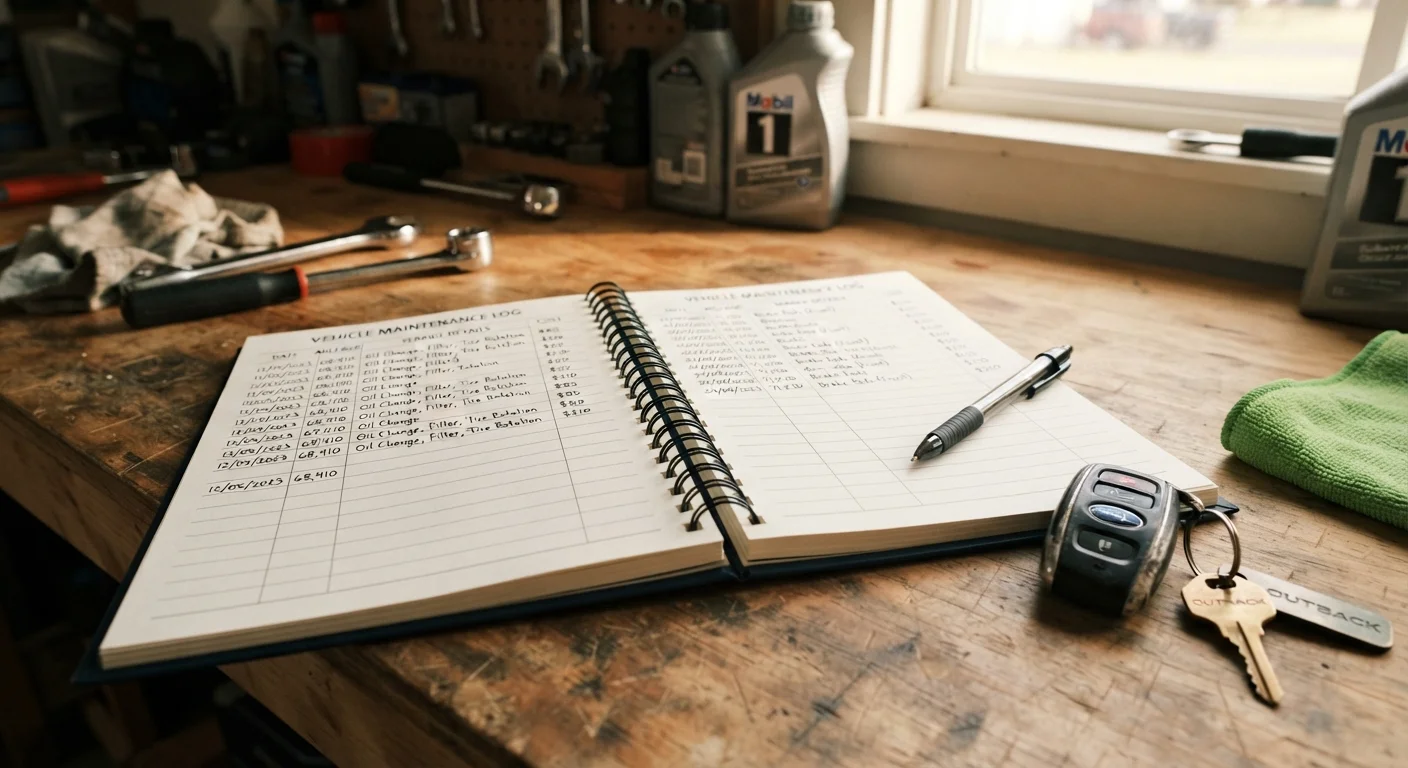
A car maintenance log is a running record of every service, repair, and inspection performed on your vehicle. It typically captures the date, current mileage, work performed, parts replaced, and cost. Some drivers use a dedicated notebook stored in the glove box; others use a spreadsheet or a smartphone app.
The format is less important than what goes inside. A good log covers routine services - oil changes, tire rotations, air filter replacements - as well as unscheduled repairs like brake pad replacements or a new battery. For a broader look at what your vehicle actually needs and when, see our guide to maintenance schedules explained.
Think of the log as your car's medical history. Just as a doctor works more effectively with a complete patient record, a mechanic can pinpoint problems faster when they know what's already been done - and what hasn't.
The Real Advantages of Keeping Records
The benefits of a maintenance log show up in situations most drivers don't anticipate until they're already in them.
Supports warranty claims with documented proof
Many manufacturer and extended warranties require evidence that scheduled maintenance was completed. A log provides that paper trail and can prevent a claim from being denied on a technicality.
Can increase resale value and buyer confidence
A complete service history signals that the vehicle was cared for, which gives private buyers and dealerships more confidence in the condition of the car - often resulting in better offers.
Helps mechanics diagnose issues faster
A clear service timeline lets a technician rule out recently serviced components and focus on likely culprits, reducing diagnostic time and the associated labor costs.
Keeps you on top of upcoming service intervals
Logging the next recommended service date or mileage alongside each entry acts as a built-in reminder system, helping you avoid missed oil changes or overdue inspections.
Reveals patterns in recurring problems
If the same component keeps failing, a log makes that pattern visible - useful information when deciding whether to repair again or consider other options.
Up to $1,500+
Potential resale value gain with full service history
Industry pricing guides and automotive consumer resources consistently note that verifiable service records can meaningfully increase a used vehicle's market value compared to comparable cars without documentation.
30-60 min
Diagnostic time potentially saved per visit
Mechanics who can review a clear service history spend less time reconstructing what's already been done, which directly reduces billable labor time on diagnostic appointments.
When a warranty dispute arises, manufacturer and dealer warranty claims often hinge on proof that required maintenance was performed on schedule. Without documentation, that proof is nearly impossible to produce. A log also strengthens your hand in private-party car sales - buyers and their mechanics can verify the vehicle's history rather than taking your word for it, which often translates to a higher asking price and faster sale.
For mechanics, a log reduces diagnostic guesswork. Rather than spending billable time retracing service history, they can see at a glance that the transmission fluid was changed 12,000 miles ago or that the coolant was last flushed three years back - narrowing down possibilities quickly.
The Honest Drawbacks to Consider
A maintenance log only works if it's kept consistently, and that's where many drivers fall short.
Requires consistent effort after every service
The value of a log depends entirely on keeping it up to date. Drivers who update it sporadically end up with a record that's incomplete and potentially misleading.
Gaps in records can raise buyer suspicions
A log with unexplained gaps may concern buyers more than no log at all, prompting questions about what maintenance was skipped or what problems occurred during the undocumented period.
Paper logs can be lost or damaged
A notebook kept in the glove box is vulnerable to spills, theft, or simply being misplaced during a sale, potentially eliminating years of accumulated history.
Digital records require backup and accessibility planning
Apps can be discontinued, phones can break, and not everyone receiving the vehicle will know how to access the digital records - making a format strategy important from the start.
The habit requires discipline after every service visit, not just the first few. A log with large gaps can actually create problems - a prospective buyer may wonder what happened during the undocumented periods, which can raise more suspicion than no log at all. Similarly, handwritten records can be lost, damaged, or become illegible over time, especially if the vehicle changes hands multiple times.
Digital records solve some of these problems but introduce others: apps can become unavailable, data can be lost if not backed up, and not every mechanic or buyer is comfortable receiving records in that format. Keeping both a simple paper backup and a digital version is a practical middle ground.
What to Include in Every Log Entry
Each entry should capture enough detail to be useful months or years later. A minimal but effective log entry includes:
- Date of service
- Odometer reading at the time of service
- Work performed - be specific (e.g., "replaced rear brake pads and rotors" rather than "brake work")
- Parts used - note part numbers if available, especially for filters and fluids
- Shop or technician who did the work, and whether it was DIY
- Total cost
- Next service due - mileage or date, whichever comes first
Keep Receipts Alongside Your Log
Whenever a shop performs work, ask for an itemized receipt and file it with your log. Receipts provide third-party verification that services were actually completed - something a self-written entry alone cannot fully prove. A simple envelope tucked inside the logbook works well for paper receipts, while photos of receipts stored in a dedicated folder on your phone serve the same purpose digitally.
If you're newer to car ownership and unsure which services to log first, our maintenance primer for new drivers walks through the essentials from the beginning. For tasks that are genuinely complex or risky to tackle yourself, it's worth understanding which jobs are worth paying a mechanic for.