

Key Takeaways
- Preventive maintenance almost always costs less than emergency repairs.
- Your owner's manual contains the most reliable maintenance schedule for your specific vehicle.
- Several routine checks - fluids, tire pressure, lights - require no tools and no mechanical experience.
- Learning to recognize warning signs early helps you avoid breakdowns and costly damage.
- Keeping a simple maintenance log protects your car's resale value over time.
Start here
Why Maintenance Matters Before You Need It
Build your knowledge
The Core Systems Every New Driver Should Know
Get practical
Simple Checks You Can Do Yourself
Know your limits
When to Call a Mechanic
Why Maintenance Matters Before You Need It
Most new drivers focus entirely on learning to drive - which makes sense - but the moment you own a vehicle, you also own its upkeep. A car that isn't maintained doesn't just become inconvenient; it becomes expensive. Routine maintenance typically costs a fraction of what reactive repairs run, and the habits you build early tend to stick.
Think of car ownership like managing a home for the first time: the tasks feel unfamiliar at first, but ignoring them leads to problems that compound. The same logic applies to vehicles. A neglected coolant system doesn't send a warning months in advance - it overheats on the highway.
Getting comfortable with maintenance early also pays off when you eventually sell or trade in the vehicle. A documented service history is one of the clearest signals to buyers that a car has been cared for - and it can meaningfully affect resale offers. For more on how ownership decisions affect a car's long-term value, see our piece on how vehicle depreciation works.
The Core Systems Every New Driver Should Know
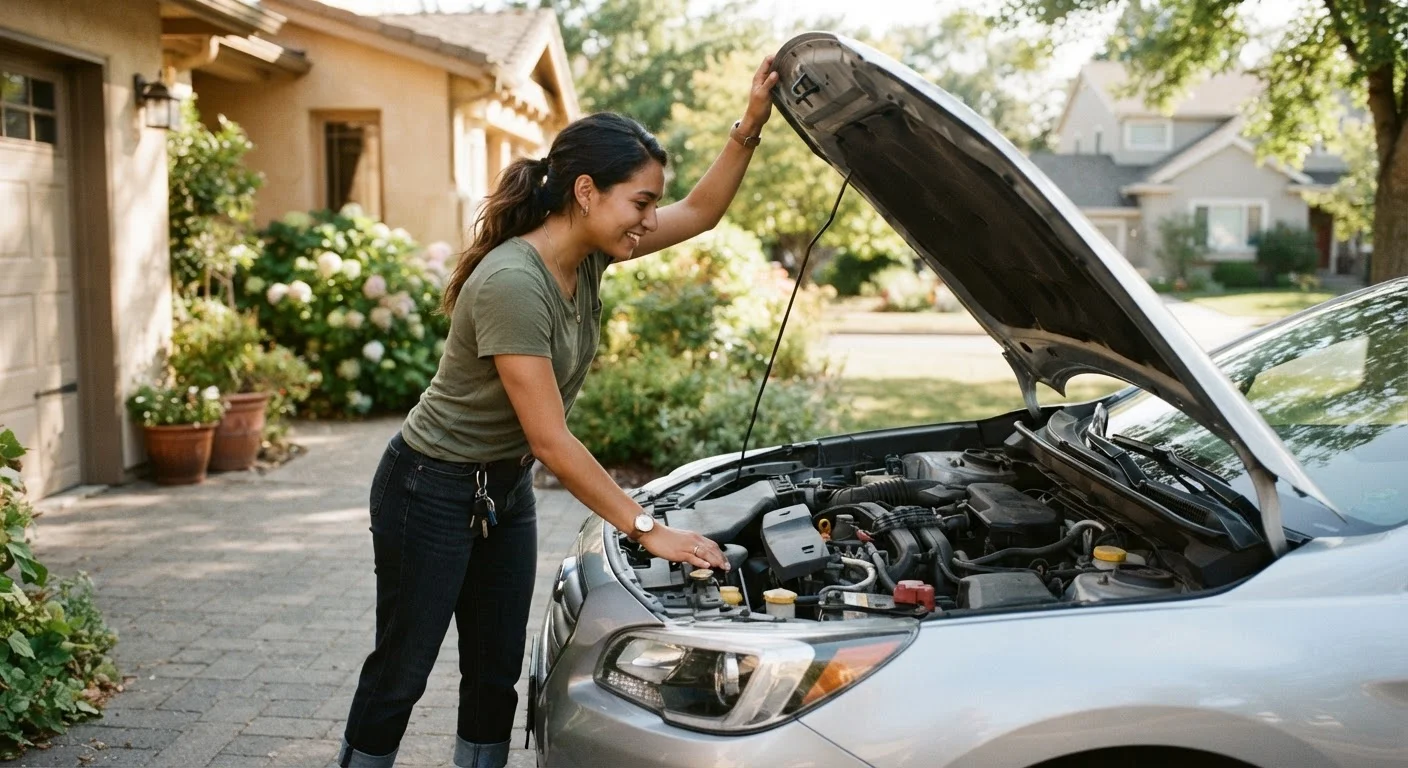
You don't need to become a mechanic, but understanding what's under the hood - at least conceptually - helps you catch problems early and communicate clearly with a shop.
Engine oil
A lubricating fluid that coats moving metal parts inside the engine, reducing friction and heat. It needs to be changed at regular intervals because it breaks down over time.
Coolant (antifreeze)
A liquid that circulates through the engine and radiator to keep the engine from overheating in summer and freezing in winter.
Tire tread depth
The depth of the grooves on a tire's surface. Adequate tread channels water away and maintains grip; worn tread significantly increases stopping distance, especially on wet roads.
Serpentine belt
A single rubber belt that drives multiple engine accessories - such as the alternator, power steering pump, and air conditioning compressor - simultaneously. If it fails, several systems can stop working at once.
Dipstick
A long metal rod inserted into the engine that lets you check the oil level and condition without specialized tools. Markings on the end indicate whether oil is low, full, or overfilled.
ASE certification
A credential awarded by the Automotive Service Excellence organization to mechanics who pass standardized competency tests. It's a widely recognized indicator of professional training in the US.
Engine oil lubricates moving parts and prevents metal-on-metal wear. When it breaks down or runs low, the engine suffers. Coolant (also called antifreeze) regulates engine temperature; running low can cause overheating in minutes. Brake fluid transmits the pressure from your pedal to the brakes - low or contaminated fluid reduces braking power. Transmission fluid keeps gear shifts smooth, and power steering fluid makes steering feel effortless. Each fluid has a reservoir under the hood marked with a symbol or label.
Beyond fluids, your battery, tires, and belts and hoses are the components most likely to strand you unexpectedly. Tires affect every aspect of handling and stopping distance, so they deserve regular attention. Belts - particularly the serpentine belt - drive multiple engine systems simultaneously; a broken belt can disable your alternator, power steering, and cooling in one moment.
Reading Your Owner's Manual (It's Shorter Than You Think)
Many new drivers never open the owner's manual. That's a missed opportunity. The manual contains the exact maintenance schedule your manufacturer engineered for your vehicle - oil change intervals, tire rotation frequency, spark plug replacement windows, and more. Following it is the closest thing to a guarantee that you're caring for your car correctly.
Focus first on the maintenance schedule section, which is typically organized by mileage milestones (e.g., every 5,000 miles, 30,000 miles, 60,000 miles). You don't need to memorize it - just know where to find it. For a plain-English explanation of what each service interval actually involves, our maintenance schedule guide walks through each milestone in detail.
Keep a Simple Maintenance Log
A small notebook in your glove compartment - or a notes app on your phone - is enough. Record the date, mileage, and what was done each time you service the car. This log helps you stay on schedule, proves service history to future buyers, and can be invaluable if a warranty question arises.
If you've bought a used car and the manual is missing, many manufacturers publish digital versions on their websites, searchable by model year and trim level.
Simple Checks You Can Do Yourself
Several routine checks require no tools, no mechanical background, and under ten minutes. Building these into a monthly habit prevents most minor issues from becoming major ones.
- Tire pressure: Check with an inexpensive gauge when tires are cold (before driving). The correct pressure is printed on a sticker inside your driver's door jamb - not on the tire sidewall.
- Oil level: Use the dipstick with the engine off and cool. The oil should sit between the two markers and look amber-brown. Very dark or gritty oil is overdue for a change.
- Coolant level: Check the translucent reservoir - it has min/max markings visible from the outside. Never open the radiator cap when the engine is hot.
- Wiper blades: Streaking or skipping during rain means the rubber has degraded. Replacement blades are straightforward to install and inexpensive.
- Exterior lights: Walk around the car periodically and verify that all brake lights, turn signals, and headlights are functioning. A burnt-out brake light is a safety and legal issue.
As seasons shift, your checklist should shift too. Our seasonal car care guide covers the specific checks that matter most before winter, summer, and the transitions in between.
When to Call a Mechanic
Knowing your limits is just as important as knowing what you can handle. Some warning signs require professional attention - attempting to diagnose or fix them without the right tools or knowledge can create safety risks or worsen the problem.
Take your car to a qualified mechanic promptly if you notice:
- A check engine light that stays on or flashes
- Grinding, squealing, or pulsating when braking
- The steering wheel pulling consistently to one side
- Any fluid pooling under a parked vehicle
- Unusual smells - particularly burning, sulfur, or fuel odors
- Difficulty starting, or a battery warning light
When choosing a shop, look for ASE-certified technicians (ASE stands for Automotive Service Excellence, a nationally recognized credential program) and ask for written estimates before authorizing any work. You have the right to a second opinion on any major repair.
Safe vehicle operation goes hand in hand with safe driving habits. If you're building your overall road knowledge from scratch, our driving safety guide covers the habits and hazards that matter most at every stage of driving experience.