

Key Takeaways
- R-value measures thermal resistance - higher numbers mean better insulation performance.
- Batts and blown-in insulation are the most DIY-accessible and budget-friendly options.
- Spray foam offers the highest air-sealing performance but requires professional installation.
- Rigid foam excels in specific applications like basement walls and exterior sheathing.
- Climate zone, installation location, and budget should all guide your insulation choice.
Our Verdict
No single insulation type wins across every situation - each excels in specific locations, climates, and budgets. Batts and blown-in remain the most accessible starting points for most homeowners, while spray foam and rigid board fill critical performance gaps in challenging areas.
| Best for | Recommended |
|---|---|
| Budget-conscious homeowners insulating open wall cavities | Fiberglass or mineral wool batts |
| Retrofitting finished attics or irregular spaces | Blown-in (loose-fill) insulation |
| Basement walls, crawl spaces, or exterior sheathing | Rigid foam board |
| Homes needing maximum air sealing and thermal performance | Spray foam insulation |
What R-Value Actually Means
Before comparing insulation types, it helps to understand the metric that defines them: R-value. R-value measures a material's resistance to heat flow - the higher the number, the more effective the insulation. The U.S. Department of Energy publishes recommended R-values by climate zone, and they vary significantly. Attics in cold northern climates may call for R-49 to R-60, while warmer southern zones may only need R-30.
R-value is additive - you can layer insulation types to reach a target. However, R-value alone doesn't tell the whole story. Air leakage, moisture management, and installation quality all affect real-world performance. A perfectly rated material installed with gaps or compression loses a meaningful portion of its effectiveness. For a broader view of how insulation fits into your home's envelope, see our weatherizing guide on reducing energy loss season by season.
Batts: The Familiar Workhorse
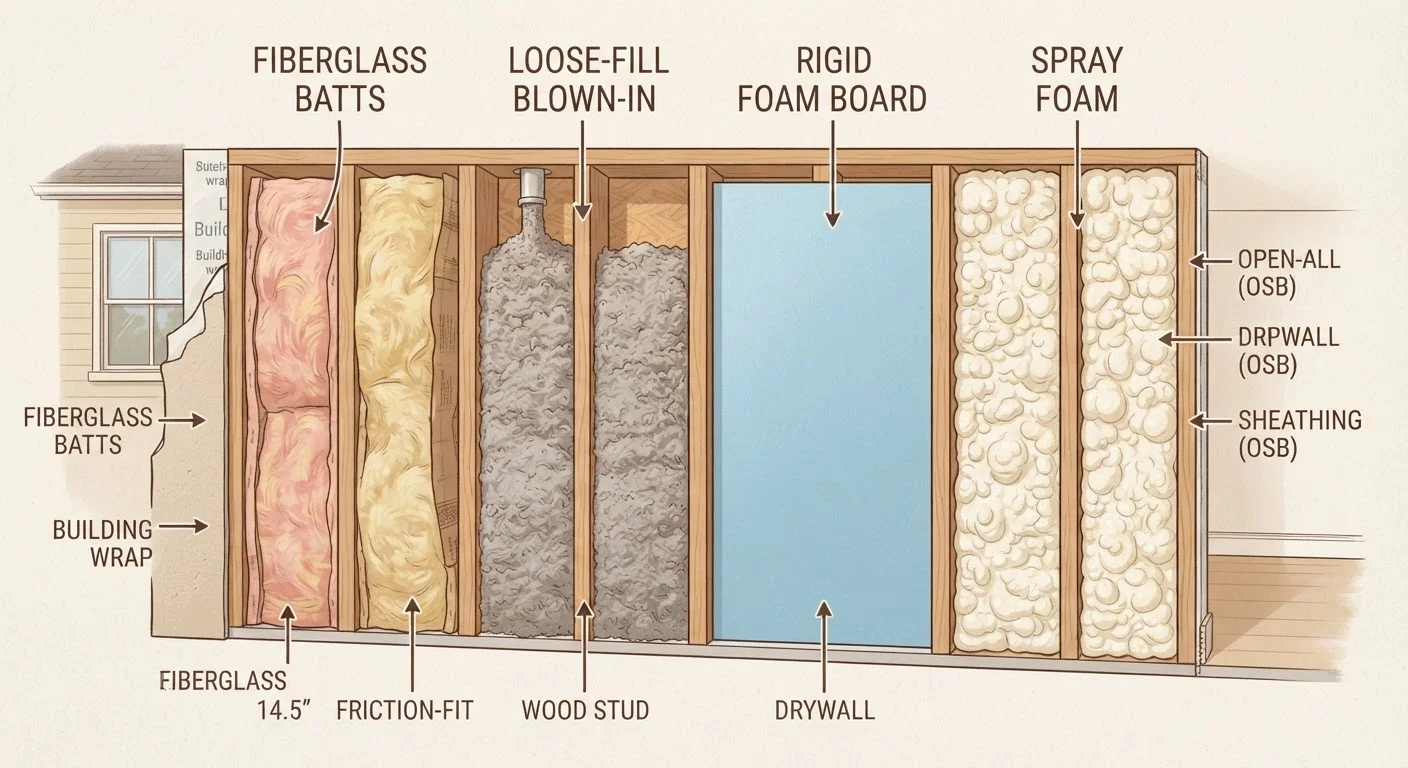
Fiberglass and mineral wool batts are the most widely recognized insulation form - pre-cut panels sized to fit standard stud and joist spacing. They're available at most home improvement stores and are realistic for experienced DIYers working in open, unfinished wall or ceiling cavities.
- R-value: Roughly R-3.0 to R-4.3 per inch, depending on material and density.
- Cost: Generally the most affordable option per square foot.
- Best locations: Open wall cavities, attic floors, floor joists between conditioned and unconditioned spaces.
- Limitations: Must fit precisely - gaps or compression significantly reduce performance. Fiberglass can irritate skin and lungs during installation; wear protective gear.
Combine Insulation Types for Better Results
Many high-performing installations use more than one insulation type - for example, rigid foam on the exterior of a wall combined with batts inside the stud cavity. Layering approaches this way can help you hit target R-values while managing costs and addressing air gaps more effectively than any single material alone.
Mineral wool batts offer slightly better fire resistance and moisture tolerance than fiberglass, making them worth considering in areas with higher humidity exposure.
Blown-In Insulation: Flexible Fill for Hard-to-Reach Spaces
Blown-in insulation - also called loose-fill - uses a machine to blow cellulose, fiberglass, or mineral wool into cavities, attics, or wall voids. It's particularly effective for retrofitting finished spaces without demolition.
- R-value: Cellulose achieves approximately R-3.2 to R-3.8 per inch; fiberglass loose-fill runs slightly lower.
- Cost: Moderate; equipment rental is available at many home improvement stores for attic applications.
- Best locations: Open attics, closed wall cavities (via small holes), irregular spaces with obstructions.
- Limitations: Settling over time can reduce R-value; professional installation is advisable for wall cavities to ensure even coverage.
15%
Typical home heat loss through the attic
The U.S. Department of Energy estimates that attics are among the largest sources of home energy loss when under-insulated.
R-49 to R-60
Recommended attic R-value in cold climates
DOE zone recommendations show northern U.S. attics require significantly more insulation depth than warmer regions.
For attic insulation, blown-in and batt insulation often work together. Our article on attic insulation and ventilation explains how to balance insulation depth with proper airflow to avoid moisture problems.
Rigid Foam and Spray Foam: High-Performance Options
Rigid foam board (polyisocyanurate, EPS, or XPS) delivers high R-value in a thin profile and is moisture-resistant, making it well suited for basement walls, crawl space perimeters, and exterior wall sheathing. R-values range from R-3.8 to R-6.5 per inch depending on type. It can be cut with a utility knife and applied by DIYers in accessible areas, though any application that affects structural sheathing or building envelope continuity should be reviewed by a qualified contractor.
Spray polyurethane foam (SPF) comes in open-cell and closed-cell varieties. Closed-cell spray foam delivers the highest R-value of any insulation type - approximately R-6.0 to R-7.0 per inch - and doubles as an air and vapor barrier. Open-cell foam is less dense and more affordable, with an R-value around R-3.5 per inch, and works well in interior applications. Spray foam installation involves chemical agents that require professional equipment and protective gear; it is not a safe DIY task. Vapors during installation require occupants to vacate the home for a period specified by the installer.
| Batts | Blown-In | Rigid Foam | Spray Foam | |
|---|---|---|---|---|
| R-value per inch | R-3.0 to R-4.3 | R-3.2 to R-3.8 | R-3.8 to R-6.5 | R-3.5 to R-7.0 |
| Relative cost | Low | Low to moderate | Moderate | High |
| DIY-friendly | Yes | Partially | Partially | No - professional only |
| Air sealing ability | Poor | Moderate | Moderate | Excellent |
| Best application | Open wall/ceiling cavities | Attics, retrofits | Basements, exterior | Crawl spaces, rim joists |
| Moisture resistance | Low (fiberglass) | Moderate (cellulose) | High | High (closed-cell) |