

Key Takeaways
- The 50/30/20 rule divides after-tax income into needs, wants, and savings using broad percentage categories.
- Zero-based budgeting assigns every dollar a specific job so income minus expenses equals zero each month.
- The 50/30/20 rule demands less time but offers less detail; zero-based budgeting is thorough but time-intensive.
- Your income stability, financial goals, and tolerance for tracking effort determine which method suits you better.
- Both methods can be adapted or combined - no single framework works identically for every household.
- Consulting a qualified financial professional is recommended for complex situations or major financial decisions.
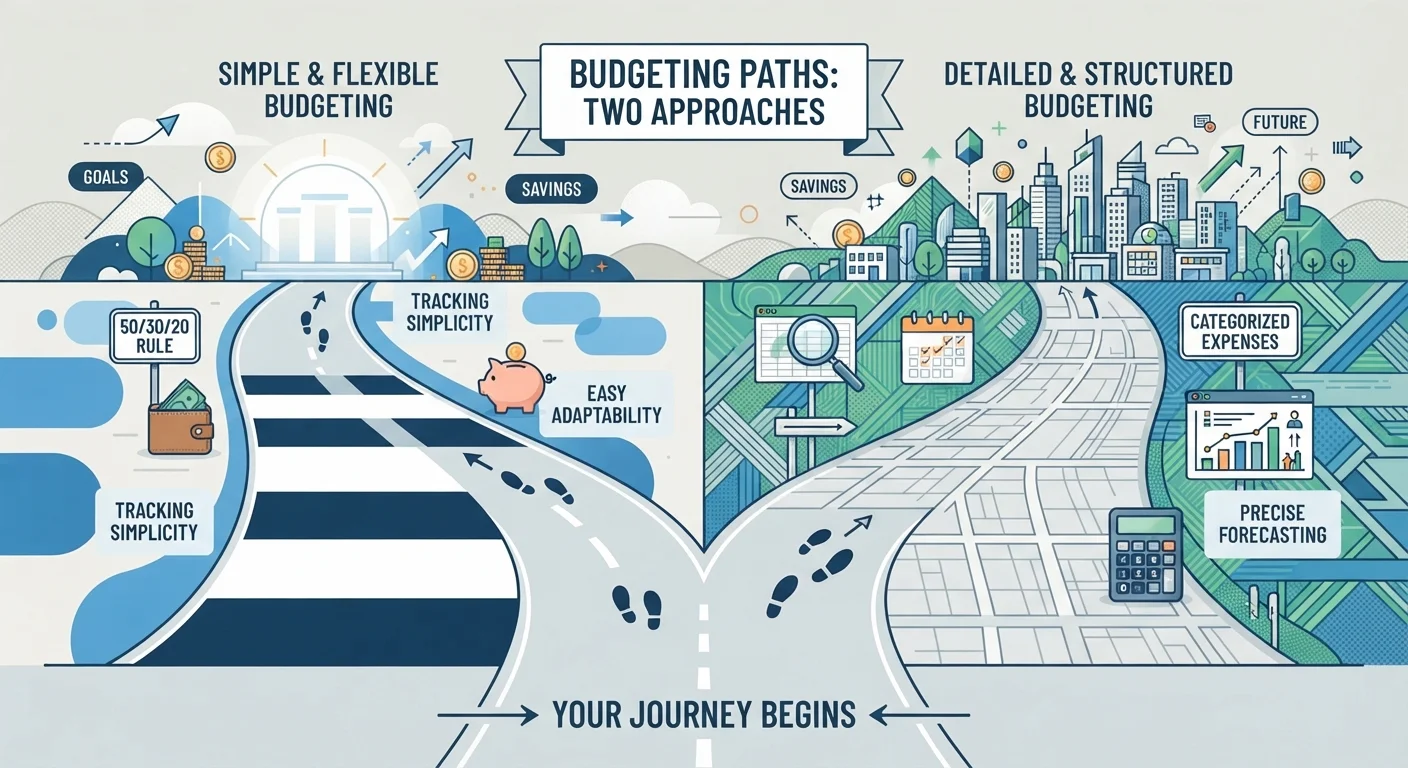
Option A
The 50/30/20 Rule
The flexible, low-maintenance framework for busy lives.
Best for: People who want clear spending guardrails without tracking every individual purchase.
Option B
Zero-Based Budgeting
The precise, dollar-by-dollar method for total financial control.
Best for: People who want complete visibility into where every dollar goes each month.
If you have a steady income and want a simple structure
The 50/30/20 Rule
The broad category splits require minimal tracking and work well when income is consistent and predictable month to month.
If you have irregular income or variable monthly expenses
Zero-Based Budgeting
Building a fresh budget from scratch each month lets you adapt allocations to actual income, preventing overspending when earnings fluctuate.
If you're aggressively paying down debt or building an emergency fund
Zero-Based Budgeting
Line-by-line allocation makes it harder for money to slip into unplanned spending, directing more resources toward high-priority financial goals.
If you're new to budgeting and want a sustainable starting point
The 50/30/20 Rule
The simple three-bucket structure is easy to understand and implement, reducing the risk of burnout that can come with highly detailed systems.
If you want maximum insight into your spending patterns
Zero-Based Budgeting
Assigning every dollar a category forces you to confront exactly how money moves through your household, surfacing habits that broad frameworks often hide.
How Each Method Works
Understanding the mechanics of each framework is the first step toward choosing the one that fits your life.
The 50/30/20 Rule divides your monthly after-tax income into three broad buckets: 50% toward needs (housing, utilities, groceries, minimum debt payments), 30% toward wants (dining out, subscriptions, hobbies), and 20% toward savings and debt repayment above the minimum. The appeal is simplicity - you categorize spending at a high level rather than line by line. For a deeper look at how this framework holds up under real conditions, see what the 50/30/20 rule actually means.
Zero-based budgeting (ZBB) starts from zero every month. You list every anticipated dollar of income, then assign every dollar to a specific expense category - rent, groceries, car insurance, savings, entertainment, and so on - until income minus all assigned expenses equals zero. Nothing is left unaccounted for. Our zero-based budgeting explainer walks through the full setup process step by step.
| Criterion | 50/30/20 Rule | Zero-Based Budgeting |
|---|---|---|
| Setup time | Minimal - broad categories only | 30-60 min per month |
| Tracking detail | Three high-level buckets | Every dollar assigned a category |
| Monthly rebuild required | No - percentages stay fixed | Yes - built fresh each month |
| Best income type | Steady, predictable income | Variable or irregular income |
| Visibility into spending | Moderate - broad category view | High - line-by-line clarity |
| Beginner-friendliness | High - easy to start | Moderate - learning curve applies |
| Debt payoff focus | 20% savings bucket covers it | Dedicated line item, more control |
| Adaptability mid-month | Easy - adjust category spending | Requires re-allocating line items |
Key Trade-offs: Flexibility vs. Precision
The most practical difference between these two methods comes down to how much time and attention you're willing to invest - and how much control you want in return.
The 50/30/20 rule is deliberately broad. That broadness is a feature for many households: it sets meaningful guardrails without requiring you to log every coffee or track whether a dinner out counts as a "need" or a "want." The downside is that money can quietly disappear inside large categories. If 30% feels comfortable but hides a subscription graveyard or creeping lifestyle inflation, the framework won't catch it.
Zero-based budgeting closes that gap - but at a cost. Building a complete budget before each month begins can take 30 to 60 minutes, and mid-month adjustments are common when actual spending diverges from plans. For households with variable income, such as freelancers or gig workers, this monthly rebuild is actually an asset, not a burden, because it forces a realistic look at what the current month's income can actually cover.
When Your Income Doesn't Fit Neat Percentages
High housing costs in expensive metros can push the "needs" bucket well above 50% even for careful spenders, making the 50/30/20 rule difficult to apply as written. In these situations, zero-based budgeting's flexible line-item structure often adapts more naturally because percentages are guidelines, not required inputs. Similarly, households with very low incomes may find that needs alone consume nearly all take-home pay, making any fixed-percentage model more aspirational than practical. Adjusting the framework to reflect your actual constraints - rather than abandoning budgeting altogether - is always the better move.
For readers who find both approaches either too loose or too rigid, the pros and cons of a strict line-item budget explores another point on the spectrum worth considering.
Choosing the Right Fit - or Blending Both
Neither method is universally superior. The better question is: which one are you likely to stick with?
Research on habit formation consistently suggests that a budgeting system you maintain imperfectly is more useful than a perfect system you abandon. If the thought of tracking 20 line items each month feels paralyzing, starting with the 50/30/20 rule and reviewing your three category totals at month-end is far more productive than never starting at all.
On the other hand, if you've tried the 50/30/20 rule and still feel like money disappears, zero-based budgeting's forced specificity may be the accountability tool you need. Many households also blend elements: they use the 50/30/20 percentages as a high-level target while zero-basing the expenses within each bucket to eliminate waste.
For a comprehensive walk-through of building and maintaining any budget - including how to adjust as income or life circumstances change - the personal budgeting end-to-end guide covers the full process. You can also explore specific spending strategies in the Smart Spending hub.
This article is for general informational and educational purposes only and does not constitute personalized financial advice. For guidance tailored to your specific financial situation, consult a qualified financial professional.