

Key Takeaways
- A spending audit reveals the gap between where you think your money goes and where it actually goes.
- You only need 30-90 minutes and two to three months of bank or credit card statements to get started.
- Categorizing spending by need versus want produces more actionable insights than sorting by merchant alone.
- The goal is to align spending with what genuinely matters, not to eliminate every discretionary dollar.
- One audit can surface recurring charges, fee leakage, and category imbalances that quietly drain budgets.
What you will need
Why a Spending Audit Is Worth Your Time
Most people have a rough sense of their monthly expenses - but that mental estimate is almost always incomplete. Subscriptions auto-renew quietly. Convenience fees stack up. A restaurant habit that feels modest turns out to cost twice what you assumed. A spending audit forces those numbers into the open, giving you a factual baseline instead of a guess.
Unlike a full budgeting overhaul, a spending audit is a one-time diagnostic exercise. Think of it like a medical checkup: its purpose is to identify what's actually happening, not to prescribe permanent restrictions. Once you know your real spending patterns, you can make deliberate choices - keeping the expenses that genuinely add value, trimming the ones that don't.
If you're already making an effort to track day-to-day transactions, a spending audit goes one level deeper. Our guide to tracking spending without obsessing over receipts covers complementary habits that make future audits even faster.
What you will need
What You'll Need Before You Start
A spending audit doesn't require spreadsheet expertise or specialized software. The essentials are basic, and most are already at your fingertips.
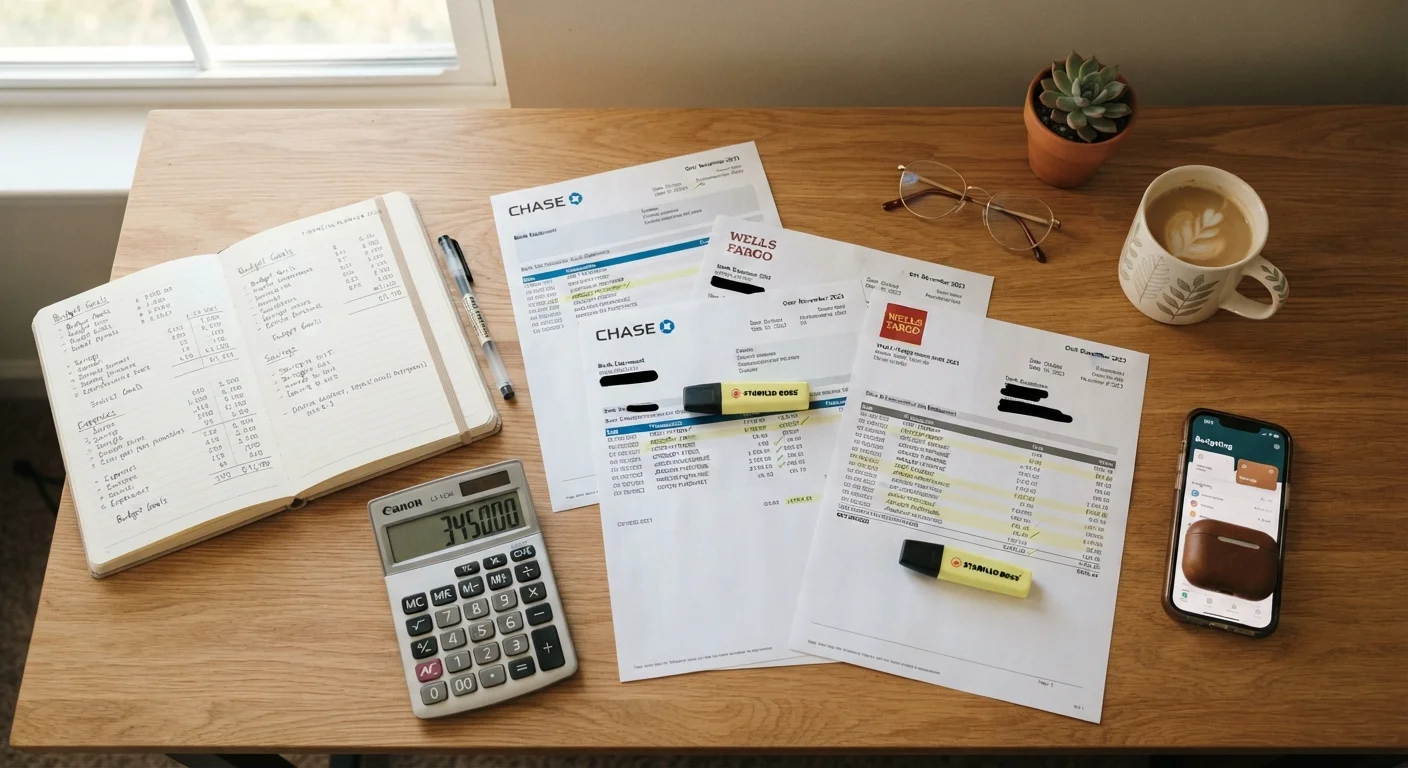
Bank and credit card statements
Primary source of transaction data - download PDF or CSV files directly from your financial institution's website.
Spreadsheet (e.g., Google Sheets or Excel)
Used to categorize and total transactions; a simple table with columns for date, description, category, and amount is sufficient.
Pen and notebook
An analog alternative to a spreadsheet for readers who prefer to work on paper.
Budgeting or expense-tracking app
Can auto-categorize transactions and speed up data entry if you already use one regularly.
Gather statements covering the past two to three months. A single month can be misleading - it may include an unusual expense or miss a quarterly charge. Three months gives you a more representative picture without becoming overwhelming.
How to Run Your Spending Audit
Follow these steps in order. You can complete the entire process in a single sitting or break it into two shorter sessions - whatever fits your schedule.
Pull all statements for the review period
Log in to every bank account, credit card, and payment platform you use - including digital wallets. Download or print statements for the past two to three months. If you use multiple accounts, consolidate them into a single document or tab so nothing falls through the cracks.
List every transaction - including subscriptions and transfers
Go line by line and record each transaction. Don't filter or judge at this stage - include everything, from a $2 parking fee to a $200 utility bill. Pay particular attention to recurring charges, which are easy to overlook because they happen automatically.
Assign each transaction to a category
Create categories that reflect your actual life, not a generic budget template. Common categories include: Housing, Utilities, Groceries, Dining Out, Transportation, Health, Entertainment, Personal Care, Subscriptions, and Miscellaneous. Assign each transaction to exactly one category. If a purchase crosses categories (a warehouse club trip that includes both food and household supplies), use your best judgment and stay consistent across months.
Total each category and calculate percentages
Sum all transactions within each category. Then divide each category total by your overall spending total to get a percentage. For example, if you spent $400 on dining out and your total spending was $4,000, dining represents 10% of your budget. Percentages make categories easier to compare across months with different income or expense totals.
Identify patterns and flag surprises
Look for three things: (1) categories that are consistently higher than you expected, (2) recurring charges you don't immediately recognize or remember signing up for, and (3) imbalances between your 'Need' and 'Want' labels that feel misaligned with your priorities. Write down specific observations - don't rely on memory.
Decide on three concrete adjustments
Resist the impulse to overhaul everything at once. Choose three specific changes based on what the data shows: one subscription or recurring charge to cancel or downgrade, one spending category to set a monthly target for, and one habit or system to introduce going forward. Document these decisions so you can evaluate them at your next monthly check-in.
For a structured way to revisit your findings regularly, the monthly budget audit checklist provides a repeatable end-of-month framework. And if you want a longer-term solution that doesn't rely on constant willpower, see our piece on building a spending system that doesn't require constant willpower.
Once you've completed the audit, the patterns you find may point toward broader structural issues in your spending. Our article on spending leaks most households never notice is a natural next read - it covers the specific categories where money tends to disappear without obvious cause.
This article is for general informational and educational purposes only and does not constitute personalized financial advice. For guidance specific to your financial situation, consider consulting a qualified financial professional.