

Key Takeaways
- Clumping clay litter is the most widely used option, offering easy scooping and moderate cost.
- Silica crystal litter absorbs moisture efficiently and requires less frequent full-box changes.
- Plant-based litters are lower in dust and more eco-friendly but may cost more upfront.
- Odor control, dust levels, and your cat's texture preferences should all guide your choice.
- No single litter type suits every household - evaluate your priorities before switching.
Our Verdict
Clumping clay remains the practical all-rounder for most households, balancing cost, availability, and reliable odor control. Crystal litter suits owners who want lower-maintenance upkeep and reduced dust, while natural plant-based options are ideal for households prioritizing environmental impact and cat safety. Your cat's own acceptance of a litter type is ultimately the deciding factor.
| Best for | Recommended |
|---|---|
| Budget-conscious owners who scoop daily | Clumping clay litter |
| Owners wanting minimal scooping and low dust | Silica crystal litter |
| Eco-minded households with sensitive cats | Natural plant-based litter |
| Multi-cat households needing strong odor control | Clumping clay litter |
How These Three Litter Types Work
Cat litter is not a one-size-fits-all product. Each of the three dominant categories - clumping clay, silica crystal, and natural plant-based - operates on a different mechanism, which directly affects how you maintain the box and how your cat experiences it.
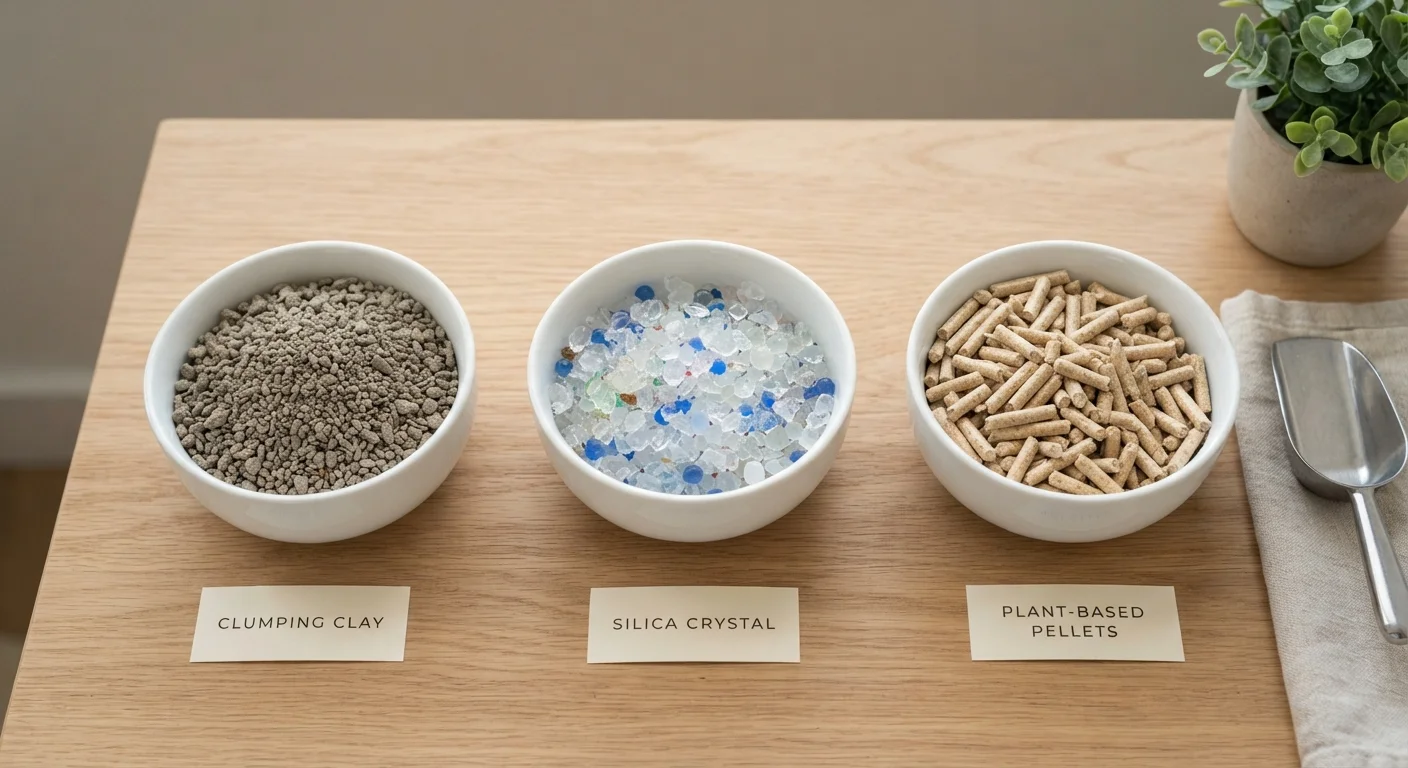
Clumping clay is made primarily from sodium bentonite, a mineral that absorbs liquid and binds into a firm mass when wet. You scoop the solid clumps and soiled solids daily, and the box is fully replaced every two to four weeks.
Silica crystal litter is composed of porous silica gel beads that absorb moisture into their structure rather than clumping. Urine is trapped inside the beads; solid waste is scooped daily. The box is typically stirred between uses and fully replaced roughly once a month for a single-cat household.
Natural plant-based litters are made from materials such as corn, wheat, pine, walnut shells, or recycled paper. Some formulations clump, while others absorb without clumping. These are generally biodegradable and low in silica dust.
| Clumping Clay | Silica Crystal | Natural Plant-Based | |
|---|---|---|---|
| Odor Control | Strong with daily scooping | Excellent; traps odor in beads | Moderate; varies by material |
| Dust Level | Moderate to high | Very low | Low to moderate |
| Scooping Frequency | Daily required | Daily solids; stir urine side | Daily to every other day |
| Full Box Change | Every 2-4 weeks | Monthly (single cat) | Every 2-4 weeks |
| Typical Cost | Low per pound | Higher upfront, lower usage | Low to high by material |
| Environmental Impact | Non-biodegradable clay mining | Non-biodegradable | Biodegradable; often compostable |
| Cat Acceptance | High; familiar texture | Variable; may need transition | Variable; texture differs |
Odor Control and Dust: Practical Differences
Odor management is the top concern for most cat owners, and performance varies meaningfully across litter types.
Clumping clay tends to provide strong odor control when scooped consistently - the tight clumps seal in ammonia-producing urine quickly. However, if scooping is delayed, odor can escape rapidly. Dust is a notable downside: standard clay litters produce fine airborne particles that can irritate cats with respiratory sensitivities and affect air quality in smaller spaces.
Silica crystal litter excels at trapping odors for extended periods because the beads absorb liquid without releasing it back into the air. Many owners report noticeably lower odor between scoopings. Crystal litters are also among the lowest-dust options available, making them worth considering for cats or owners with asthma or allergies.
Natural litters vary depending on the base material. Pine-based options release a mild wood scent. Corn and wheat varieties rely on enzymes to neutralize odors. Paper-based litters tend to absorb well but have weaker odor neutralization over time. Dust levels are generally low across natural options, though some wheat and corn formulations can become crumbly.
Transitioning Litter Types Gradually
Switching litters abruptly can cause box avoidance. Mix roughly 25% of the new litter into the existing type, then increase the proportion every three to four days until you've fully transitioned. This gives your cat time to adjust to new textures and scents without stress. Keeping the box in the same location during a transition also helps.
Cost and Long-Term Upkeep
Understanding the real cost of a litter type means looking beyond the sticker price at the frequency of full box changes and the amount used per week.
Clumping clay is the most affordable option by volume and is sold almost universally. A typical single-cat household might go through 20-30 lbs per month depending on usage. The low per-pound price makes it budget-friendly for multi-cat homes.
Silica crystal litter is more expensive per bag but lasts longer per change. A single cat may need only one bag replacement per month rather than continuous top-offs, which can partially offset the higher initial price. It also tends to track less than clay, reducing cleanup outside the box.
Natural litters fall across a wide price range. Paper-based options are relatively affordable; walnut or specialty formulations can be significantly pricier. Owners who value compostability or flushing convenience (always check local regulations before flushing any litter) may find natural options worth the added expense. Just as you might weigh nutrition versus convenience when comparing wet food vs. dry kibble, choosing litter involves balancing daily practicality against longer-term priorities.
What Your Cat Actually Prefers
No litter performs well if your cat refuses to use the box. Cats are highly sensitive to texture, scent, and depth of fill, and individual preferences are real.
Most cats tolerate fine-grain clumping clay readily - it closely resembles the sandy soil cats naturally gravitate toward outdoors. Some cats find crystal beads unfamiliar at first, particularly kittens. Natural litters with coarser textures, such as pine pellets, are rejected by a portion of cats and may require a gradual transition rather than an abrupt switch.
If your cat starts avoiding the litter box after a change in litter type, revert to the previous material and introduce the new one slowly by mixing increasing proportions over one to two weeks. Litter box avoidance is a common behavioral issue, and discomfort with the litter texture or scent is frequently the cause. If avoidance persists, a veterinarian can help rule out underlying health concerns.
This article provides general information for educational purposes and is not a substitute for veterinary advice. Consult a licensed veterinarian for guidance specific to your cat's health or behavior.