

Key Takeaways
- Transferable credit card points can be moved to airline frequent flyer programs, often at fixed ratios.
- Transfers are almost always immediate to near-instant, but some programs take 1-3 business days.
- Most point transfers are one-way and irreversible - verify your redemption target before initiating.
- Transfer ratios vary by program; 1:1 is common but not universal.
- Availability of award seats must be confirmed in the airline program before you transfer points.
- Transfer bonuses occasionally appear but should not drive a transfer decision on their own.
What you will need
How Point Transfers Actually Work
If you carry a credit card that earns transferable points - meaning the card issuer lets you move your balance to external frequent flyer or hotel programs - you hold a flexible currency. Understanding how that flexibility works is the first step to using it well. For a plain-language primer on the broader landscape, see our overview of travel rewards programs.
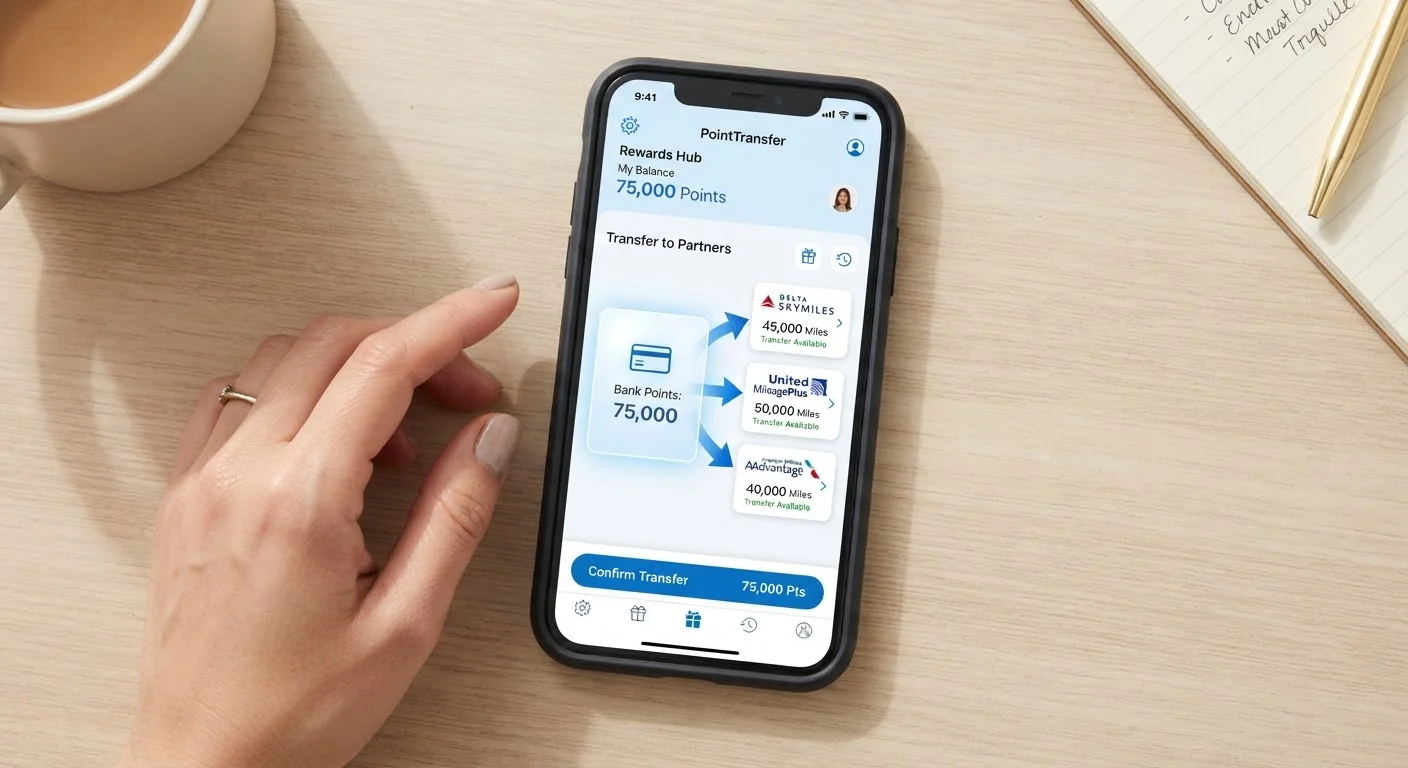
When you initiate a transfer, your card issuer sends your points to the airline's frequent flyer account you designate. The airline then credits the equivalent in its own miles currency, according to a set transfer ratio. A 1:1 ratio means 1,000 card points become 1,000 airline miles. Some partnerships transfer at 2:1 or 1:2 - always check the ratio before assuming the math works in your favor. Our article on fixed-value vs. transferable points explains why that ratio matters so much to your overall strategy.
Timing varies. Many major programs post transferred miles within minutes. Others may take up to three business days. This matters because airline award availability can disappear quickly. Never transfer points to grab a seat you haven't already confirmed is bookable with miles.
Transfers Are One-Way and Irreversible
Once you confirm a point transfer from your credit card account to an airline frequent flyer program, the transaction cannot be reversed. Your card points are gone whether or not you ultimately complete an award booking. Always identify and confirm the specific award you intend to redeem before moving a single point.
Before You Transfer: What to Confirm First
Point transfers are almost universally one-way and irreversible. Once your card points land in an airline account, they cannot be transferred back. That makes pre-transfer research essential, not optional.
What you will need
Check whether your target airline is actually a transfer partner of your card program - partner lists differ across issuers and change over time. Confirm the current transfer ratio directly on the issuer's transfer page, not a third-party site. Finally, verify that the award seat you want is available before you move the points. Log into the airline's own booking tool and price the itinerary in miles. Screenshot the availability as a reference.
If you're weighing whether airline miles are the right currency at all, our comparison of airline miles vs. hotel points can help you think that through.
Step-by-Step: Completing a Point Transfer
Follow these steps carefully. Rushing any stage - especially step 3 - is the most common and costly mistake travelers make.
Log into your card issuer's rewards portal
Access the rewards or travel section of your credit card account. Most issuers label this "Transfer Points" or "Move Points to Partners." Locate the full list of airline transfer partners available to your specific card.
Confirm the transfer ratio for your target airline
Before entering any numbers, read the transfer ratio displayed on that page. Note whether the ratio is 1:1, 2:1.5, or something else entirely. Calculate exactly how many card points you'll need to reach your miles target under that ratio.
Verify award seat availability in the airline's booking tool first
Open a separate browser tab, log into the airline's own website, and search for the award itinerary you want. Confirm the seat is available at the miles price you expect. Note the flight number, date, and miles cost.
Enter your frequent flyer account details
Back in your card portal, select the airline and enter your frequent flyer membership number and the name on the account. Double-check the number digit by digit - a single transposition will send miles to the wrong account or block the transfer entirely.
Enter the point amount and submit the transfer
Input the number of card points you want to transfer (the portal will show the resulting miles total based on the ratio). Review the summary screen carefully - amount, destination account, and airline program - then confirm. Most portals require a final confirmation click before the transfer is executed.
Wait for the miles to post, then book immediately
Check your airline frequent flyer account for the incoming miles. Posting times range from a few minutes to three business days depending on the airline. Once the miles appear, return to the airline booking tool and complete the award reservation without delay.
Once the transfer is complete and the miles post, return to the airline's booking tool and complete your award reservation. For a broader look at how all the pieces fit together, from earning a sign-up bonus to sitting on the plane, see our end-to-end travel rewards guide.
Watch for Occasional Transfer Bonuses
Card issuers periodically run transfer bonus promotions with select airline partners - for example, a 30% bonus on points transferred during a set window. These can meaningfully increase the miles you receive. However, only use a bonus as a reason to transfer if you already have a redemption planned; chasing bonuses without a target booking in mind can leave miles stranded in an account where they may eventually expire.
Common Pitfalls and How to Avoid Them
Even experienced travelers stumble on a few recurring issues. The first is transferring points speculatively - moving miles to an account "just in case" a good deal appears. Miles sitting idle in an airline account can expire under that program's activity rules, which may differ from your card issuer's policy. Only transfer when you have a specific redemption identified.
The second pitfall is ignoring fuel surcharges. Some airlines pass significant carrier-imposed surcharges onto award tickets, which means a "free" flight may still carry a substantial cash cost at checkout. Factor that into your calculation before deciding a transfer is worthwhile.
Third, watch out for account mismatch. The name on your frequent flyer account must exactly match the name on the credit card account initiating the transfer. Discrepancies can cause delays or rejected transfers that are difficult to resolve. Also review our comparison of co-branded vs. general travel cards if you're still deciding which card structure best fits how you travel.
This article is for general informational purposes only and does not constitute financial or investment advice. Rewards program terms, transfer ratios, and partner availability are subject to change; always verify current details directly with your card issuer and airline program before making any transfer decisions.