

Key Takeaways
- MSRP is a starting point for negotiation, not a fixed or guaranteed price.
- The invoice price is what the dealer paid the manufacturer - it's typically lower than MSRP.
- Dealer markups above MSRP are legal and common for high-demand vehicles.
- Destination charges, options packages, and fees all appear on the Monroney sticker.
- The out-the-door price - including taxes and fees - is the number that truly matters.
Sticker Price (MSRP)
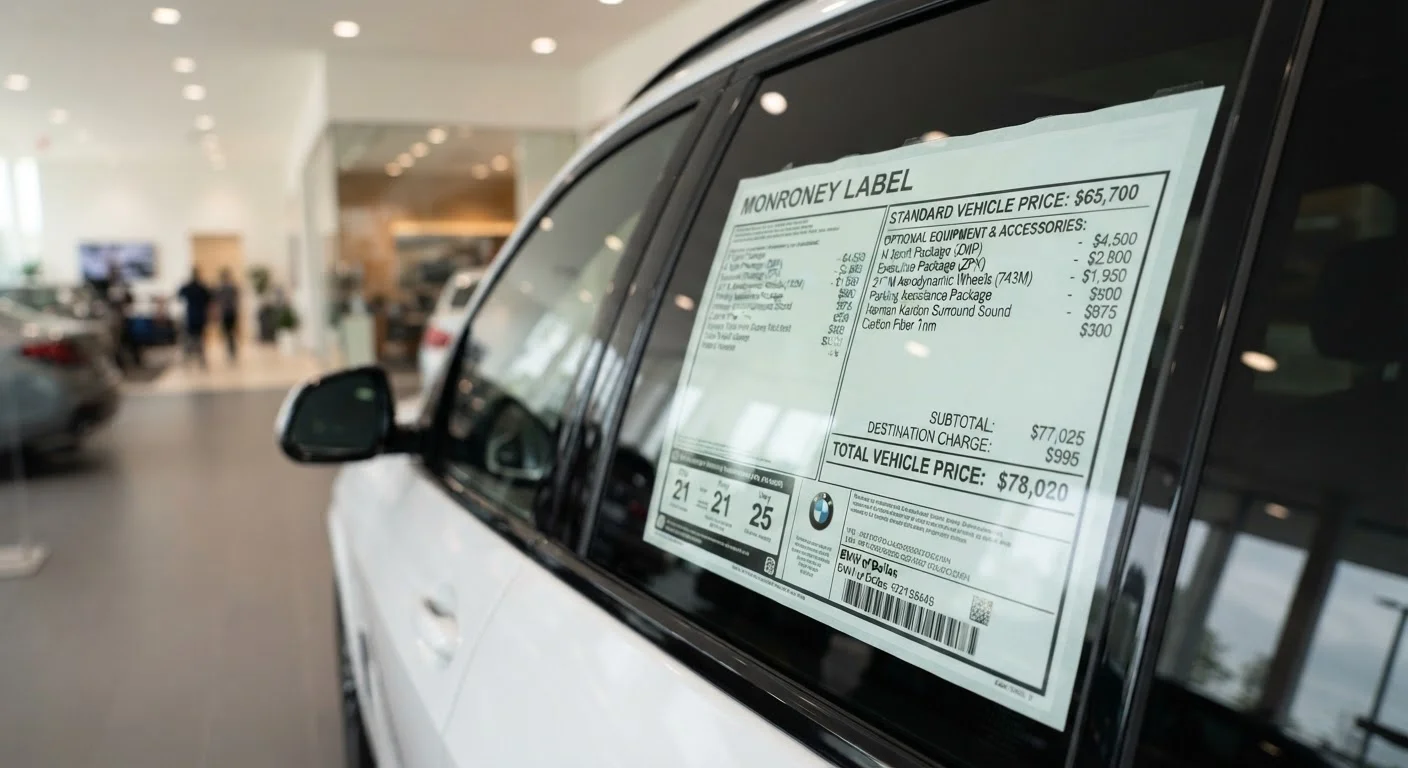
The sticker price - formally called the Manufacturer's Suggested Retail Price, or MSRP - is the price a vehicle's manufacturer recommends that dealers charge customers. It appears on a federally required label (nicknamed the "Monroney sticker") attached to every new car's window. The key word is "suggested": dealers are not required to sell at this price, and the amount you actually pay can be higher or lower.
The Automobile Information Disclosure Act of 1958 mandates the Monroney label and makes it illegal for anyone other than the buyer to remove it before purchase.
What's Actually Printed on That Window Sticker
Walk up to any new car on a dealership lot and you'll spot a large label on the window. Federal law requires this label - called the Monroney sticker - on every new vehicle sold in the US. It isn't just a price tag; it's a structured disclosure document with several distinct line items.
Here's what those lines typically represent:
- Base price: The MSRP for the vehicle in its standard configuration, with no optional equipment.
- Options and packages: Each factory-installed add-on (navigation, premium audio, towing package, etc.) is listed with its individual MSRP.
- Destination charge: A fixed manufacturer fee for shipping the car from the factory to the dealer. It's non-negotiable and the same regardless of which dealership you visit.
- Total MSRP: The sum of the base price, all options, and the destination charge.
What the sticker does not show is dealer-added accessories, documentation fees, taxes, or registration costs - those appear elsewhere during the purchase process. See our guide to hidden dealership fees to understand what gets added after the sticker.
The Monroney Label Is Federally Required
The Automobile Information Disclosure Act requires that a Monroney sticker be affixed to every new car before sale. It's illegal for anyone other than the final buyer to remove it. If you're shown a vehicle without one, ask for it - dealers are required to have it. Any additional pricing sticker placed by the dealer (such as a market adjustment sheet) is separate from the federally mandated label.
MSRP, Invoice Price, and Dealer Markup - Three Different Numbers
Buyers often treat MSRP as the price of the car. In reality, it's one of at least three distinct figures worth understanding before you negotiate.
MSRP
This is the manufacturer's suggested price - the number on the sticker. It's a reasonable market anchor, but "suggested" is doing real work in that phrase. Common assumptions about car prices - including the belief that MSRP is fixed - frequently lead buyers to overpay.
Invoice Price
The invoice price is the amount the dealer was billed by the manufacturer. It's typically a few hundred to a few thousand dollars below MSRP depending on the model. However, dealers often receive additional manufacturer incentives, holdbacks, or bonuses that effectively lower their true cost below even the invoice. So while invoice is a useful data point, it's not a perfect floor.
Dealer Markup (Market Adjustment)
When demand for a vehicle exceeds supply, dealers may add a market adjustment above MSRP. This surcharge is entirely at the dealer's discretion and is legal. It most commonly appears on newly launched models or vehicles with limited production. Knowing current transaction prices - what buyers are actually paying in your region - helps you recognize when a markup is inflated. The relationship between reference prices and perceived deals is also worth understanding; our article on sale price vs. reference price explores how inflated anchors affect perception.
~$48,000
Average new vehicle transaction price in the US
According to Kelley Blue Book data published in late 2024, average new vehicle transaction prices hovered near this figure, well above average MSRP levels from just five years prior.
1-3%
Typical dealer holdback as a percentage of MSRP
Many manufacturers pay dealers a quarterly holdback - roughly 1-3% of MSRP - as an additional profit buffer beyond the invoice price, which is why the invoice isn't always the dealer's true cost.
$400-$900
Typical destination charge range for US new vehicles
Destination fees vary by manufacturer and vehicle class; they are disclosed on the Monroney sticker and are the same at every dealership selling that model.
The Number That Actually Matters: Out-the-Door Price
The MSRP gets most of the attention, but the figure you should focus on is the out-the-door (OTD) price - the total you'll pay to drive the car home. This includes:
- Vehicle price (MSRP or negotiated price)
- Sales tax (varies by state)
- Title and registration fees
- Documentation fee (set by the dealer)
- Any dealer-installed accessories
Always ask for the OTD price in writing before discussing financing or trade-ins. Mixing these conversations makes it easier to lose track of what you're actually agreeing to pay for the car itself.
Once you understand the purchase price, it's also worth thinking longer-term. The sticker is just the entry point - see the real cost of owning a car beyond the monthly payment for a full picture of what ownership will cost over time, and how to read a car's total cost of ownership before you buy for a practical comparison framework.
Always Ask for the Out-the-Door Total
Before you discuss monthly payments or trade-in value, ask the salesperson to give you the complete out-the-door price in writing. This single number - covering the vehicle price, taxes, and all fees - is the only apples-to-apples basis for comparing offers from different dealerships. Breaking it apart mid-negotiation makes it easy to lose track of what you're actually agreeing to pay.