

Key Takeaways
- Center wear usually points to chronic overinflation; edge wear suggests underinflation.
- One-sided wear is a common sign of wheel misalignment that worsens if ignored.
- Cupping or scalloping often indicates worn shock absorbers or struts.
- Catching wear patterns early can prevent premature tire replacement and more expensive suspension repairs.
- Rotating tires on schedule helps reveal patterns before they become severe.
- Regular visual inspections take less than two minutes and can save hundreds of dollars.
Tire Wear Pattern
A tire wear pattern is the specific way rubber erodes from your tire's surface over time. When wear is uneven - heavier on one edge, down the center, or in patches - it indicates that something about your vehicle's alignment, inflation, or suspension is off. Reading these patterns correctly can help you catch costly problems before they get worse.
Tire wear is assessed by comparing tread depth across different zones of the tire's contact patch - the area that actually touches the road. A tread depth gauge or the penny/quarter test can help quantify wear severity.
Why Tire Wear Patterns Matter
Your tires are the only part of your vehicle that touches the road, which makes them unusually good at revealing mechanical problems elsewhere. When something is wrong with your alignment, suspension, or tire pressure, that stress has to go somewhere - and it goes into the rubber. The result is a wear pattern that, if you know how to read it, tells you exactly what needs attention.
Most drivers only look at tires when something is visibly wrong, like a flat or a bulge. But uneven tread wear develops gradually, and catching it early means cheaper, simpler fixes. A wheel alignment that costs under $150 can prevent a full set of premature tire replacements that might run $500 or more. The inspection itself costs nothing.
Understanding tread depth and pressure basics gives you the foundation - but reading wear patterns takes you a step further, into diagnosing why your tires are wearing the way they are.
The Most Common Wear Patterns and What They Mean
Each pattern corresponds to a specific type of mechanical or maintenance problem. Here's how to recognize the most common ones:
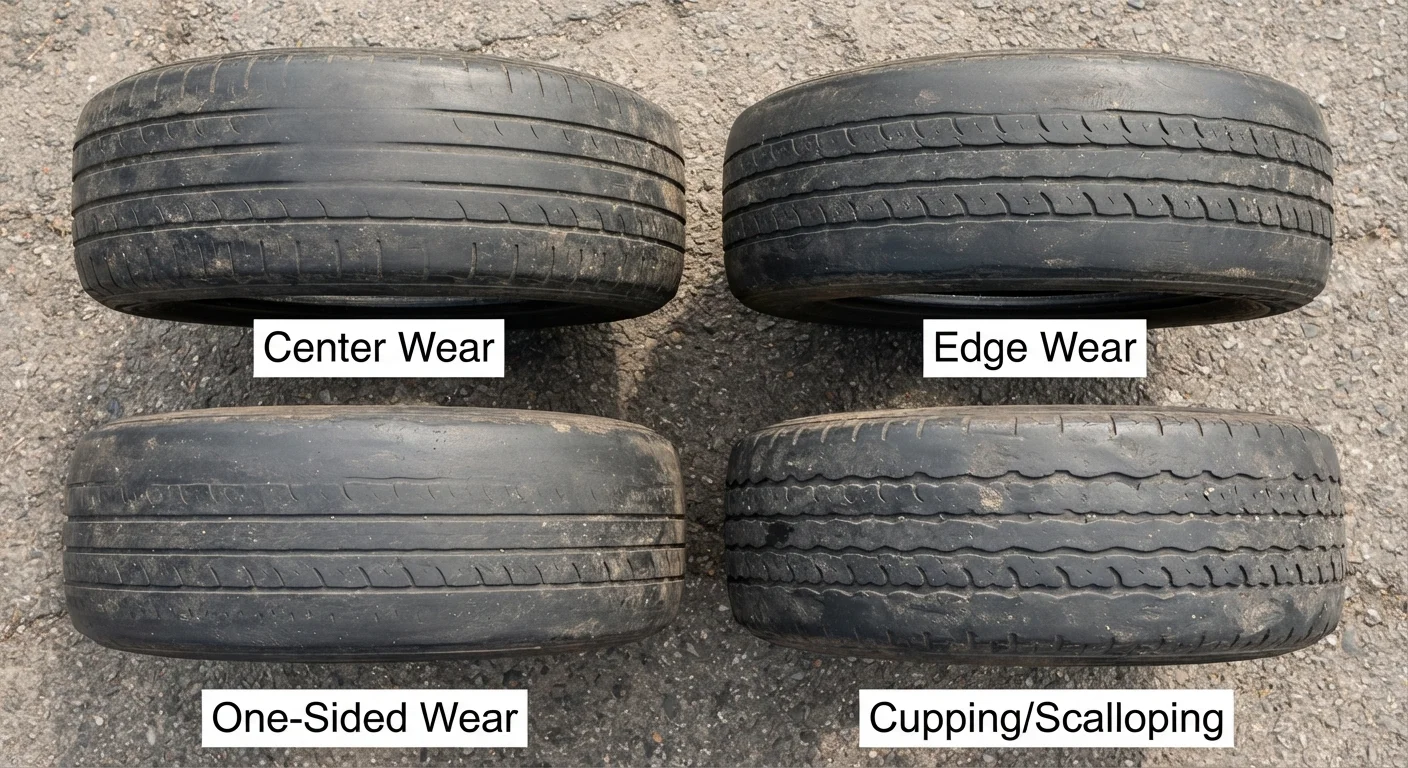
Center Wear
When the middle of the tread is significantly more worn than the edges, your tires have been chronically overinflated. An overinflated tire bulges slightly in the center, so only that portion carries the load. The fix is straightforward: check and correct your inflation to the pressure listed on the sticker inside your driver's door - not the number printed on the tire sidewall, which is the maximum, not the recommended pressure. See why proper tire pressure matters for more context.
Edge Wear (Both Sides)
When both outer edges wear faster than the center, the tire has been running underinflated. A low tire flattens out, placing more load on the shoulders. Beyond wear, underinflated tires generate excess heat and are a leading contributor to blowout risk.
One-Sided Wear
Wear concentrated heavily on just one edge - inner or outer - is a strong indicator of misalignment, specifically a camber problem. Camber refers to the inward or outward tilt of the wheel when viewed from the front of the car. Negative camber (top of wheel leaning inward) wears the inner edge; positive camber wears the outer. A wheel alignment service corrects this.
Cupping or Scalloping
Cupping appears as a series of high and low spots around the tire, giving the tread a wavy or scooped look. This pattern almost always points to worn or damaged shock absorbers or struts. As these components lose their ability to dampen wheel bounce, the tire hops against the road surface rather than rolling smoothly, creating those uneven dips. Cupped tires also tend to produce a distinctive thumping or humming noise at highway speed.
Feathering
Feathering occurs when tread blocks are smooth on one side and sharp on the other, creating a sawtooth appearance. This is caused by incorrect toe alignment - the degree to which your tires angle inward (toe-in) or outward (toe-out) relative to each other. It's corrected with a standard alignment.
~$500-$800
Average cost of a full tire set replacement
Industry estimates from tire retailers suggest a full set of four standard all-season tires typically costs between $500 and $800 installed, making preventive maintenance a high-value investment.
5,000-7,500 mi
Recommended tire rotation interval
Most vehicle manufacturers and tire industry organizations recommend rotating tires every 5,000 to 7,500 miles to promote even wear and extend tire life.
~$75-$150
Typical four-wheel alignment cost
A four-wheel alignment at most US repair shops generally runs between $75 and $150, far less than the cost of a premature tire replacement caused by uncorrected misalignment.
How to Check Your Tires in Under Two Minutes
You don't need special equipment for a basic inspection. Park on a flat surface, crouch down at each tire, and visually scan across the full tread width from the outer edge to the inner edge. Look for:
- Obvious differences in tread depth between the center and the edges
- Worn patches on one side only
- A wavy or scalloped surface texture
- Tread blocks that look sharp on one side and rounded on the other
For the inner edge, which is harder to see, reach in with your hand and run your fingers across the tread. You'll often feel the wear before you can see it clearly.
Pair this check with a monthly tire pressure reading using an inexpensive gauge. Correct inflation is the single easiest way to prevent premature wear. If you notice a pattern you can't explain, have a mechanic put the car on a lift - they can see the full picture, including the inner sidewall and suspension components.
Make Tire Checks Part of a Fuel Stop
The easiest way to build a tire inspection habit is to attach it to something you already do regularly - like filling up the gas tank. While the pump runs, walk around the car and visually scan each tire for uneven wear, low profile, or any visible damage. It takes under 60 seconds and ensures you're never more than a few weeks away from catching a developing problem.
The Downstream Costs of Ignoring Wear Patterns
Uneven tire wear doesn't stay local to the tires. Misalignment stresses steering components. Worn shocks lead to brake fade and reduced control - especially on wet or compromised surfaces where traction margins are already slim. For a deeper look at how tire condition affects your ability to handle difficult roads, see our article on adapting to hazardous driving surfaces.
The financial math is straightforward. A $100 alignment job done at the first sign of one-sided wear can extend tire life by tens of thousands of miles. Waiting until the tread is gone means buying tires - and possibly replacing tie rods or other worn components at the same time. Meanwhile, poor braking performance from degraded contact patches adds another layer of risk. Our guide on getting more life out of your brakes explains how tire condition and braking are directly connected.
The bottom line: tires are not a set-and-forget item. A regular two-minute look at the tread - combined with scheduled rotations every 5,000 to 7,500 miles - gives you an early warning system for problems that would otherwise quietly escalate into much larger repair bills.