

Key Takeaways
- A check engine light doesn't automatically signal an expensive or urgent mechanical failure.
- Many triggers - like a loose gas cap - are simple fixes that cost nothing to resolve.
- Ignoring the light entirely can turn minor issues into costly repairs over time.
- A basic OBD-II scanner can reveal the fault code within minutes at low or no cost.
- A steady light usually warrants attention soon; a flashing light requires immediate action.
What the Check Engine Light Actually Does
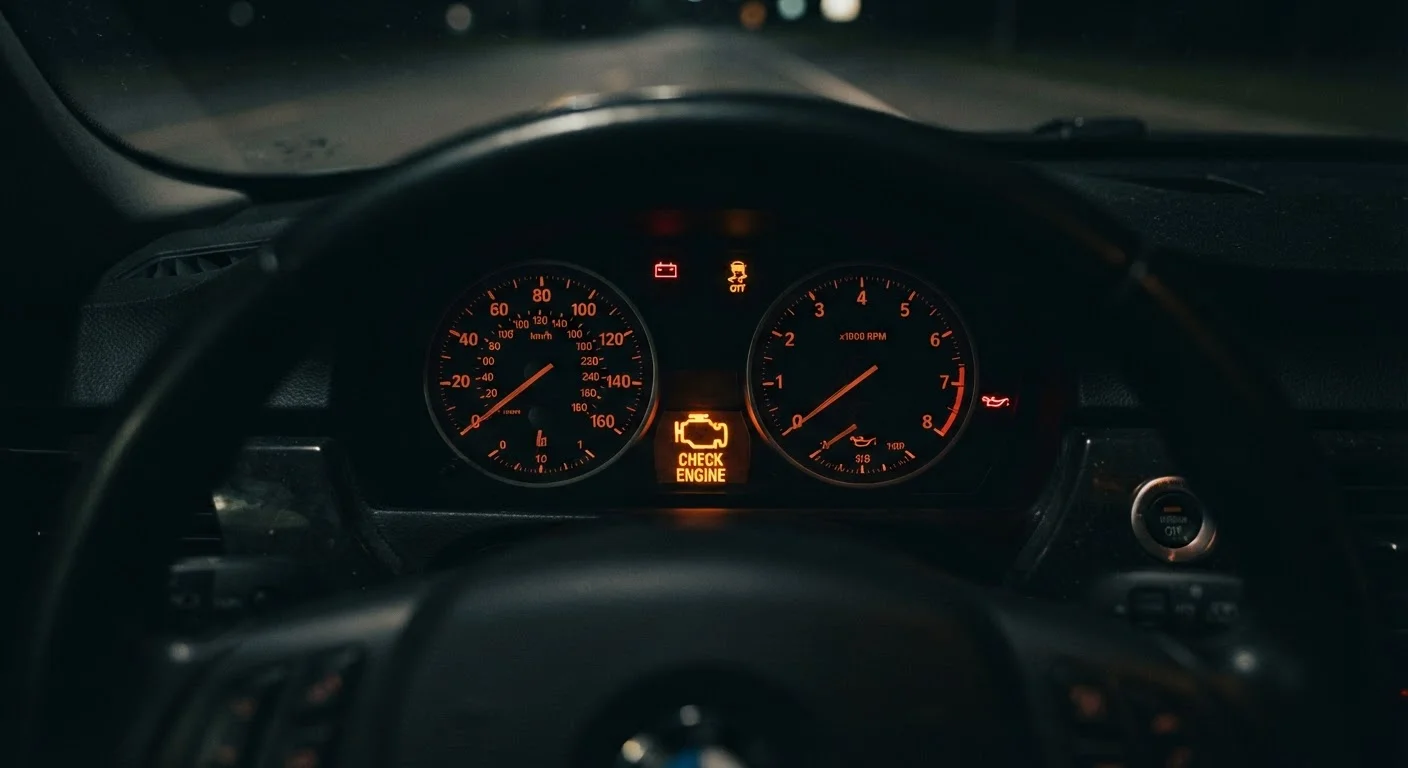
The check engine light - formally called the Malfunction Indicator Lamp (MIL) - is part of your vehicle's onboard diagnostics system, known as OBD-II. Every car sold in the US after 1996 is required to have it. When a sensor detects a reading outside normal parameters, the system stores a diagnostic trouble code (DTC) and illuminates the light.
That's the key insight most drivers miss: the light is triggered by a sensor reading, not necessarily a confirmed mechanical failure. A faulty sensor, a momentary glitch, or a loose connection can all set it off just as easily as a failing component. Understanding this distinction helps you respond calmly and appropriately rather than assuming the worst.
For a broader look at what your dashboard signals mean, see what your dashboard warning lights are actually telling you.
Myth
If the check engine light comes on, I need to pull over immediately and stop driving.
Fact
A steady check engine light rarely requires you to stop driving immediately - a flashing light does.
A solid, steady check engine light signals that a fault has been logged, but your vehicle is generally still operable. You should schedule a diagnostic check soon, but you don't need to abandon your car on the shoulder. The exception is a flashing check engine light, which indicates an active engine misfire. Continuing to drive during a misfire can overheat and damage the catalytic converter - an expensive component. If the light is flashing, reduce speed and get the vehicle to a safe stop or shop as quickly as possible.
Myth
The check engine light means something in the engine itself has broken down.
Fact
The light covers dozens of vehicle systems beyond the engine, including emissions, fuel, and sensors.
The OBD-II system monitors a wide range of components: oxygen sensors, the evaporative emissions system, the transmission, the fuel system, and more. In practice, one of the most common triggers is a loose or missing gas cap, which allows fuel vapors to escape and upsets the evaporative emissions system. Tightening or replacing the gas cap - a fix that often costs nothing - can clear the light after a few drive cycles. The name "check engine" is historically rooted, not a precise description of what the light monitors today.
Myth
Once the check engine light is on, the car is unsafe to drive under any circumstances.
Fact
Driveability and safety depend on what triggered the light, not the light itself.
Many fault codes have little to no impact on your vehicle's immediate safety or performance. A failing oxygen sensor, for example, may reduce fuel efficiency over time but won't suddenly cause the car to stop or handle dangerously. That said, ignoring the light indefinitely is never wise - a minor issue left unaddressed can degrade other components. The practical approach is to read the code promptly, assess the severity, and act accordingly rather than treating every illumination as an emergency.
Myth
Clearing the code with a scanner fixes the underlying problem.
Fact
Clearing a code only erases the stored fault; it does not repair whatever caused it.
An OBD-II scanner can erase the stored trouble code, turning off the check engine light. But if the underlying condition persists, the system will detect it again and re-illuminate the light - sometimes within a single drive cycle. Erasing codes without fixing the root cause can also reset readiness monitors, which are required to pass emissions inspections in most states. This means clearing codes shortly before an inspection can actually cause a vehicle to fail. Always address the cause, not just the symptom.
Myth
A mechanic can instantly tell you exactly what to replace from the fault code alone.
Fact
Fault codes identify the affected system or circuit, not the specific failed part.
A code like P0420 points to catalyst efficiency below threshold on bank 1 - but that could stem from a failing catalytic converter, a bad oxygen sensor, an exhaust leak, or even an engine misfire that damaged the catalyst. A thorough diagnosis involves inspecting related components and sometimes live data testing. Jumping straight to the most expensive repair without proper diagnosis is a common and costly mistake. A qualified mechanic uses the code as a starting point, not a final answer.
How to Respond Without Overreacting - or Underreacting
The smartest first step when the light comes on is to note how it's behaving. A steady light means the system has logged a fault that needs attention but isn't actively causing a critical problem. A flashing or blinking light is a different story - it typically indicates active misfires that can damage your catalytic converter within minutes. Pull over safely and seek professional help promptly if the light is flashing.
Flashing Light Requires Immediate Action
If your check engine light is blinking or flashing rather than glowing steadily, do not continue driving normally. A flashing light typically signals active engine misfires, which can cause rapid and severe damage to the catalytic converter - a repair that can cost well over a thousand dollars. Reduce your speed, avoid hard acceleration, and get the vehicle to a qualified mechanic as soon as safely possible.
For a steady light, retrieve the fault code before spending a dollar on repairs. Many auto parts retailers will read your OBD-II codes for free, and inexpensive handheld scanners are widely available. The code won't tell you exactly what part to replace, but it narrows down the system involved - which is far better than guessing. Once you have the code, research it and consult a trusted mechanic for an accurate diagnosis.
Building good pre-drive habits also helps you catch developing problems before they trigger the light. Our pre-trip vehicle check guide walks you through a quick routine that takes just a few minutes.
~$0
Cost of loose gas cap fix
A loose or missing gas cap is among the most frequently cited check engine light triggers and typically costs nothing to resolve.
1 in 3
Check engine lights linked to emissions issues
Industry diagnostic data consistently shows that emissions-related faults - including oxygen sensors and catalytic converters - account for a large share of check engine codes.
This article is for general informational purposes only. For specific vehicle concerns, consult a qualified mechanic or automotive professional.