

| Warning light colors | Red = urgent/stop; Amber = caution/schedule service; Green/Blue = informational |
| OBD-II standard applies to | All cars and light trucks sold in the US from 1996 onward (US EPA / NHTSA) |
| TPMS required since | 2008 (all new US passenger vehicles) (NHTSA TPMS Final Rule) |
| Flashing check engine light | Indicates active engine misfire - reduce speed and seek service promptly |
| Correct tire pressure location | Driver's door jamb sticker - not the tire sidewall |
| Oil pressure warning response | Stop safely, shut engine off - continued driving risks permanent engine damage |
Why Warning Lights Exist - and Why They're Easy to Misread
Modern vehicles use an onboard diagnostic system (OBD-II) that continuously monitors hundreds of sensors. When something falls outside acceptable parameters, the system triggers a warning light on your instrument cluster. The problem is that most drivers either panic at the sight of any light or, just as dangerously, ignore lights that have been on so long they've become background noise.
Warning lights fall into two broad categories: red lights, which signal an immediate or safety-critical condition requiring you to stop driving soon, and amber/yellow lights, which indicate a condition that needs attention but may not require pulling over immediately. A blue or green light is simply informational - your high beams are on, for example.
Before diving into specific lights, note that your owner's manual is the definitive reference for your vehicle. Symbols can vary slightly by manufacturer. See our breakdown of what the check engine light actually means for a deeper look at one of the most misunderstood signals.
| Warning light colors | Red = urgent/stop; Amber = caution/schedule service; Green/Blue = informational |
| OBD-II standard applies to | All cars and light trucks sold in the US from 1996 onward (US EPA / NHTSA) |
| TPMS required since | 2008 (all new US passenger vehicles) (NHTSA TPMS Final Rule) |
| Flashing check engine light | Indicates active engine misfire - reduce speed and seek service promptly |
| Correct tire pressure location | Driver's door jamb sticker - not the tire sidewall |
| Oil pressure warning response | Stop safely, shut engine off - continued driving risks permanent engine damage |
The Lights You Should Know by Heart
The following are the warning lights US drivers encounter most often, what triggers them, and how urgently each demands action.
OBD-II
On-Board Diagnostics II is the standardized system used in most vehicles sold in the US after 1996 to monitor engine and emissions-related components. When a sensor reading falls outside normal range, OBD-II stores a fault code and triggers a warning light.
Fault Code (DTC)
A Diagnostic Trouble Code is an alphanumeric code stored by the OBD-II system when a problem is detected. Mechanics and scan tools read these codes to identify which system triggered the warning light.
Alternator
A generator driven by the engine that recharges the battery and powers the vehicle's electrical systems while the car is running. A failing alternator is a common cause of the battery warning light.
TPMS
Tire Pressure Monitoring System - a sensor-based system required on all new US passenger vehicles since 2008 that alerts you when a tire's pressure drops significantly below the recommended level.
Catalytic Converter
An emissions control device in the exhaust system that converts harmful combustion gases into less harmful substances. A misfiring engine can overheat and permanently damage this component, making prompt service important.
Check Engine (Amber Engine Icon)
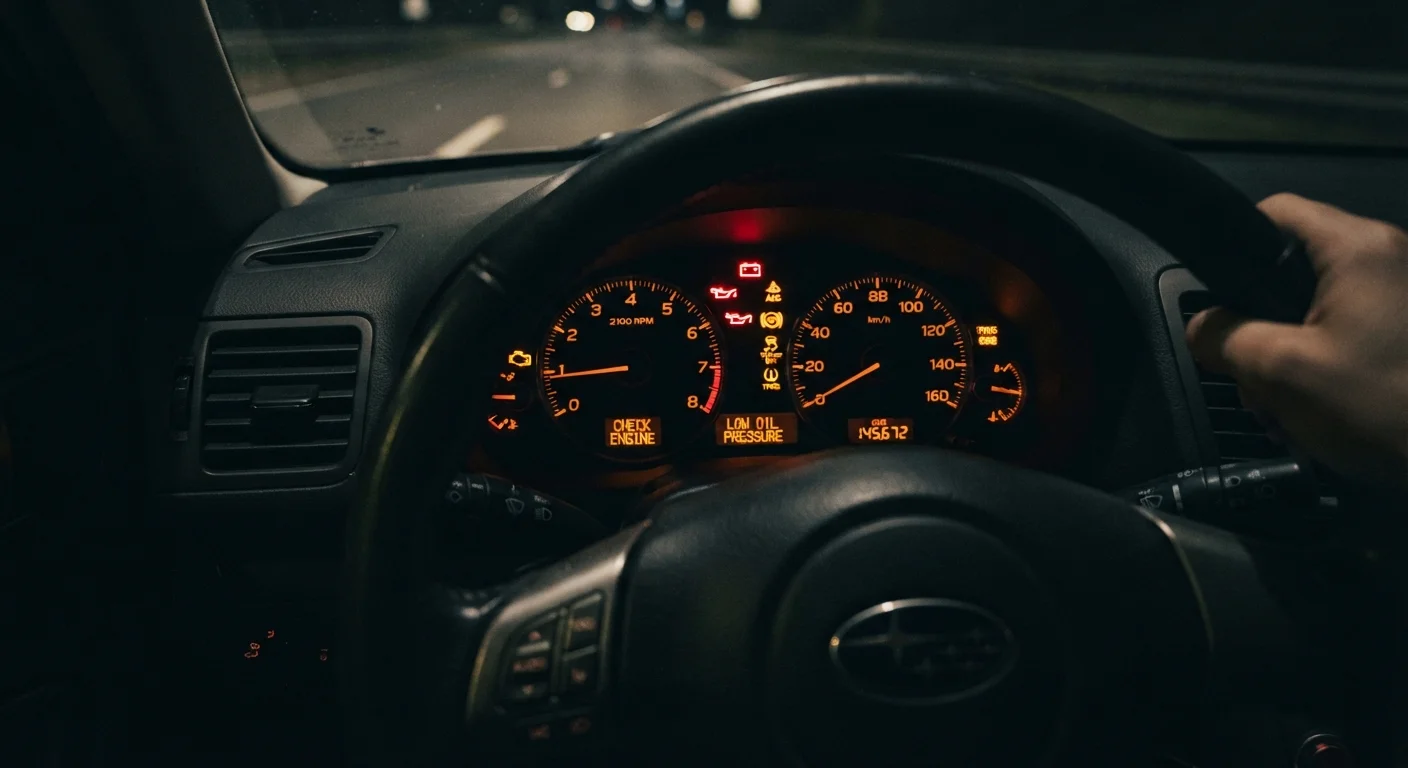
This light covers a wide range of issues - from a loose gas cap to a failing catalytic converter. A steady amber check engine light means the system has logged a fault code; you can continue driving cautiously but should have a mechanic read the code soon. A flashing check engine light indicates an active misfire that can damage the catalytic converter - reduce speed and seek service promptly.
Oil Pressure Warning (Red Oil Can)
This is one of the most serious lights on your dashboard. Low oil pressure means engine components are not being properly lubricated. Continuing to drive can cause permanent engine damage within minutes. Pull over safely, shut the engine off, and check the oil level. Do not restart until the cause is identified. Learn more about fluids in our guide to car fluids every driver should know.
Battery / Charging System (Red Battery Icon)
This light signals that your vehicle is running on battery power alone rather than the alternator. Electrical systems will begin to fail progressively. Head toward a service location without unnecessary electrical use - no A/C, no radio - and expect a short window before the car stalls.
Temperature Warning (Red Thermometer in Liquid)
Your engine is overheating. Pull over, turn off the engine, and allow it to cool. Do not open the radiator cap on a hot engine - pressurized coolant can cause serious burns. Continuing to drive while overheating can warp cylinder heads, a repair that costs far more than a tow.
Tire Pressure Monitoring System - TPMS (Amber Exclamation in Tire)
One or more tires is significantly under-inflated. Under-inflated tires reduce fuel efficiency, affect handling, and can fail at highway speeds. Check all four tires with a gauge and inflate to the pressure listed on the driver's door jamb sticker - not the number on the tire sidewall. Our article on tire wear patterns explains related warning signs.
Brake System Warning (Red Circle with Exclamation)
If your parking brake is released and this light remains on, your brake fluid may be low or there is a fault in the braking system. Have this checked immediately - brakes are your primary safety system.
What to Do When a Light Comes On
Your response should match the color and behavior of the light. Red or flashing? Stop driving as soon as it is safe to do so. Steady amber? Drive cautiously and schedule service within days, not weeks. If multiple lights illuminate at once, or if you notice accompanying symptoms - unusual sounds, vibrations, smoke, or a burning smell - treat the situation as urgent regardless of light color.
Getting a fault code read (often free at auto parts stores) gives you a starting point, but a code alone doesn't tell the full story. Codes describe the sensor reading that triggered the alert, not always the root cause. A mechanic can interpret the code in context. For a broader understanding of which repairs genuinely require professional attention, see our guide on when to pay a mechanic.
Incorporating regular visual checks into your routine dramatically reduces the chance that a warning light will catch you off guard. Our pre-trip vehicle check guide walks you through a quick inspection before any drive. And if you want to stay ahead of issues before they trigger a light, understanding your maintenance schedule is a practical next step.