

Key Takeaways
- The two-second rule is a baseline - not a guarantee of safety in all conditions.
- At highway speeds or in poor weather, a three- to four-second following gap is more appropriate.
- Heavier vehicles like trucks and SUVs require longer stopping distances than passenger cars.
- Tailgating is a leading cause of rear-end collisions, which are among the most common crash types.
- Drivers should continuously adjust following distance based on speed, visibility, and road surface.
Safe Following Distance
Safe following distance is the space you intentionally keep between your vehicle and the one ahead - enough room to stop safely if traffic slows or stops suddenly. The widely taught 'two-second rule' gives drivers a quick baseline: count two seconds between when the car in front passes a landmark and when your car does. However, two seconds is a minimum starting point, not a universal standard.
Stopping distance is the sum of reaction distance (the distance traveled before braking begins) and braking distance (the distance needed to fully stop). Both increase with speed, meaning the gap that's safe at 30 mph is dangerously insufficient at 65 mph.
Where the Two-Second Rule Comes From
The two-second rule became a standard teaching tool because it's simple to apply at any speed without doing mental math. Rather than memorizing distance in feet for each speed increment, drivers count seconds - a fixed time gap that automatically scales with how fast they're traveling.
At 30 mph, two seconds translates to roughly 88 feet of space. At 60 mph, that same two seconds becomes about 176 feet. The rule was designed as a minimum for dry roads in good conditions with an alert driver. Driving education programs in the US have used it for decades as an accessible entry point, not a ceiling.
The problem is that many drivers treat two seconds as the final word - and it isn't. Understanding why the gap exists helps you judge when more space is needed. See our end-to-end driving safety guide for a broader look at how safe habits evolve over time behind the wheel.
When Two Seconds Falls Short
Several factors can make a two-second gap genuinely dangerous, even though it sounds reasonable:
- High speed: At 70 mph, two seconds gives you about 205 feet. That sounds like a lot until you account for reaction time - roughly 1.5 seconds for most drivers - plus braking distance. Three to four seconds is more appropriate at freeway speeds.
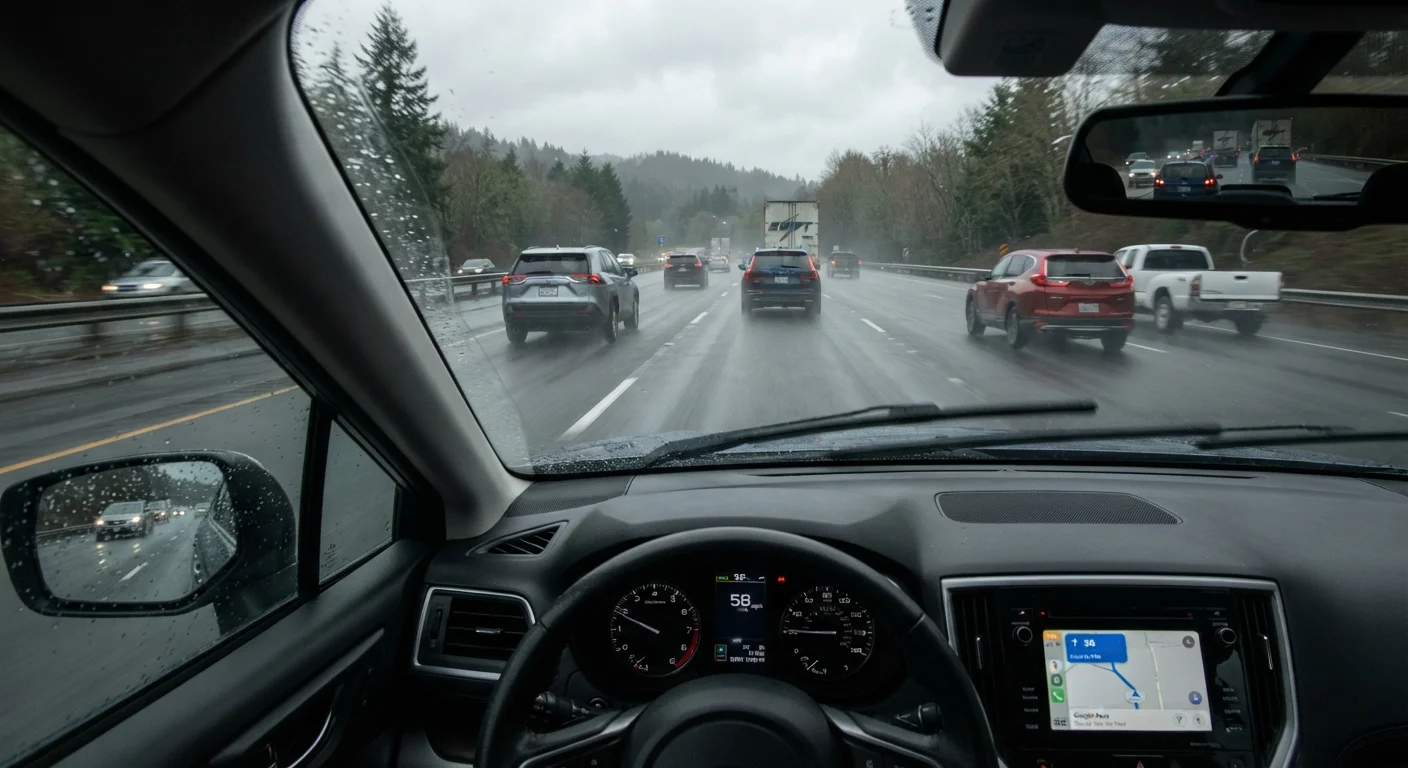
- Wet or slippery roads: Water, ice, and snow dramatically reduce tire traction. On a wet road, stopping distances can roughly double. On ice, they can increase tenfold. Drivers should increase their following gap significantly the moment conditions deteriorate.
- Reduced visibility: Fog, heavy rain, glare, and darkness shorten how far ahead you can see. If you can't see hazards early, you need more time - and more space - to respond. This pairs directly with the hazards covered in our night driving risks guide.
- Heavy or tall vehicles: SUVs, trucks, and vehicles with trailers have higher centers of gravity, more weight to stop, and sometimes reduced sightlines. If you're driving one - or following one - add more buffer.
- Distraction or fatigue: Even brief inattention adds to effective reaction time, eating directly into whatever cushion you've built.
How to Count Your Following Gap
Choose a fixed point on the road - a sign, a shadow line, or a lane marking. When the rear bumper of the car ahead passes it, begin counting: 'one-one-thousand, two-one-thousand.' If your front bumper passes the same point before you finish counting, you're too close. Increase your gap and check again.
A Practical Framework for Adjusting Your Gap
Rather than memorizing different rules for every situation, think in terms of multipliers:
| Condition | Recommended Gap |
|---|---|
| Dry road, normal speed | 2 seconds |
| Highway speed (60+ mph) | 3-4 seconds |
| Rain or wet road | 4+ seconds |
| Snow or ice | 8-10 seconds |
| Fog or low visibility | 4+ seconds |
| Towing or heavy load | 4+ seconds |
These aren't arbitrary numbers - they reflect the physics of stopping a moving vehicle under real-world conditions. The goal is always to give yourself enough time to perceive a hazard, decide to brake, apply pressure, and actually stop before reaching the vehicle in front.
~29%
Of all crashes are rear-end collisions
According to the National Highway Traffic Safety Administration (NHTSA), rear-end crashes consistently represent roughly a third of all US traffic crashes annually.
1.5 sec
Average driver reaction time before braking
Research on driver behavior commonly cites 1.5 seconds as the average perception-reaction time, meaning your car travels significant distance before braking even begins.
10x
Longer stopping distance on ice vs. dry road
Vehicle dynamics research indicates stopping distances on packed ice can be roughly ten times longer than on dry pavement at the same speed.
Highway driving introduces additional complexity: traffic can compress quickly, and lane changes mean the car suddenly in front of you may be closer than you expect. Our guide to merging and lane changes explains how to read traffic flow and position yourself safely before gaps close.
The Real Cost of Tailgating
Rear-end collisions are one of the most common crash types on US roads, and following too closely is the primary contributing factor. The financial consequences extend beyond the immediate repair bill - insurance rates often increase after an at-fault collision, and any injuries sustained can carry medical and legal costs that last years.
Many tailgating incidents aren't aggressive - they're habitual. Drivers unconsciously creep forward in traffic, matching the speed of the car ahead without maintaining a true buffer. Building the habit of counting seconds each time you find yourself in a following position is one of the simplest, most durable safety practices available to any driver.
Adjusting your following distance costs nothing and requires no equipment - only awareness. Like the 50/30/20 budgeting rule that works as a starting framework but needs adjustment for individual circumstances (see what the 50/30/20 rule actually means), the two-second rule is a foundation to build on - not a ceiling to stay at.
State Laws on Following Distance
Most US states require drivers to follow at a 'reasonable and prudent' distance - a legal standard that gives officers discretion to issue citations based on conditions, not just a fixed measurement. Some states reference specific distance minimums. Check your state's vehicle code for the exact language that applies where you drive.