

Key Takeaways
- Fatal crash rates are significantly higher at night despite fewer vehicles on the road.
- Human vision degrades substantially in low light, reducing hazard detection distance and accuracy.
- Drowsy driving peaks between midnight and 6 a.m. and impairs reaction time similarly to alcohol.
- Dirty or aging headlights can reduce effective illumination by more than half.
- Increasing following distance and slowing down are the most reliable compensations for reduced night visibility.
Why Night Driving Deserves More Respect
Most drivers treat nighttime roads as simply a darker version of daytime travel. That assumption is worth reconsidering. According to the National Safety Council, roughly half of all traffic fatalities in the United States occur at night, even though only about a quarter of driving happens after dark. The math is stark: mile for mile, driving at night is far more dangerous than driving during the day.
The reasons go beyond just limited visibility. Impaired and drowsy drivers, wildlife crossings, reduced pedestrian visibility, and depth-perception failures all converge after sunset. Understanding each risk - and how it compounds the others - gives you a meaningful advantage. The adjustments required aren't dramatic, but they need to be deliberate. This is also relevant reading if you've already explored hazardous driving conditions, since night adds another layer of challenge to any compromised road surface.
Your eyes underperform more than you realize
Human vision relies heavily on cone cells for detail and color, but cones require relatively bright light to function well. In low-light conditions, the eye shifts to rod cells, which detect motion and shape but produce poor resolution and no color information. This means you're processing a fundamentally lower-quality image of the road at night, even when it doesn't feel that way.
Depth perception - your ability to judge how far away an object is - also degrades significantly in the dark. This matters most when estimating the speed of oncoming vehicles, the distance to the car ahead, or spotting hazards at the edge of the road. Slowing down by even 5-10 mph gives your visual system more processing time and your brakes more stopping margin.
At night, your depth perception degrades enough to misjudge distances that feel familiar in daylight.
Headlight range creates a stopping distance trap
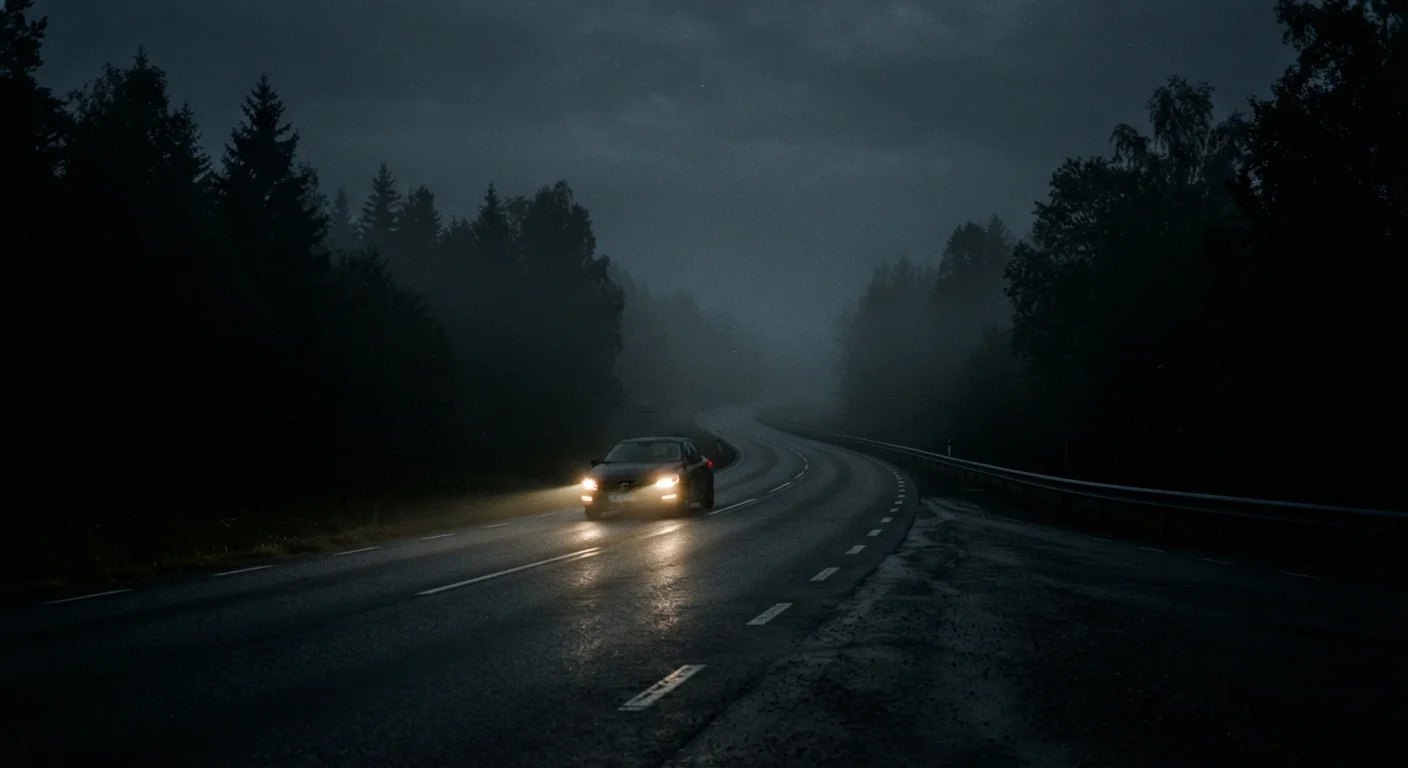
Standard low-beam headlights typically illuminate about 160 feet ahead. At 60 mph, a vehicle travels roughly 88 feet per second - meaning your headlights give you less than two seconds of lit road ahead. Factor in reaction time (generally 1-1.5 seconds for an alert driver) and actual braking distance, and it becomes clear that many drivers are regularly outdriving their headlights without knowing it.
Headlight condition compounds the problem. Oxidized or foggy headlight lenses, which are common on vehicles older than five to seven years, can reduce light output dramatically. Restoring cloudy lenses or replacing aging bulbs is a straightforward maintenance step that pays real safety dividends - and is worth checking as part of any pre-trip inspection.
Many drivers are outdriving their headlights without realizing it - especially on rural or unlit roads.
Drowsy driving peaks in the early morning hours
The body's circadian rhythm creates a strong pull toward sleep between midnight and 6 a.m., and again in the early afternoon. Driving during these windows - even after what feels like adequate rest - elevates impairment risk considerably. Research published by the AAA Foundation for Traffic Safety has found that going 18 hours without sleep produces impairment comparable to a blood alcohol concentration of 0.05%, and 24 hours without sleep approaches the legal limit of 0.08%.
Warning signs include difficulty keeping your eyes open, drifting between lanes, missing exits you intended to take, or not remembering the last few miles. These are not situations to push through. Pulling over, taking a short rest, switching drivers, or choosing not to drive during peak drowsiness hours are the only reliable countermeasures - caffeine provides temporary alertness but does not restore safe reaction time.
Driving after 18 hours awake produces impairment levels comparable to a measurable blood alcohol level.
Impaired drivers are disproportionately active at night
While impaired driving is a problem at any hour, the risk of encountering an impaired driver rises sharply at night - particularly on weekend nights between 10 p.m. and 2 a.m. NHTSA data consistently shows that alcohol-involved fatal crashes cluster heavily in this window. You can't control other drivers, but you can adjust your own exposure by increasing following distance, staying out of a driver's blind spot for extended periods, and leaving space to maneuver if someone ahead behaves erratically.
Defensive positioning matters more at night. Staying in lanes that give you an exit path, covering the brake when approaching intersections, and scanning beyond just the car immediately ahead are habits that create reaction time you'd otherwise lose.
Weekend nights between 10 p.m. and 2 a.m. represent the highest concentration of impaired-driver crash risk.
Wildlife and pedestrians become much harder to detect
Deer-vehicle collisions in the US peak in October and November, with most occurring around dawn and dusk - but nighttime rural driving carries consistent wildlife risk year-round. Animals often appear suddenly at the edge of headlight range, giving drivers very little time to respond. Scanning the road shoulders actively, especially in wooded or agricultural areas, and slowing down when you see one animal (others are usually nearby) can reduce the severity of an encounter.
Pedestrians present a parallel challenge. A person wearing dark clothing may not be visible until they're within 50-75 feet of your headlights. In urban and suburban areas at night, treat every intersection and crosswalk as a potential pedestrian zone even when you don't immediately see anyone - and be particularly cautious near bus stops, parks, and bars.
A pedestrian in dark clothing may only become visible within 50-75 feet - far inside a safe stopping distance.
Glare from oncoming headlights disrupts adaptation
When a bright light hits your eyes after they've adapted to darkness, temporary vision loss - sometimes called flash blindness - can last several seconds. Modern high-intensity headlights and poorly aimed beams make this a frequent problem on two-lane roads. The standard guidance is to avoid looking directly at oncoming headlights; instead, shift your gaze to the right edge of your lane and use lane markings to guide your path until the vehicle passes.
If your own night vision seems especially poor or you experience halos and starbursts around lights, it may be worth having your vision checked. Conditions like uncorrected astigmatism or early cataracts can significantly worsen glare sensitivity and are often overlooked until they create a driving problem.
Glare from oncoming headlights can cause several seconds of vision disruption - look to your lane's right edge instead.
Applying What You Know Before You Drive
Awareness only helps if it changes behavior. Before a nighttime trip - especially a long one - run through a quick vehicle check focused on lighting: confirm your headlights, taillights, and brake lights are clean and functioning. A pre-trip vehicle walkthrough takes only a few minutes and can catch the kind of equipment failures that become genuinely dangerous after sunset.
Following distance is another adjustment worth ingraining as a habit. The two-second rule is a starting point, but at night - when your stopping distance may exceed your visible range - extending that gap to three or four seconds is a reasonable precaution. Small habit shifts like these don't add significant time to your commute, but they meaningfully reduce the consequences of the unexpected.
Simple adjustments with outsized impact
Cleaning your windshield inside and out before a night drive reduces glare dramatically - interior film buildup scatters light in ways drivers rarely notice until it's removed. Reducing your speed by 5-10 mph on unlit roads and extending your following distance are the two easiest changes that meaningfully reduce night driving risk without adding significant travel time.
This article provides general safety education for informational purposes only. Always use your own judgment and comply with all applicable traffic laws when driving.