

Key Takeaways
- Prolonged unbroken sitting is linked to metabolic and cardiovascular health risks, independent of exercise habits.
- You don't need a gym or a new schedule - small movement breaks throughout the day make a measurable difference.
- Habit-stacking, environmental cues, and micro-walks are among the most sustainable strategies for reducing sedentary time.
- Consistency across the week matters more than intensity; frequent short bouts of movement are the practical goal.
- Always consult a healthcare professional before making significant changes if you manage a chronic health condition.
Why Sitting Less Matters - Even If You Already Exercise
Research in public health consistently shows that the amount of time people spend sitting continuously throughout the day carries its own health implications - separate from whether they exercise regularly. Long, unbroken periods of sedentary time are associated with higher risks of metabolic issues, cardiovascular concerns, and musculoskeletal discomfort, according to guidance from organizations such as the American Heart Association.
The good news: you don't need to redesign your life. The strategies below are grounded in behavioral science and realistic for people with demanding schedules. Think of them as tools to keep in rotation, not a rigid program to follow perfectly. For a broader framework, a weekly movement checklist can help you track progress without overcomplicating things.
Stack movement onto existing habits
Habit-stacking - linking a new behavior to an existing routine - is one of the most reliable behavior-change techniques studied in psychology. Identify moments in your day that already happen consistently: brewing coffee, waiting for a meeting to start, finishing a phone call. Attach a brief standing or walking behavior to each one. Over weeks, the movement becomes automatic rather than effortful.
Linking movement to existing habits removes the need for willpower or reminders.
Take calls standing or walking
Phone and video calls are natural movement opportunities. For audio-only calls, stepping outside or pacing your space turns passive time into light activity. Even standing in place during a video call shifts your posture and engages different muscle groups than sitting. Many people find they also think more clearly when moving - a common observation backed by research on walking and cognitive function.
Standing or walking during calls is one of the lowest-friction movement habits available.
Use a reminder system - but make it smart
Passive reminders (timers, app notifications) work best when they prompt a specific, easy action rather than a vague instruction to "move." Set a reminder every 45-60 minutes that cues a defined behavior: stand up and walk to the kitchen, do five slow neck rolls, walk to a colleague's desk instead of messaging them. The specificity is what makes the behavior actually happen.
[note_callout]A reminder paired with a specific action is far more effective than a general nudge.
Restructure your environment as a cue
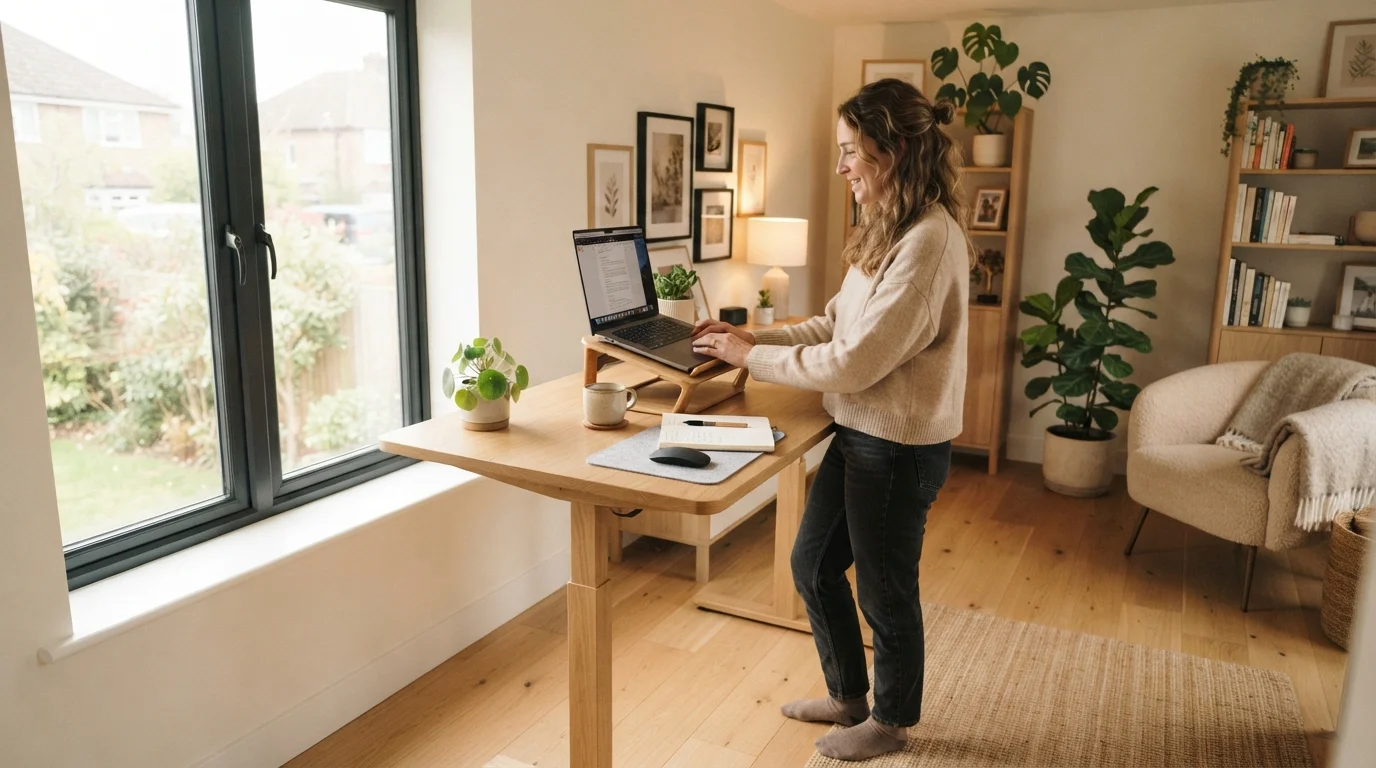
Your physical environment shapes behavior more than motivation does. Placing your printer farther away, keeping a glass of water at a location that requires you to stand to refill it, or positioning your workspace near a window you enjoy looking out of from standing - all of these create organic reasons to get up. Environmental design is a tool used in public health precisely because it operates below the level of conscious decision-making.
Redesigning your environment quietly prompts movement without relying on motivation.
Build "micro-walks" into transitions
Transitions between tasks are an underused asset. Instead of moving directly from one seated activity to another, insert a brief walk - even two minutes around the block or through your building. Research published in health journals suggests that light walking after periods of sitting can help moderate blood sugar responses and improve circulation. These micro-walks compound meaningfully over a full day.
Two minutes of walking after sitting has measurable physiological benefits according to research.
Rethink meetings and social catch-ups
Not every meeting needs a table and chairs. Suggesting a walking one-on-one - whether with a coworker, friend, or family member - normalizes movement as part of conversation. Walking meetings tend to be shorter, more focused, and less likely to drift into unproductive territory, making them a practical pitch to colleagues beyond the personal health benefit.
Walking meetings often run shorter and more efficiently than seated ones.
Reclaim commercial breaks and screen pauses
Evening screen time is one of the longest uninterrupted sedentary blocks many people accumulate. Using commercial breaks or natural pauses to stand, stretch, or briefly walk to another room adds up without requiring you to sacrifice rest. This also applies to streaming: setting an intention to stand during opening credits or between episodes costs no enjoyment and provides a consistent daily movement opportunity.
Screen time pauses are one of the most accessible and untapped movement opportunities of the day.
Making It Stick Over Time
The strategies that endure are the ones that require the least willpower, because they're woven into what you already do. If you find yourself reverting to long sedentary stretches, that's normal - the goal isn't perfection but gradual recalibration. Movement habits also tend to reinforce other health behaviors: people who interrupt sitting more often frequently report better energy levels and mood, which can make it easier to sustain practical nutrition habits as well.
Start with just one change
Trying to implement all of these strategies at once usually leads to none of them sticking. Pick the single adjustment that fits most naturally into your current routine and practice it for two weeks before adding another. Small, sustainable changes consistently outperform ambitious overhauls in behavior-change research.
This article is for general informational and educational purposes only and is not a substitute for professional medical advice. If you have a chronic condition, injury, or specific health concern, consult a qualified healthcare provider before changing your physical activity patterns.