

Key Takeaways
- A small number of versatile items can cover most home workout needs effectively.
- Many expensive or bulky pieces of equipment end up unused within months of purchase.
- Bodyweight training requires zero equipment and can build real strength and endurance.
- Your available space, goals, and consistency habits should drive any equipment decision.
- Consulting a fitness professional before investing in specialized gear can help you avoid costly mistakes.
No commute removes a major barrier to exercise
Eliminating travel time is one of the most commonly cited reasons people exercise more consistently at home. Removing that friction can make a genuine difference in follow-through.
Flexible scheduling around family and work
Home workouts can happen at 6 a.m. or 10 p.m. without worrying about gym hours, class schedules, or childcare. This adaptability supports habit formation over the long term.
No intimidation or social pressure
For people who feel self-conscious in gym settings, exercising at home removes that psychological friction entirely, which can be especially meaningful for beginners.
Long-term cost savings compared to gym membership
A modest set of resistance bands and a mat costs far less over several years than an ongoing gym membership, particularly if gym attendance is irregular.
Bodyweight training requires no equipment at all
Push-ups, squats, lunges, and planks can build meaningful strength without any purchase. The comparison between bodyweight and free-weight approaches shows both can be highly effective.
Easy to over-purchase before establishing a habit
Many people invest heavily in equipment before knowing what they'll actually use consistently. Understanding why routines fall apart early can help avoid expensive impulse buys.
Limited variety can stall progress over time
A home setup rarely matches the range of equipment a full gym offers. Without variety, some people plateau or lose motivation after initial progress.
Space and storage become real constraints
Dumbbells, benches, and cardio machines take up meaningful floor space. In apartments or smaller homes, this can make a comprehensive setup impractical.
No built-in accountability or community
Group classes and gym culture provide social motivation that home workouts don't replicate easily. Some people find solo training harder to sustain without external encouragement.
Harder to learn correct form without guidance
Without a trainer or instructor nearby, beginners risk developing poor movement habits. This is particularly relevant for those new to strength training.
Our Verdict
A well-chosen home setup doesn't need to be expensive or crowded to be effective. A few versatile, low-cost items - combined with consistent bodyweight movement - can serve most people's fitness needs. Where home equipment shines is in convenience and removing friction from routine; where it fails is when purchases outpace actual habits.
Home equipment works best for people who value convenience over variety, have limited gym access, or are actively building a consistent movement habit and want a low-pressure environment to do it.
Why Home Workouts Attract So Many People - and So Much Clutter
The appeal of working out at home is real: no commute, no waiting for equipment, no judgment. But the gap between buying gear and actually using it is wide. Industry data consistently shows that a significant portion of home fitness equipment ends up as storage furniture within months of purchase.
The problem isn't the concept - it's the sequence. Many people invest in equipment before building a reliable movement habit, which means they're setting up a home gym for a version of themselves they haven't yet become. If you're still working on building a consistent movement habit, starting with minimal or no equipment is almost always the more sustainable path.
No commute removes a major barrier to exercise
Eliminating travel time is one of the most commonly cited reasons people exercise more consistently at home. Removing that friction can make a genuine difference in follow-through.
Flexible scheduling around family and work
Home workouts can happen at 6 a.m. or 10 p.m. without worrying about gym hours, class schedules, or childcare. This adaptability supports habit formation over the long term.
No intimidation or social pressure
For people who feel self-conscious in gym settings, exercising at home removes that psychological friction entirely, which can be especially meaningful for beginners.
Long-term cost savings compared to gym membership
A modest set of resistance bands and a mat costs far less over several years than an ongoing gym membership, particularly if gym attendance is irregular.
Bodyweight training requires no equipment at all
Push-ups, squats, lunges, and planks can build meaningful strength without any purchase. The comparison between bodyweight and free-weight approaches shows both can be highly effective.
What's Actually Worth Having
Not all home fitness purchases are equal. A few items earn their floor space through genuine versatility and regular use:
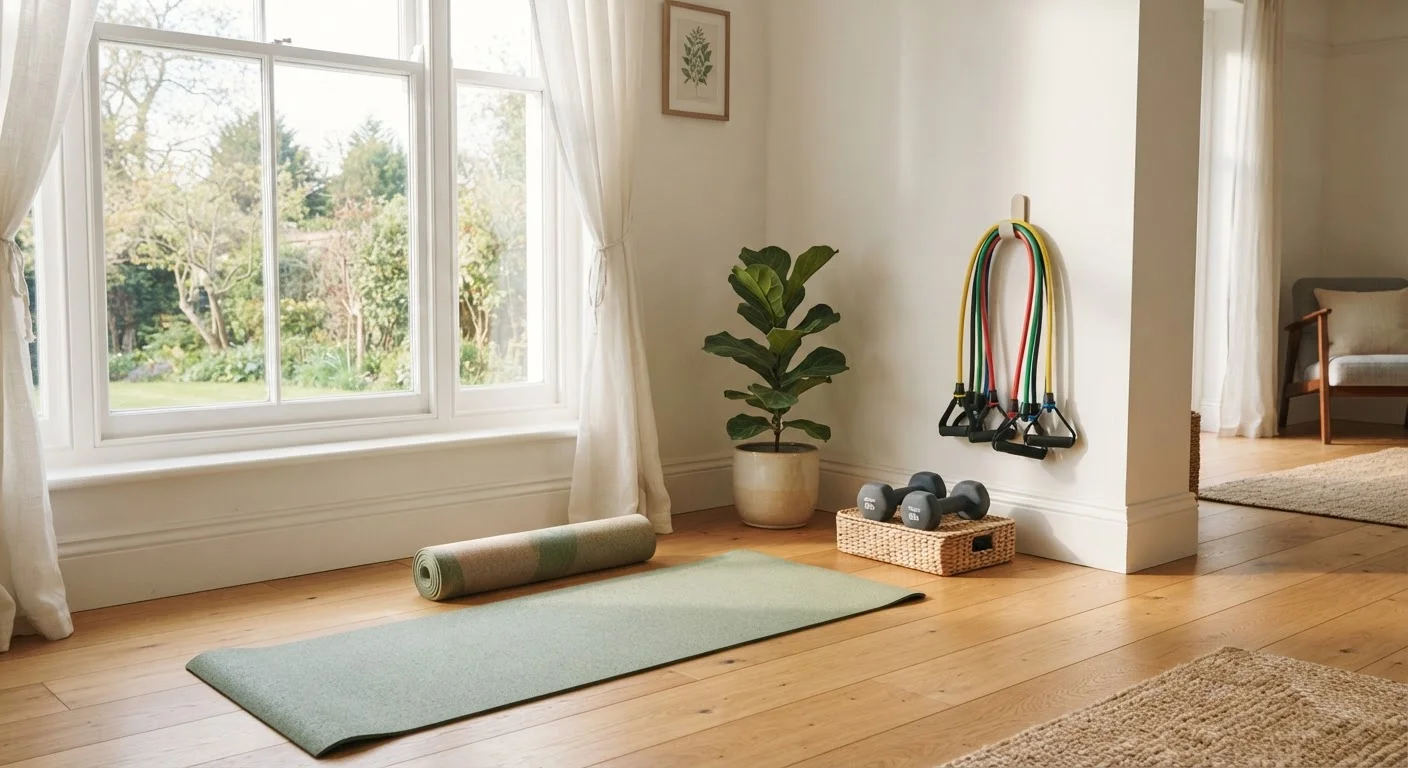
- Resistance bands: Affordable, compact, and adaptable across strength, mobility, and rehabilitation work. A set covering multiple resistance levels handles a wide range of exercises.
- Adjustable dumbbells: If budget and space allow, a single pair of adjustable dumbbells replaces an entire rack and supports progressive strength training over time.
- A quality exercise mat: Useful for floor work, stretching, yoga, and bodyweight training. Thickness and grip matter more than branding.
- A pull-up bar: Doorframe-mounted bars are inexpensive and add upper-body pulling movements that bodyweight alone can't replicate as easily.
These four items, combined with thoughtful bodyweight training, can support a genuinely well-rounded routine - including the kind of balance between cardio and strength that most fitness guidelines recommend.
When to Consult a Professional First
If you have a chronic condition, are recovering from injury, or haven't exercised in an extended period, it's worth speaking with a healthcare provider or certified fitness professional before setting up a home routine. They can help you identify which types of movement are appropriate and flag any exercises to approach cautiously. General guidance here is educational, not a substitute for personalized advice.
What You Can Reasonably Skip
The fitness equipment industry is skilled at making products feel essential. Most aren't - particularly for beginners or people training for general health rather than specialized performance.
Easy to over-purchase before establishing a habit
Many people invest heavily in equipment before knowing what they'll actually use consistently. Understanding why routines fall apart early can help avoid expensive impulse buys.
Limited variety can stall progress over time
A home setup rarely matches the range of equipment a full gym offers. Without variety, some people plateau or lose motivation after initial progress.
Space and storage become real constraints
Dumbbells, benches, and cardio machines take up meaningful floor space. In apartments or smaller homes, this can make a comprehensive setup impractical.
No built-in accountability or community
Group classes and gym culture provide social motivation that home workouts don't replicate easily. Some people find solo training harder to sustain without external encouragement.
Harder to learn correct form without guidance
Without a trainer or instructor nearby, beginners risk developing poor movement habits. This is particularly relevant for those new to strength training.
- Treadmills and ellipticals: Large, expensive, and often underused. Unless cardiovascular equipment is genuinely the only way you'll do cardio, walking outdoors or following bodyweight cardio circuits covers most of the same ground.
- Ab rollers, waist trainers, and vibrating platforms: Products marketed around targeted fat loss or passive toning do not reflect how the body actually responds to exercise. These are among the lowest-value purchases in the category.
- Full weight benches and squat racks: Valuable for serious strength training, but overkill for most home setups - especially before habits are established.
The broader principle: if a piece of equipment requires a dedicated room, significant upfront cost, or complex assembly, it's worth waiting until your workout habit is stable enough to justify it.
Building Habits Before Building a Home Gym
The most effective home workout setup is one you'll actually use. That sounds obvious, but it's frequently overlooked. Research on behavior change suggests that environmental design - making exercise easy and accessible - matters more than motivation or equipment quality for long-term adherence.
This means that a yoga mat rolled out in a visible spot in your living room may do more for your consistency than a treadmill tucked in a spare room. It also means that understanding the role everyday movement plays in your overall health can shift your perspective: structured workouts matter, but so does staying active between them.
If you're older or managing health considerations, the calculus may differ slightly - fitness priorities shift with age, and equipment that supports lower-impact, joint-friendly movement may be worth prioritizing earlier. Similarly, building recovery time into your routine is as important as the workout itself, and requires no equipment at all.
This article is for general informational and educational purposes only and is not a substitute for personalized fitness or medical advice. Consult a qualified healthcare provider or certified fitness professional before beginning any new exercise program.