

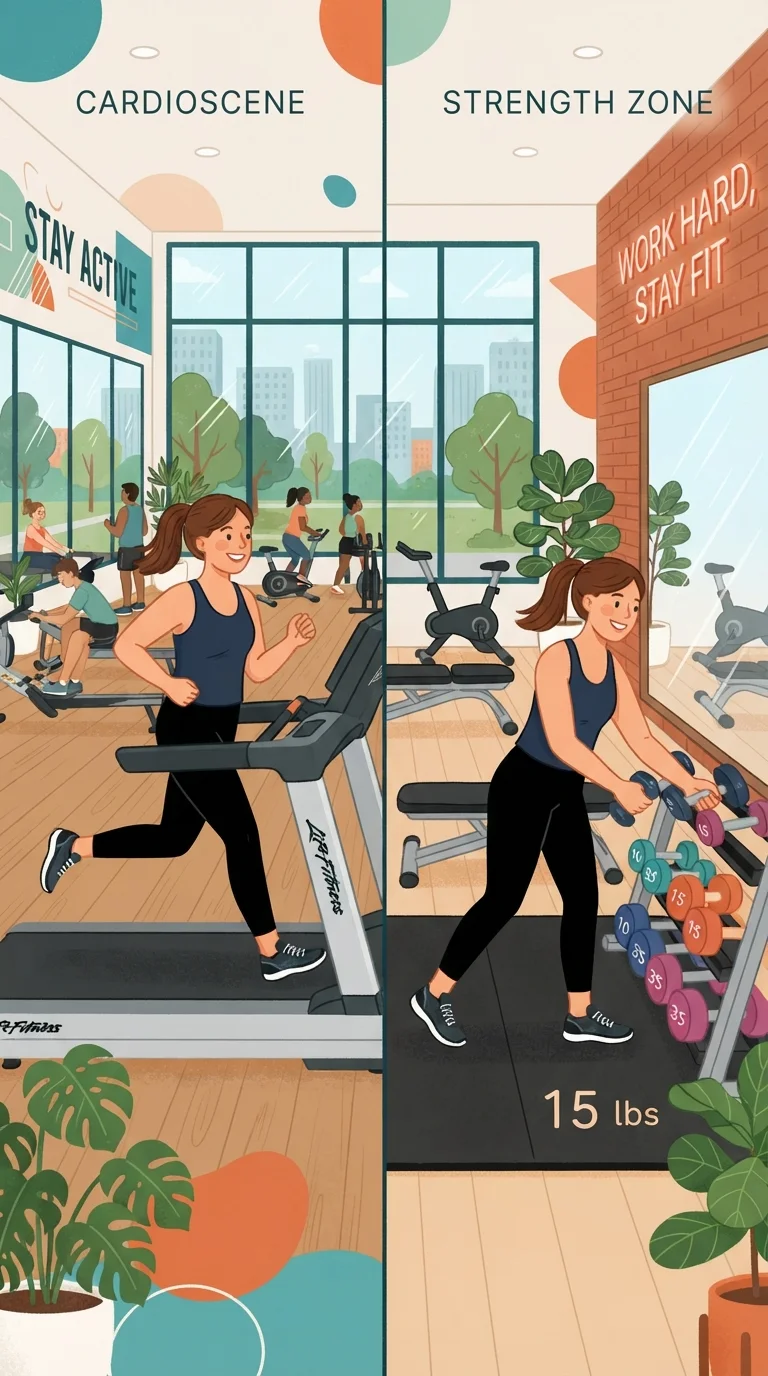
Key Takeaways
- Cardio and strength training address different but equally important aspects of physical health.
- Research consistently supports combining both modalities for better long-term health outcomes.
- Most adults do not need to choose - a balanced routine can incorporate both without extreme time commitments.
- Neither type of exercise is inherently superior; individual goals and health context should guide priorities.
- Consistency over intensity is the most reliable predictor of long-term fitness success.
Option A
Cardio Training
The heart-health foundation most people start with.
Best for: People looking to improve cardiovascular endurance, manage weight, and support mood and energy levels.
Option B
Strength Training
The muscle-building complement that often gets overlooked.
Best for: People aiming to build lean muscle, support bone density, boost metabolism, and improve functional everyday movement.
If your primary goal is heart health and endurance
Cardio Training
Aerobic exercise directly trains the cardiovascular system, improving heart efficiency, lung capacity, and circulation. It remains the most evidence-supported approach for reducing cardiovascular disease risk.
If you want to preserve muscle and support long-term metabolism
Strength Training
Muscle mass naturally declines with age. Resistance training helps slow that loss, supports bone density, and maintains the metabolic activity that makes everyday movement easier.
If you want the most comprehensive health benefits from exercise
Cardio Training
A routine that blends both types - even in modest amounts - consistently outperforms either approach alone in studies examining longevity, body composition, and functional fitness. Start with cardio if you can only pick one, then layer in strength work.
If you're short on time and need an efficient weekly routine
Strength Training
Two to three strength sessions per week can deliver meaningful health benefits. Compound movements naturally elevate heart rate, offering some cardiovascular benefit alongside muscle development.
Why the Either-Or Framing Doesn't Hold Up
Walk into any conversation about fitness and you'll encounter it quickly: the implied competition between cardio and strength training. Runners dismiss lifting. Lifters dismiss running. Both camps can make the other feel like a lesser choice. But the research tells a more practical story - one where most people benefit from both, and the real problem is treating them as mutually exclusive.
The American Heart Association and the U.S. Department of Health and Human Services both recommend that adults aim for a combination of aerobic activity and muscle-strengthening exercise each week. The framing isn't cardio or strength - it's how much of each fits your life. If you've been putting off strength work because you assumed it would undermine your cardio, or skipping cardio because you thought lifting covered it, that assumption is worth revisiting.
Understanding why fitness routines lose momentum often comes down to picking an approach that feels like a sacrifice from the start. When one type of exercise feels like a chore you're tolerating to get back to the other, adherence suffers.
What Each Type of Exercise Actually Does
Cardio - short for cardiovascular exercise - refers to sustained, rhythmic activity that raises your heart rate over time. Walking, cycling, swimming, and jogging are common examples. Its primary effect is on the heart and lungs: over time, aerobic training makes the heart pump more efficiently, lowers resting heart rate, and improves the body's ability to deliver oxygen to working muscles. These adaptations are associated with reduced risk of heart disease, type 2 diabetes, and certain chronic conditions.
Strength training - also called resistance training - uses load or resistance to challenge muscles, prompting them to adapt and grow stronger. This includes free weights, machines, resistance bands, and bodyweight exercises. Its effects extend beyond muscle: research links regular resistance training to improved bone mineral density, better blood sugar regulation, reduced injury risk, and enhanced functional movement in daily life. If you're new to lifting, a beginner-friendly introduction to strength training can help you start safely.
| Criterion | Cardio Training | Strength Training |
|---|---|---|
| Primary benefit | Heart and lung efficiency | Muscle and bone strength |
| Calorie burn during exercise | Generally higher per session | Lower during session |
| Metabolic effect at rest | Modest resting benefit | Elevated resting metabolism with muscle gain |
| Bone density impact | Moderate (weight-bearing only) | Strong, well-documented benefit |
| Equipment needed | Minimal (walking requires none) | Minimal to moderate (bodyweight viable) |
| Recommended frequency | Most days (150+ min/week moderate) | 2-3 days per week |
| Mood and mental health | Strong evidence for anxiety and depression | Growing evidence for similar benefits |
| Injury risk for beginners | Low with gradual progression | Low with proper form and guidance |
One nuance worth noting: the two categories overlap more than the gym-culture divide suggests. High-intensity interval training (HIIT) raises heart rate significantly while involving resistance elements. Circuit training blends both. Even moderate-paced strength sessions elevate heart rate enough to provide some aerobic benefit. The boundaries are less rigid in practice than in theory.
Building a Routine That Includes Both
The good news is that combining cardio and strength doesn't require a professional athlete's schedule. U.S. public health guidelines suggest roughly 150 minutes of moderate aerobic activity per week alongside two or more days of muscle-strengthening activity. That translates to about 30 minutes of walking on most days plus two strength sessions - a realistic baseline for most adults.
Sequencing matters less than consistency. Some people prefer to do cardio and strength on separate days; others combine them in a single session. Neither approach is definitively superior - what matters is that both get done regularly. Low-intensity aerobic training is one approachable way to build aerobic capacity without exhausting yourself before a strength session.
~30%
Reduced all-cause mortality risk
Adults who meet both aerobic and muscle-strengthening guidelines show roughly 30% lower all-cause mortality risk compared to inactive adults, according to research published in the British Journal of Sports Medicine.
3-8%
Muscle mass lost per decade after 30
Research estimates adults lose approximately 3-8% of muscle mass per decade from age 30 onward - a process resistance training can meaningfully slow.
150 min
Weekly aerobic activity recommended
U.S. Department of Health and Human Services Physical Activity Guidelines for Americans recommend at least 150 minutes of moderate-intensity aerobic activity weekly for substantial health benefits.
For those exercising at home, the equipment barrier is lower than it appears. Understanding what home workout equipment is actually worth having can help you build a functional setup without overcrowding your space. Similarly, bodyweight training can deliver meaningful strength results with no equipment at all.
If your goal is long-term health rather than competitive performance, the most important thing is choosing a sustainable mix - one that doesn't feel like a punishment. Exploring how walking and running differ in their effects is one useful way to find the cardio approach that fits your joints, schedule, and preferences.
This article is for general informational and educational purposes only and is not a substitute for professional medical advice. Consult a qualified healthcare provider before starting any new exercise program, especially if you have an existing health condition.