

Key Takeaways
- Drip irrigation delivers water directly to plant roots, reducing evaporation losses by up to 50% compared to sprinklers.
- Sprinkler systems are better suited for large lawn areas and ground cover where broad, even coverage is needed.
- Drip systems typically cost more to install per zone but can pay back through lower water bills over time.
- Both systems benefit from timers and soil moisture sensors to prevent overwatering.
- Your garden layout, plant types, and local water rates should drive the choice between the two approaches.
Our Verdict
Neither drip irrigation nor sprinkler systems is universally superior - each solves a distinct watering problem. Drip excels at precision watering for vegetable beds, shrubs, and trees, while sprinklers handle large turf areas efficiently. Many homeowners ultimately use a combination of both.
| Best for | Recommended |
|---|---|
| Vegetable gardens, raised beds, and established shrubs | Drip Irrigation |
| Lawns and large areas of ground cover | Sprinkler System |
| Water-scarce regions or homes with high water rates | Drip Irrigation |
| New homeowners wanting simple, all-in-one yard coverage | Sprinkler System |
How Each System Works
Understanding the mechanics of each system helps clarify why they perform so differently across garden types.
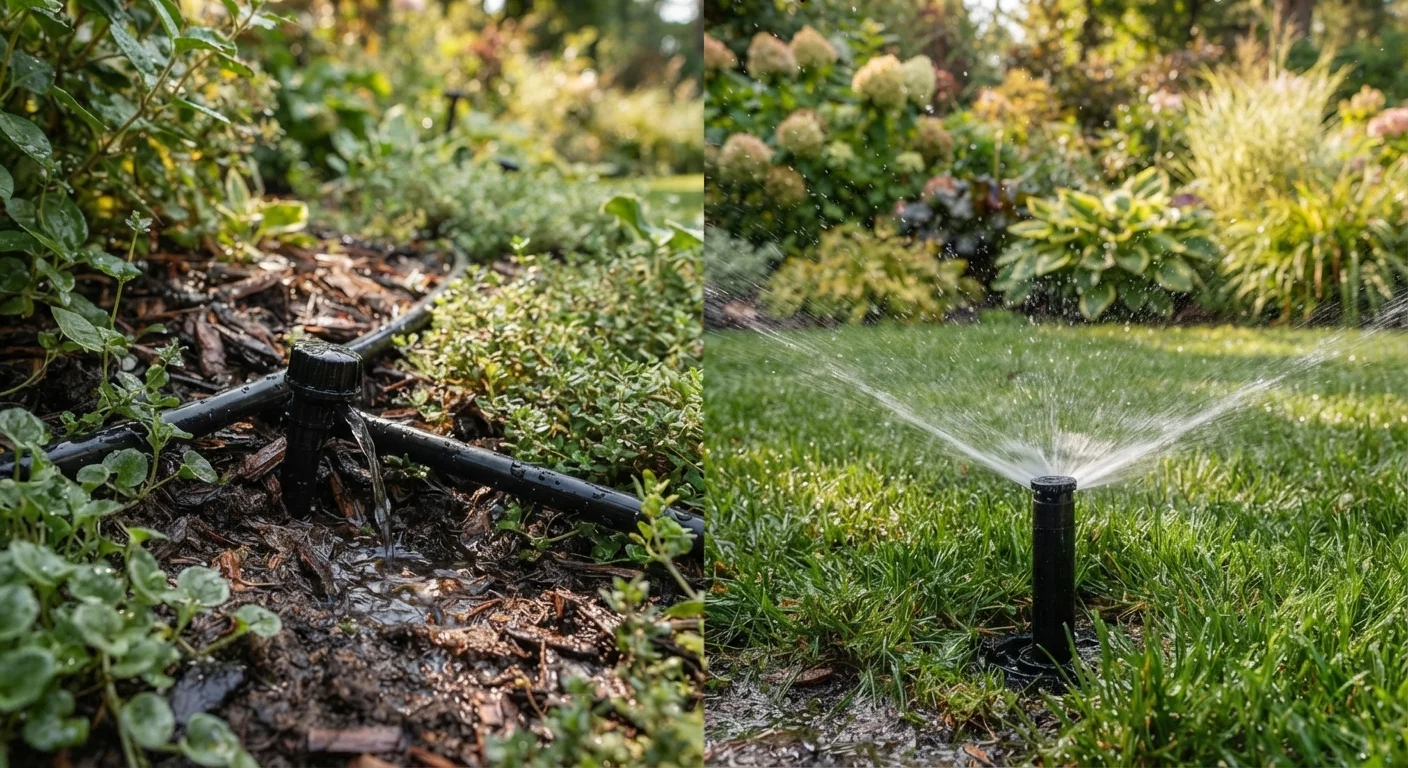
Drip irrigation runs low-pressure tubing along the soil surface or just below it, releasing water through small emitters placed near individual plant root zones. Flow rates are typically measured in gallons per hour (GPH) rather than gallons per minute, which reflects how slowly and precisely water is delivered. Because moisture goes directly to where roots can absorb it, far less is lost to evaporation or wind drift.
Sprinkler systems distribute water through pressurized heads that spray or rotate across an area. Pop-up heads are the most common residential choice for lawns; rotary heads cover wider radii. Coverage is broad and relatively uniform, which makes sprinklers practical for turf but less precise for mixed planting beds where different plants have different needs.
If you're already thinking about common watering mistakes to avoid, understanding these mechanics is a useful first step.
Water Efficiency: Where the Numbers Land
Water efficiency is often the deciding factor for homeowners in drought-prone regions or those looking to reduce utility costs.
30-50%
Water savings with drip vs. sprinkler
The EPA's WaterSense program estimates drip systems can use 30-50% less water than conventional sprinkler setups when properly installed.
50%
Outdoor water use lost to inefficiency
According to EPA estimates, roughly half of outdoor residential water use is wasted due to evaporation, wind, and overwatering.
Drip systems consistently outperform sprinklers on efficiency because they minimise surface evaporation, eliminate overspray onto pavement or structures, and can be paused or adjusted zone by zone. Sprinkler systems, by contrast, lose a meaningful share of applied water to evaporation - particularly when they run during midday heat or on windy days.
That said, sprinkler efficiency has improved considerably. Pressure-regulating heads, matched precipitation rate nozzles, and smart controllers with weather-based scheduling all help close the gap. A well-designed, properly timed sprinkler system will outperform a poorly maintained drip setup every time.
Lawn water costs add up faster than most homeowners expect, which is worth factoring in before committing to a system.
Installation Complexity and Cost
Both systems involve upfront investment in materials and, depending on yard size, possibly professional labor.
| Drip Irrigation | Sprinkler System | |
|---|---|---|
| Typical efficiency | 90-95% water applied to roots | 70-80% with well-designed heads |
| Best use case | Beds, shrubs, trees, vegetables | Lawns and broad ground cover |
| DIY installation ease | Moderate - no trenching needed | Complex - trenching usually required |
| Upfront cost (typical residential) | Lower per zone for small areas | Higher due to labor and trenching |
| Ongoing maintenance | Emitter flushing, line checks | Seasonal start-up and winterization |
| Wind and evaporation loss | Minimal - ground-level delivery | Moderate to high in wind or heat |
Drip systems are modular and relatively DIY-friendly for small gardens - basic kits are widely available and require no trenching. Scaling up to cover larger properties or integrating with an existing irrigation controller adds complexity. Emitters can also clog, particularly in areas with hard water, making periodic flushing part of routine upkeep.
Sprinkler systems for lawns typically require trenching for underground supply lines, which usually calls for professional installation unless the homeowner has relevant experience. Once installed, however, in-ground systems are largely out of sight and out of mind, requiring mainly seasonal start-up and winterization. Note that any work connecting to your home's main water supply line should be handled by a licensed plumber or irrigation professional, and local permits may apply - check your municipality's requirements before starting.
Which Plants and Landscapes Benefit Most
Matching the right system to your specific planting scenario is more important than choosing based on cost alone.
Drip irrigation works best for:
- Vegetable gardens and annual flower beds - raised beds and in-ground plots alike benefit from targeted root-zone watering
- Established trees and shrubs, where deep, slow watering encourages strong root development
- Hillside or sloped areas where sprinkler runoff would be significant
- Container plantings and greenhouse setups requiring precise moisture control
Sprinkler systems work best for:
- Lawns, particularly cool-season grasses that prefer overhead watering
- Large open areas of ground cover or mixed annual beds
- Newly seeded or sodded areas needing frequent, light moisture across wide surfaces
Many homeowners find that a hybrid approach - drip for planting beds and sprinklers for turf - delivers the best overall outcome. Combining them into a single controller with separate zones is straightforward with most modern irrigation systems.
Add a Soil Moisture Sensor for Either System
A soil moisture sensor - available at most hardware stores for under $30 - prevents both drip and sprinkler systems from running after rain or when the ground is already adequately moist. Pairing one with a programmable timer is one of the most cost-effective upgrades you can make to any irrigation setup, regardless of which system type you choose.