

Key Takeaways
- The 50/30/20 rule divides after-tax income into needs, wants, and savings using three broad percentages.
- Envelope budgeting assigns a fixed dollar amount to each spending category before the month begins.
- The 50/30/20 rule offers flexibility; envelope budgeting offers precision and firm category limits.
- Neither method requires a specific income level - both can be adapted to most household budgets.
- Hybrid approaches, such as using 50/30/20 allocations to fund envelopes, are a practical option for many readers.
- The best budgeting framework is one you will consistently use, not the one that looks best on paper.
Option A
The 50/30/20 Rule
The flexible, big-picture percentage framework.
Best for: People who want broad spending guidelines without tracking every dollar category by category.
Option B
Envelope Budgeting
The tactile, category-by-category cash control system.
Best for: People who struggle with overspending in specific categories and benefit from a physical or firm spending boundary.
If you want a low-maintenance budget with room for lifestyle flexibility
The 50/30/20 Rule
The three-category structure requires minimal tracking and gives you freedom within each broad bucket, making it easier to sustain long-term.
If you consistently overspend in specific categories like dining or entertainment
Envelope Budgeting
Hard per-category limits - whether in physical cash or a digital equivalent - remove ambiguity and prevent one category from draining another.
If you are building your very first budget and want a simple starting point
The 50/30/20 Rule
Broad buckets lower the barrier to entry; you can layer in more granularity later as you get comfortable tracking your spending.
If you primarily use cash or a debit card and want real-time spending awareness
Envelope Budgeting
Physical envelopes make your remaining balance visible at a glance, reducing the need to check an app or spreadsheet throughout the month.
If your income is irregular or varies month to month
Envelope Budgeting
Funding envelopes based on actual income received each pay period makes it easier to adapt your spending limits when income fluctuates.
How Each Framework Works
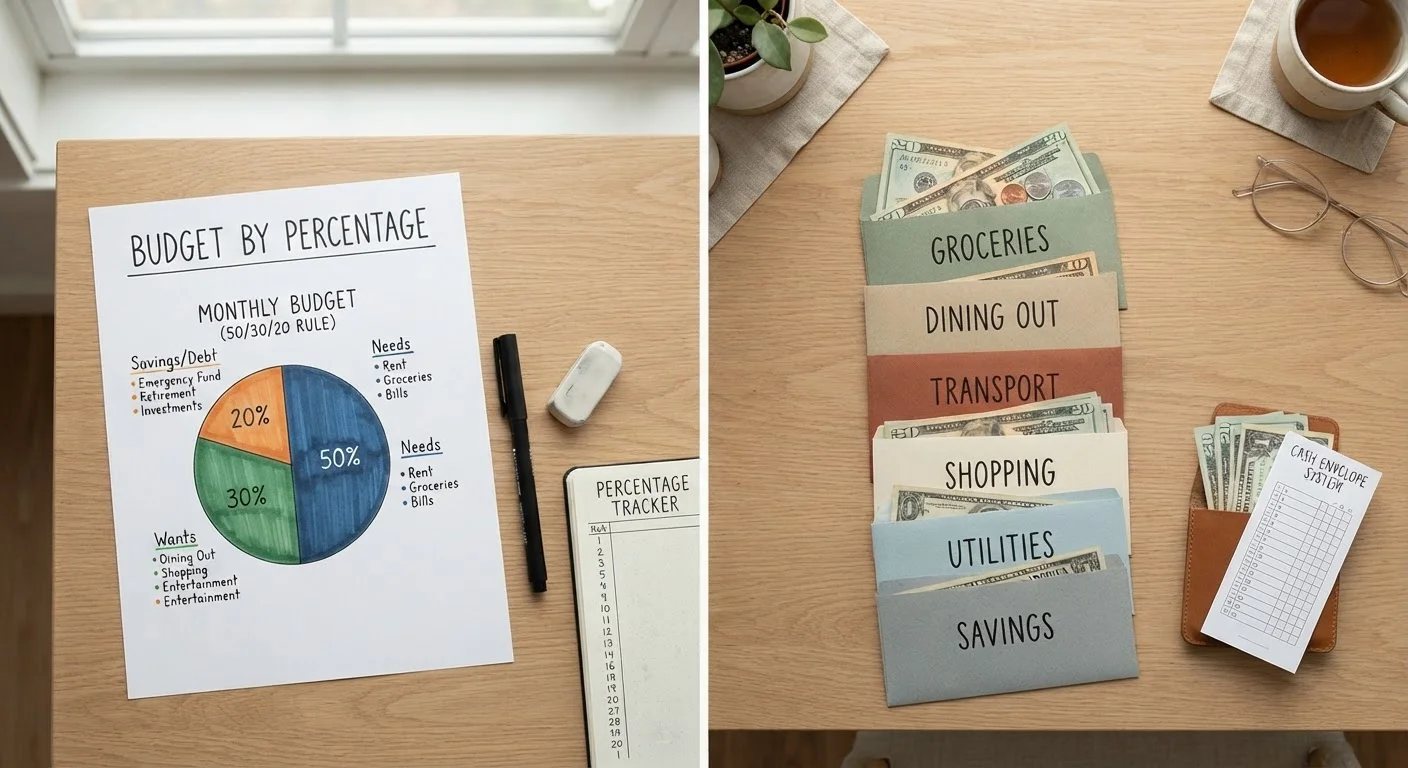
The 50/30/20 rule - popularized by Senator Elizabeth Warren and her daughter Amelia Warren Tyagi in their 2005 book All Your Worth - divides your monthly after-tax income into three categories: 50% toward needs (housing, utilities, groceries, minimum debt payments), 30% toward wants (dining out, subscriptions, hobbies), and 20% toward savings and debt repayment beyond minimums. The percentages are targets, not rigid laws. The framework's core value is simplicity: it asks you to sort spending into three buckets and check whether the proportions feel sustainable.
Envelope budgeting predates the 50/30/20 rule by decades and works on a different principle entirely. At the start of each month (or pay period), you divide your expected income into a set of labeled spending categories - groceries, rent, transportation, entertainment, clothing, and so on. Each category gets a fixed dollar amount. Traditionally, this meant placing physical cash into paper envelopes; today, many people replicate the system digitally. The rule is simple: when an envelope is empty, spending in that category stops for the month.
If you're just starting to think about monthly cash flow, our guide to building your first monthly budget walks through the foundational concepts both methods rely on.
| Criterion | 50/30/20 Rule | Envelope Budgeting |
|---|---|---|
| Setup effort | Low - three categories only | Moderate - 10-15 categories typical |
| Day-to-day tracking | Minimal - periodic check-ins | Active - update each envelope per purchase |
| Flexibility | High - broad buckets absorb variation | Low - firm per-category limits |
| Overspending prevention | Moderate - patterns may be masked | Strong - empty envelope is a hard stop |
| Suits irregular income | Less naturally - percentages assume stable income | Well - fund envelopes from actual income received |
| Best payment method | Any - cash, card, digital | Traditionally cash; digital apps available |
| Learning curve | Shallow - intuitive percentages | Steeper - requires category planning upfront |
Where Each Method Excels - and Where It Struggles
The 50/30/20 rule's greatest strength is its low friction. Because it uses broad categories, you don't need to decide in advance whether a given restaurant meal counts as a grocery or entertainment expense. That flexibility makes it approachable, particularly for readers who find granular tracking burdensome. The tradeoff: the broad buckets can mask problem spending. Someone who overspends on dining may still hit their 30% wants target by underspending elsewhere - and never notice the pattern.
Envelope budgeting's strength is precisely where the 50/30/20 rule is weakest. By isolating each spending category, it surfaces exactly where money is going and creates a hard stop before you overspend. Research in behavioral economics consistently shows that people spend more when using abstract payment methods than when physical money changes hands - envelopes exploit that tendency in your favor. The challenge is setup complexity: creating and maintaining 10-15 spending categories requires more upfront effort, and rigid categories can feel punishing when unexpected spending doesn't fit neatly into any envelope.
~33%
Americans with no written budget
A Gallup poll found roughly one-third of U.S. adults do not maintain a household budget, underscoring how many people manage spending without any formal framework.
20%
Savings target in the 50/30/20 rule
The Federal Reserve's Report on the Economic Well-Being of U.S. Households consistently finds many Americans saving less than this threshold, highlighting the gap between guideline and reality.
For a deeper look at how structure - rather than sheer willpower - determines budgeting success, see how to design a spending system that reduces decision fatigue.
Comparing the Two Side by Side
The table above maps both frameworks across the dimensions most readers care about: setup effort, day-to-day maintenance, flexibility, and suitability for different income types. A few points deserve elaboration:
- Income variability: Envelope budgeting adapts naturally to irregular income because you fund each envelope based on what you actually received, rather than a fixed percentage of an estimated monthly figure.
- Digital vs. cash households: The 50/30/20 rule works equally well whether you pay with cash, card, or digital wallet. Traditional envelope budgeting requires cash handling, though apps and digital equivalents have largely solved this limitation.
- Hybrid use: Many households use the 50/30/20 framework to set their overall allocation, then use envelopes (physical or digital) within the wants and needs buckets to control category-level spending. This approach preserves the simplicity of percentage targets while adding the precision of per-category limits.
For a comparison of the 50/30/20 approach against another structured method, see The 50/30/20 Rule vs. Zero-Based Budgeting. And if you're weighing whether to use physical envelopes or a digital tracking app, Envelope Budgeting vs. Digital Tracking Apps offers a practical side-by-side.
This article is for general informational purposes only and does not constitute personalized financial advice. Consult a qualified financial professional before making decisions specific to your situation.