

| Clearance: Product Condition | Typically new; markdown driven by retailer inventory decisions |
| Closeout: Product Condition | Typically new; product line discontinued at manufacturer level |
| Open-Box: Product Condition | Varies; packaging opened and product previously handled |
| Return Policy Risk | Higher for all three vs. regular merchandise; open-box often sold as-is |
| Long-Term Support Risk | Highest for closeout; parts and warranty service may be unavailable |
| Discount Depth | Closeout and open-box often deepest; clearance varies by markdown stage |
Three Labels, Three Different Situations
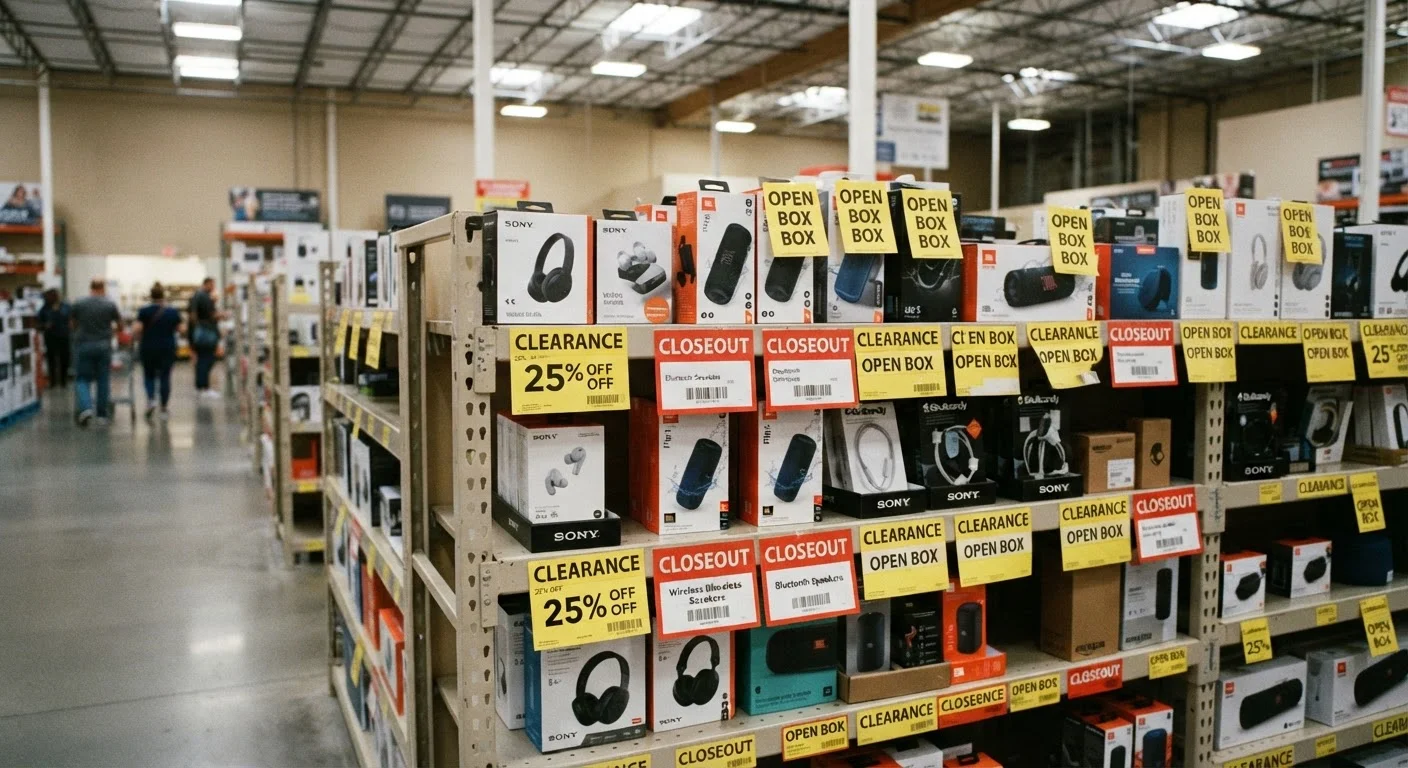
Walk through any big-box store or scroll a retail website and you'll encounter at least one of these terms: clearance, closeout, or open-box. Retailers use them to signal a discount, but each one describes a fundamentally different situation. Treating them as interchangeable can lead to unpleasant surprises - particularly around return eligibility and product condition.
| Clearance: Product Condition | Typically new; markdown driven by retailer inventory decisions |
| Closeout: Product Condition | Typically new; product line discontinued at manufacturer level |
| Open-Box: Product Condition | Varies; packaging opened and product previously handled |
| Return Policy Risk | Higher for all three vs. regular merchandise; open-box often sold as-is |
| Long-Term Support Risk | Highest for closeout; parts and warranty service may be unavailable |
| Discount Depth | Closeout and open-box often deepest; clearance varies by markdown stage |
Understanding what each label actually signals - rather than just assuming "discount" - puts you in a stronger position before committing to a purchase. For a broader grounding in retail discount mechanics, see the Avoiding Consumer Traps hub and the companion piece on common misbeliefs about clearance and outlet shopping.
Clearance: The Store Is Moving On
Clearance means the retailer has decided to discontinue carrying a specific item - typically to free up shelf space for new inventory. The product itself is often perfectly new and undamaged; the issue is the store's inventory management, not the item's quality.
Key things to understand about clearance merchandise:
- It's retailer-driven, not manufacturer-driven. A product going clearance at one chain may still be sold at full price elsewhere.
- Prices may drop in stages. Many retailers apply progressive markdowns - an item may start at 20% off and fall to 50% or more as weeks pass.
- Return policies often differ. Some retailers restrict clearance returns to store credit only or shorten the return window significantly. Always check before purchasing.
- Stock is finite and not replenished. Once it's gone, that location won't reorder it.
Clearance is generally the lowest-risk of the three label types from a product-condition standpoint, since the item usually hasn't been used. That said, packaging may be damaged from shelf wear, and accessories or documentation might be missing if items were display units.
Closeout: End of the Line for the Product Itself
Closeout merchandise is being discontinued at the manufacturer or distributor level - meaning the product line is ending, inventory is being liquidated, or a supplier relationship has concluded. Closeout goods often move through discount retailers, liquidators, or dedicated closeout sections of major chains.
Clearance
A retailer's decision to discontinue stocking a specific product, typically to free up shelf or warehouse space. The item is usually new and undamaged; the markdown reflects inventory strategy rather than product condition.
Closeout
Merchandise being liquidated because the product line is ending at the manufacturer or distributor level. Closeout items are generally new but may lack ongoing accessory support or warranty service.
Open-Box
A product whose original packaging has been opened - by a returned customer, during inspection, or as a display unit. Condition varies widely and responsible retailers grade open-box items by inspection results.
Condition Grade
A retailer-assigned classification for open-box or refurbished items (e.g., Excellent, Good, Fair) that describes the degree of cosmetic wear and whether all original contents are present.
Liquidation
The process of selling off inventory quickly, often at steep discounts, to recover capital. Closeout merchandise is commonly sold through liquidation channels.
As-Is Sale
A purchase made with no return or exchange rights. Open-box and closeout items are frequently sold as-is; always confirm the return terms before completing a transaction.
The practical implications for shoppers:
- No future restocking or replacement parts. If you need a replacement component later - a filter, a battery, a charger - it may simply not exist. This is especially relevant for appliances and electronics.
- Warranty service may be complicated. If a manufacturer has discontinued a line, honoring warranties can become uncertain. Check whether the warranty is backed by a third party or remains active through authorized service centers.
- Items are typically new, not used. Closeout does not indicate the product was returned or tested - it refers to the product's market status, not its physical condition.
- Pricing can be genuinely deep. Because sellers need to liquidate inventory, closeout prices often represent real reductions rather than inflated reference prices.
Closeout purchases make the most sense for consumable or standalone items - things that don't require ongoing accessory support or manufacturer service. For more complex purchases, weigh the risk carefully.
Open-Box: Previously Handled, Varying Condition
Open-box items have had their original packaging opened - by a previous customer, a store associate, or during an inspection process. The key distinction from the other two labels is that the product's physical condition is the variable, not its market status.
Open-box condition is not uniform. Responsible retailers grade their open-box inventory; others do not. When grades are provided, they typically run along these lines:
| Grade | What It Usually Means |
|---|---|
| Excellent / Like New | Opened but unused; all original contents included |
| Good / Certified | Minor cosmetic wear; tested and functional; may have missing accessories |
| Fair / Scratch & Dent | Visible cosmetic damage; functionality verified but appearance compromised |
When no grading system is provided, ask a store associate about the inspection process - or factor in additional risk accordingly. Return policies on open-box items vary widely; some retailers offer a short return window, others sell them as-is with no returns. Always confirm before purchasing.
Open-box is particularly worth evaluating for electronics and appliances, where a small cosmetic flaw can translate into a meaningful price reduction on a fully functional product. For guidance on how return policies interact with these purchases, see reading a retail return policy without getting caught off guard.
Comparing All Three: What to Verify Before You Buy
Each label carries different risks and different opportunities. Here's a practical framework for evaluating any discounted purchase under these categories:
- Confirm the physical condition. Clearance and closeout are usually new; open-box requires direct inspection or a verified grade.
- Check the return policy before, not after, purchase. All three labels commonly come with modified return terms. The return policy article covers what clauses to look for.
- Assess long-term support needs. Closeout items especially warrant consideration of parts, accessories, and warranty coverage.
- Compare to other savings tools. A clearance price isn't always the floor - stacking eligible promotions may reduce costs further. See how cashback, coupons, and promo codes work for context on combining savings methods.
- Weigh in-store versus online availability. Clearance and open-box stock often differ significantly between channels. The in-store vs. online deal hunting guide outlines when each channel has an edge.
None of these labels is inherently good or bad - they're signals. Knowing what each one actually communicates lets you decide whether the trade-offs make sense for your specific purchase.