

Key Takeaways
- In-store shopping gives you tactile confidence and eliminates shipping delays, but rewards those willing to browse unpredictably.
- Online deal hunting offers price transparency and comparison tools, but requires vigilance against inflated reference prices.
- Neither channel is universally cheaper - your savings depend heavily on timing, category, and strategy.
- Combining both approaches strategically often yields better results than committing exclusively to one.
- Hidden costs like shipping, fuel, and impulse purchases can quietly erode apparent savings on either side.
Our Verdict
In-store and online deal hunting are genuinely complementary rather than competitive. Shoppers who treat them as interchangeable tools - rather than picking a side - tend to find consistently better prices. The right channel depends on the product category, time pressure, and how much verification the purchase warrants.
| Best for | Recommended |
|---|---|
| Shoppers who value tactile inspection and immediate possession | In-Store |
| Those comparing prices across many sellers with flexible delivery timelines | Online |
| Deal hunters working with limited time who need to automate search | Online |
| Buyers pursuing clearance, open-box, or end-of-season markdown items | In-Store |
Why the Channel You Choose Matters More Than You Might Think
Most shoppers drift between in-store and online shopping based on convenience rather than strategy. That's a missed opportunity. Each channel has structural advantages that, when deliberately exploited, can produce meaningfully different outcomes on the same purchase. Before defaulting to whichever is habitual, it's worth understanding what you're actually trading away.
Start with the fundamentals: building consistent deal-finding habits means recognizing that pricing isn't uniform across channels, and that retailers often use different markdown strategies depending on where inventory lives. A clearance tag in a physical store and a "sale" banner on a product page are governed by entirely different logic.
The Real Advantages of In-Store Deal Hunting
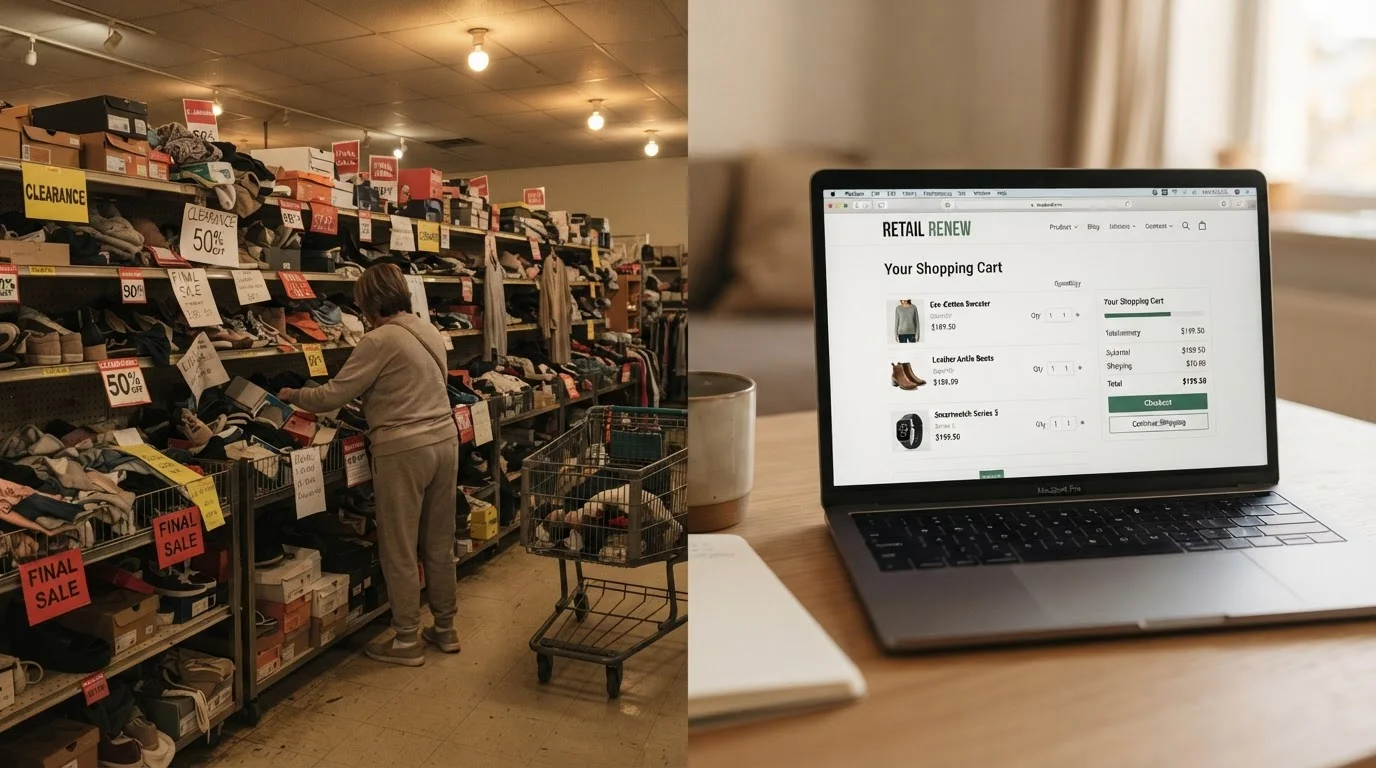
Physical retail has one underappreciated structural edge: clearance inventory is often priced to move fast, with markdowns that don't always appear online. End-of-aisle clearance, floor model sales, and seasonal resets can yield genuine discounts - not the manufactured urgency common in e-commerce. Understanding what clearance and closeout labels actually signal helps you evaluate whether that red tag represents real value or routine rotation.
Other concrete in-store advantages include:
- No shipping costs - the price on the shelf is the price you pay, barring tax.
- Immediate availability - no waiting, no tracking numbers, no delivery windows.
- Physical inspection - you can assess quality, fit, and condition directly, which matters most for clothing, produce, furniture, and appliances.
- Negotiation potential - particularly on floor models, open-box items, or visible damage, store associates often have discretion to apply additional markdowns.
The trade-off is time. Productive in-store deal hunting typically requires flexibility - visiting stores when markdowns are freshest (often mid-week and early morning) and being willing to leave empty-handed when inventory doesn't deliver.
| In-Store | Online | |
|---|---|---|
| Price transparency | Limited - requires physical visits to compare | High - comparison tools and price history available |
| Clearance depth | Often deeper; floor space creates markdown urgency | Variable; "sale" prices may be inflated baselines |
| Shipping cost | None | Can erode savings; free shipping often requires minimums |
| Item inspection | Direct tactile evaluation possible | Relies on photos, specs, and reviews |
| Time investment | Higher - physical travel required | Lower - searchable from home |
| Stacking savings | Limited stacking options | Codes, cashback, and card rewards often combinable |
| Impulse purchase risk | Higher - curated store layouts encourage browsing | Moderate - recommendations and retargeting ads |
| Returns ease | Generally straightforward at customer service desk | Varies significantly by retailer; can be cumbersome |
Where Online Shopping Holds a Structural Edge
The online channel's core advantage is price transparency. Comparing prices across multiple sellers takes seconds, and tools like browser extensions can surface historical price data that exposes whether a "sale" is genuine. This directly addresses one of the most common retail tactics: inflated reference prices. Our guide to how reference pricing works explains how to tell a real markdown from theater - a skill that pays dividends specifically in online environments where "was" prices are easy to fabricate.
Other structural online advantages:
- Search and filter efficiency - find specific items without physically traversing a store.
- Stackable savings - promo codes, cashback portals, and credit card rewards can often be combined. See how stacking discounts works in practice.
- Price tracking - automated alerts notify you when a watched item drops to your target price.
- Wider selection - especially useful for niche or specialty items unavailable locally.
The primary drawbacks are shipping costs, delivery timelines, and the inability to inspect the item before committing. Return processes also vary significantly, and some online sellers make returns deliberately difficult. For privacy considerations around account creation, understanding what account registration actually costs you is worth a look.
Use Online Prices as In-Store Leverage
If you've found a lower price online, many retailers will price-match it at the register - even at checkout. Pull up the competing listing on your phone before approaching the counter. This tactic works particularly well for electronics and appliances, where price differences between channels are most common. Always check the retailer's price-match policy before assuming it applies.
Building a Hybrid Approach That Actually Works
The sharpest deal hunters don't pick a channel - they match the channel to the purchase type. A few practical frameworks:
- High-touch categories (mattresses, shoes, produce, furniture): default to in-store for initial evaluation, then check online for competitive pricing before committing.
- Commodity and electronics purchases: online price comparison tools and historical price data provide a genuine information advantage. Verify you're looking at a real discount, not a manufactured one - separating real savings from marketing noise covers the key signals.
- Clearance and seasonal items: in-store clearance often moves faster than online equivalents and isn't always reflected on retailer websites.
- Subscription or repeat purchases: online subscriptions with auto-ship discounts can beat one-time in-store prices for predictable consumables.
One caution worth naming: the effort of deal hunting itself has a cost. Building a low-effort savings routine is often more effective than chasing every opportunity across both channels. Focus your energy where your actual spending is heaviest, and let the channel choice follow from that.
This article is for general informational purposes only and does not constitute financial or purchasing advice. Individual results will vary based on retailer, location, timing, and product category.