

Key Takeaways
- Shipping fees cover carrier costs; handling fees cover the retailer's labor and materials to prepare your order.
- "Free shipping" is rarely free - its cost is typically built into the item price or requires a minimum purchase threshold.
- Service and convenience fees on marketplace platforms are common and generally non-negotiable.
- Reviewing the order summary page before submitting payment is the most reliable way to catch unexpected charges.
- Sales tax on online purchases is now collected in most U.S. states following the 2018 South Dakota v. Wayfair Supreme Court ruling.
E-Commerce Add-On Fees
E-commerce add-on fees are charges beyond an item's listed price that appear during or after the checkout process. They include costs like shipping, handling, service fees, and taxes - each covering a different part of the transaction. These fees can significantly increase the total amount you pay compared to what was advertised.
Some fees, such as marketplace service fees, are set by the platform and passed to the buyer; others, like dimensional weight shipping surcharges, are set by carriers based on package size rather than actual weight.
Shipping Fees: What You're Actually Paying For
Shipping fees are the most visible add-on cost in online shopping, yet they're also among the least understood. The charge on your receipt doesn't go directly to the retailer - it's passed (in full or in part) to the carrier that physically moves your package from a warehouse to your door.
Carrier rates are calculated using several variables: origin and destination ZIP codes, package weight, package dimensions, and the speed of service selected. This is why shipping costs for the same item can vary significantly depending on where you live. A buyer in a rural area may pay substantially more than one near a major distribution hub.
Flat-rate shipping, offered by some retailers, simplifies this by charging a fixed fee regardless of package weight - up to a limit. It's predictable, but it isn't always the cheapest option for small or lightweight items.
Check the Total Before You Commit
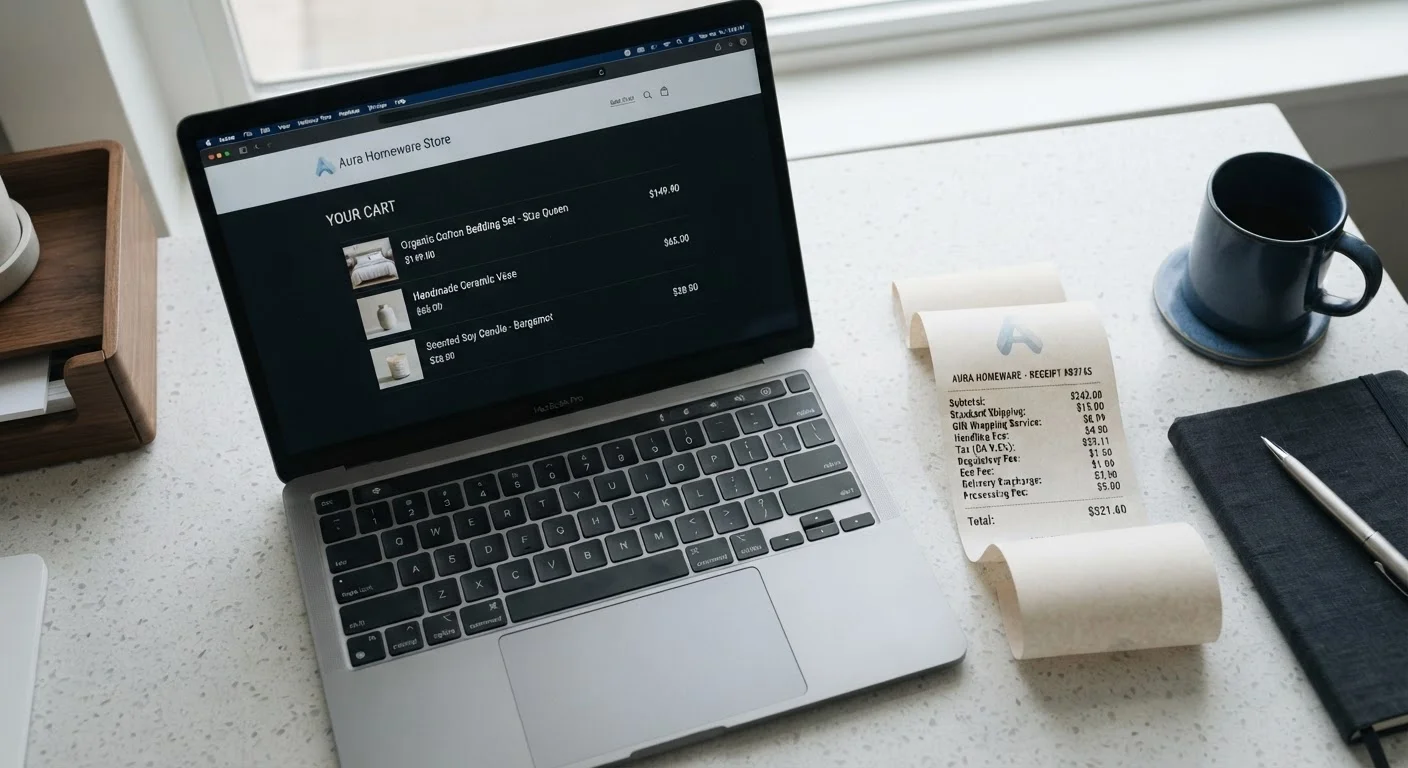
Most checkout flows reveal all fees on the final order summary page - before you click "Place Order." Take 30 seconds to review every line item at this stage. If a charge appears that wasn't disclosed earlier, look it up in the retailer's terms or FAQ before proceeding. You're under no obligation to complete a purchase after fees are revealed.
Understanding what drives shipping prices also helps explain why "free shipping" thresholds exist. When a retailer offers free shipping above a certain order total, they're essentially averaging the shipping cost across larger orders to make the math work. See our guide to shipping windows and delivery estimates for more on how fulfillment timelines factor in.
Handling Fees and Service Charges: The Less Obvious Costs
Handling fees appear on orders from a wide range of retailers, though they're more common on marketplace platforms and specialty sellers. They typically cover three things: the labor required to locate and pack your item, the cost of packaging materials (boxes, bubble wrap, tape), and general warehouse overhead.
Some retailers roll handling costs into a combined "shipping and handling" fee, making it difficult to separate the two. Others break them out on the order summary - which at least makes the cost transparent, even if it isn't negotiable.
Marketplace service fees work differently. Platforms that connect buyers with third-party sellers often add their own fee on top of the seller's price. This fee compensates the platform for payment processing, buyer protection programs, and infrastructure. It's set by the platform, not the seller, and is generally non-negotiable.
"Free Shipping" Is a Pricing Strategy
When a retailer offers free shipping - whether unconditionally or above a purchase threshold - the carrier's cost doesn't disappear. It's typically absorbed into item prices, funded by membership fees, or offset by higher minimum order requirements. This doesn't make free shipping offers a bad deal, but understanding the structure helps you evaluate them accurately.
For a broader look at how platform economics shape the prices you see, the explainer on how online pricing actually works covers dynamic pricing and algorithmic fee structures in detail.
Taxes and Regulatory Fees: The Legally Required Additions
Sales tax on online purchases is no longer optional for most U.S. retailers. Following the Supreme Court's 2018 decision in South Dakota v. Wayfair, states gained the authority to require online sellers to collect sales tax even without a physical presence in that state. Today, the vast majority of states enforce some form of online sales tax collection.
Tax rates vary by state and, in many cases, by county and city. Some categories - groceries, prescription drugs - are exempt in certain states, while others are taxed at the standard rate. The tax applied to your order is calculated based on your delivery address, not the retailer's location.
Regulatory fees are less common in standard retail but appear in specific categories: electronics recycling fees (required in many states for items like televisions and monitors), tire disposal fees for automotive purchases, and mattress recycling surcharges in states with take-back programs. These are mandated by law and are not retailer markups.
47 states
U.S. states collecting online sales tax
Following the 2018 South Dakota v. Wayfair Supreme Court ruling, the vast majority of U.S. states now require online retailers to collect sales tax at point of sale.
~$10-$15
Average U.S. e-commerce shipping cost per order
Industry estimates from logistics research firms suggest average per-order shipping costs in this range for standard domestic delivery, though costs vary widely by carrier, weight, and distance.
63%
Shoppers who abandon carts due to unexpected costs
According to the Baymard Institute's ongoing research into cart abandonment, unexpected extra costs - including shipping, taxes, and fees - are consistently cited as the leading reason shoppers leave before completing a purchase.
How to Spot and Evaluate Unexpected Charges
The most effective habit a consumer can build is reading the full order summary before clicking "Place Order." Many unexpected fees appear only at this stage - after you've already entered your payment details - which is a deliberate friction point in some checkout flows. Our guide to dark patterns on shopping websites explains how some of these design choices work against the consumer.
When reviewing a checkout page, look at each line item and ask whether it was disclosed anywhere earlier in the shopping experience. Legitimate fees should be explainable: carrier charges, tax calculated by address, handling disclosed in the seller's policies. Charges labeled vaguely - "processing fee," "convenience charge," "platform fee" - deserve scrutiny. Search the retailer's FAQ or terms of service for an explanation before completing the purchase.
For context on how these dynamics show up in other purchasing environments, similar fee structures exist in both vehicle dealerships and travel bookings - the categories differ, but the pattern of late-stage disclosure is consistent. Building the habit of reading the full itemized total before payment is one of the most straightforward ways to avoid paying more than you intended. For a broader framework on protecting yourself while shopping online, see our practical overview on shopping safely online.