

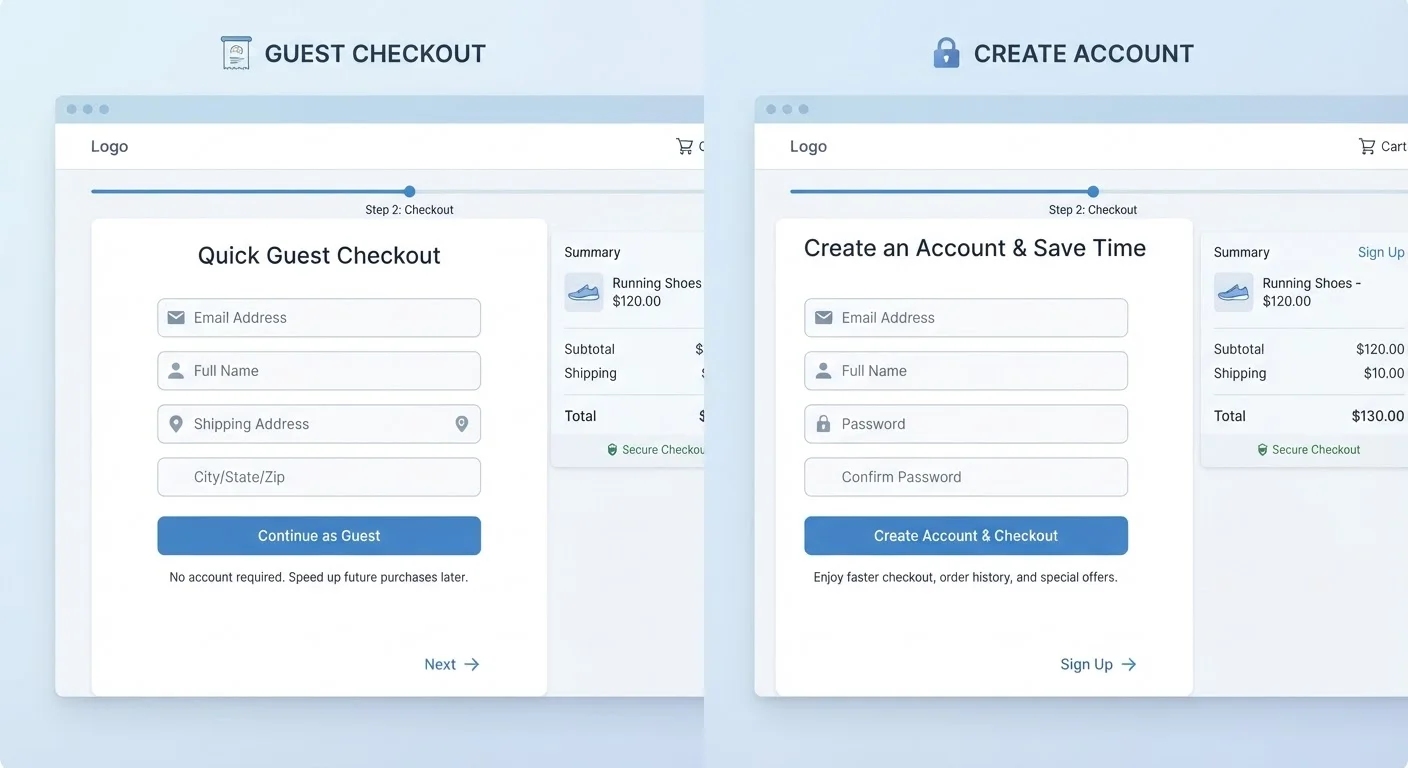
Key Takeaways
- Guest checkout limits the data a retailer retains about you after a transaction.
- Registered accounts typically offer easier returns, order tracking, and saved payment methods.
- Both options collect your payment and shipping data at the point of sale - neither is fully anonymous.
- Account holders are more exposed to targeted marketing and potential data breaches over time.
- The right choice depends on how often you shop with a particular retailer and what you value most.
Option A
Guest Checkout
The friction-free, one-and-done option.
Best for: Shoppers who want speed and minimal data sharing on a one-time purchase.
Option B
Account Registration
The long-term relationship with built-in convenience.
Best for: Frequent buyers who value order history, saved preferences, and streamlined returns.
If you're making a one-time purchase from an unfamiliar retailer
Guest Checkout
There's no benefit to registering with a site you may never revisit, and you minimize the data footprint you leave behind.
If you shop regularly at the same retailer
Account Registration
Saved addresses, order history, and streamlined returns add up to meaningful time savings over dozens of transactions.
If data privacy is your primary concern
Guest Checkout
Accounts accumulate behavioral data over time; guest checkout limits ongoing profiling after your order ships.
If you want easier dispute resolution or warranty claims
Account Registration
A logged-in purchase history provides a clear paper trail that's helpful if something goes wrong with your order.
The Illusion of the 'Safer' Option
Most shoppers assume guest checkout is the privacy-protective choice by default. That instinct isn't entirely wrong - but it's not the full picture either. When you check out as a guest, the retailer still collects your name, shipping address, email, and payment details to process the order. What changes is how long that data is retained and how it's used afterward.
With guest checkout, many retailers still link that transaction to your email address in their backend systems. You may not have a login, but you're not invisible. Expect a post-purchase marketing email regardless of which option you pick - retailers consider that fair game once you've submitted your email at checkout.
The real distinction isn't whether your data is collected - it's how much behavioral data accumulates over time. An account builds a profile: browsing history, wish lists, past purchases, returns, and product preferences. Guest checkout keeps each transaction relatively isolated. For a deeper look at how payment method choice also shapes your data exposure, see how digital wallets compare to card-on-file storage.
Both Options Share Your Email
A common misconception is that guest checkout keeps your email address out of a retailer's system. In practice, your email is required to send a receipt and is typically stored in the retailer's CRM. Many retailers use that email to match guest transactions across visits. Guest checkout limits account-based profiling, but it doesn't make you anonymous.
What You Give Up With Guest Checkout
Speed is the obvious upside of guest checkout - no password to remember, no verification email to confirm. But that convenience comes with real functional trade-offs that bite you later.
- No order history: If you need to reference a past purchase for a warranty claim or return, you're relying solely on the confirmation email you received. Lose that email, and your paper trail gets thin fast.
- Harder returns: Many retailers require an account login to initiate a return through their portal. Guest purchasers sometimes have to go through longer customer service processes.
- Can't save preferences: Size, fit notes, saved addresses, and payment methods all disappear the moment you close the browser. Every future purchase starts from scratch.
- Loyalty points left on the table: If a retailer runs a points or rewards program, guest purchases typically don't qualify. Frequent shoppers may forgo meaningful value over time.
If you're new to online shopping and still building confidence with e-commerce, this practical guide for first-time buyers covers how to protect yourself regardless of which checkout path you choose.
| Criterion | Guest Checkout | Account Registration |
|---|---|---|
| Data collected at checkout | Name, email, address, payment | Same, plus ongoing behavior |
| Order history access | Email confirmation only | Full in-account history |
| Returns process | Often requires customer service | Typically self-service via portal |
| Marketing exposure | Transactional emails only | Ongoing targeted marketing |
| Loyalty rewards eligibility | Usually excluded | Generally included |
| Data breach risk over time | Lower (isolated transaction) | Higher (cumulative profile) |
| Checkout speed on return visits | Same as first visit | Faster with saved details |
What You Give Up With Account Registration
Registering an account isn't a neutral act - it's an ongoing data relationship. Here's what that means in practice:
- Broader data profiling: Every click, search, and abandoned cart adds to a behavioral profile the retailer uses for targeting. That's how a site 'remembers' you were looking at something three weeks ago.
- Increased marketing exposure: Account holders typically receive more email, push notifications, and retargeting ads. Opt-out settings exist, but they require active management.
- Breach exposure: If the retailer suffers a data breach, account holders have more information at risk than one-time guest purchasers. Saved payment methods, purchase history, and personal details may all be compromised.
- Password fatigue: Another account means another set of credentials to manage securely. Reusing passwords across sites - a common habit - compounds risk.
The trade-offs here echo a broader pattern in consumer financial decisions. Just as choosing between cash and credit involves real behavioral trade-offs, your checkout method shapes what you expose and what you gain.
~30%
Cart abandonment linked to forced registration
Research from the Baymard Institute has consistently found that mandatory account creation is among the top reasons shoppers abandon carts before completing a purchase.
81%
Consumers concerned about how companies use their data
According to a Pew Research Center survey, the large majority of Americans feel they have little control over the data companies collect about them.
Making the Call: A Practical Framework
Neither option is universally superior. The right choice is situational, and these questions help clarify it quickly:
- How often will you shop here? If this is a one-off purchase from a niche retailer, guest checkout makes obvious sense. If you're on a site you use monthly, the convenience of an account compounds quickly.
- Does this retailer have a meaningful loyalty program? If points or member pricing are on offer, the math may favor registration - but only if you'll actually use those benefits.
- How sensitive is this purchase? Health products, personal care items, or anything you'd rather not see catalogued in a behavioral profile are reasonable candidates for guest checkout.
- How strong is this retailer's reputation? A well-established retailer with a clear privacy policy and breach response history poses a different risk profile than a lesser-known site. For broader context on navigating deal-hunting safely, see how in-store and online shopping each carry distinct trade-offs.
There's no single correct answer, but there is always a more deliberate one. Understanding what each path costs you - in data, convenience, or both - puts you in control of that choice.