

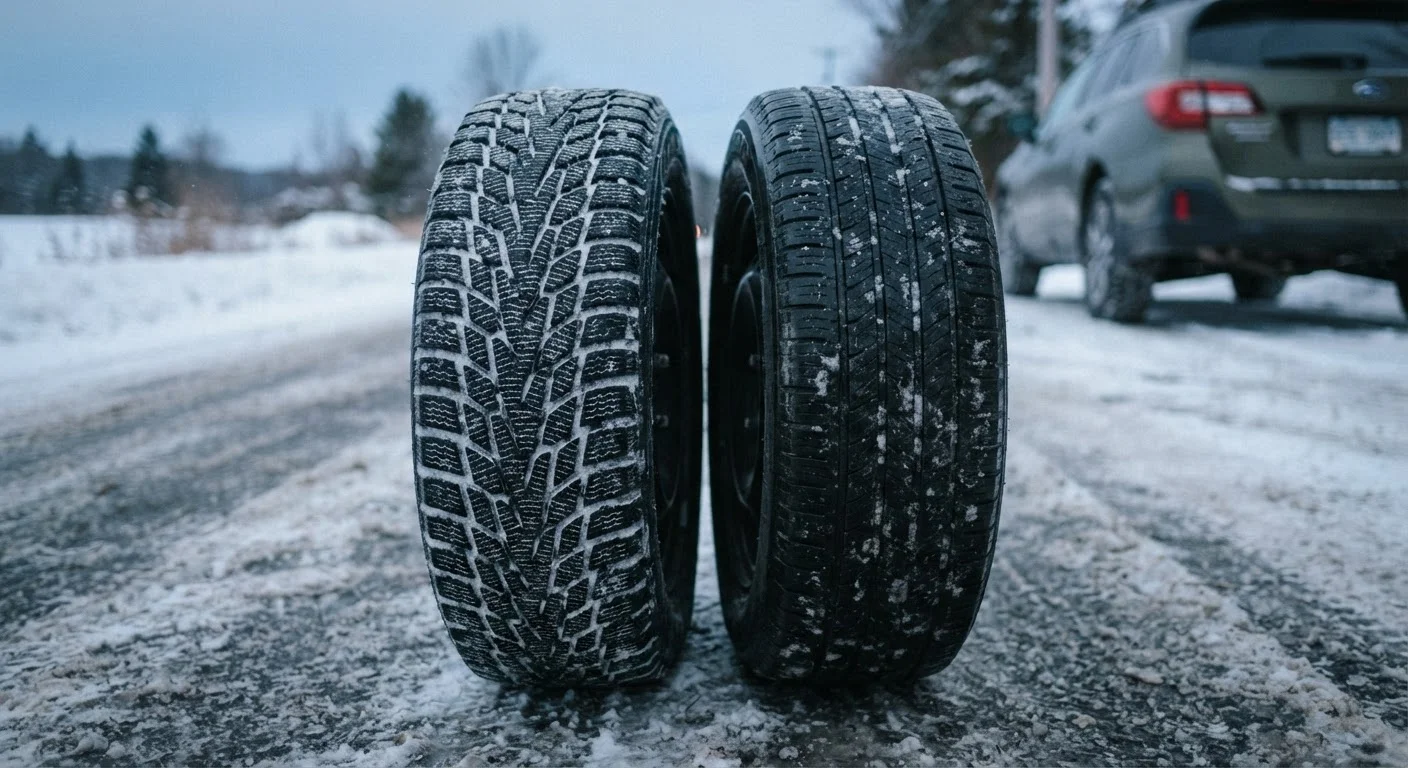
Key Takeaways
- Winter tires use a softer rubber compound that stays pliable below 45°F, giving them a significant grip advantage over all-season tires in cold conditions.
- All-season tires are a reasonable choice for mild winters, but they are not a substitute for dedicated winter tires on ice or packed snow.
- The mountain-snowflake symbol (3PMSF) on a tire indicates it has met minimum snow traction standards - the M+S marking alone does not.
- Switching to winter tires in cold months can extend the life of your all-season set by reducing wear during the harshest conditions.
- Stopping distances on ice and snow can be significantly longer with all-season tires compared to winter-rated alternatives.
Option A
Winter Tires
The cold-weather specialist engineered for ice and snow.
Best for: Drivers in regions that regularly experience temperatures below 45°F, snow accumulation, or icy roads.
Option B
All-Season Tires
The year-round generalist built for versatile, moderate conditions.
Best for: Drivers in mild climates with occasional rain and light cold, who prioritize convenience over peak winter grip.
If you live in the Midwest, Northeast, or any region with regular snow and ice
Winter Tires
Winter tires are purpose-built for these conditions, offering meaningfully shorter stopping distances and better steering response when temperatures drop and roads turn slippery.
If you live in a mild-winter climate with rare frost and no snow
All-Season Tires
All-season tires handle light cold and wet roads competently, and the added expense of a winter set is unlikely to be justified when severe conditions are uncommon.
If you drive in unpredictable weather that shifts between dry, wet, and occasionally icy
Winter Tires
Even a few icy commutes per season can represent real safety risk; winter tires provide a meaningful margin of control that all-season tires cannot match below 45°F.
If budget and storage space are limiting factors
All-Season Tires
All-season tires eliminate the need for a second set and seasonal swaps. In mild climates this trade-off is manageable, though drivers should reduce speed and increase following distance in winter conditions.
The Core Difference: Rubber Compound and Tread Design
The gap between winter and all-season tires isn't just about aggressive-looking tread - it starts with the rubber itself. All-season tires are formulated to stay firm and durable across a wide temperature range, from summer heat to light cold. That's a genuine engineering achievement, but it comes with a trade-off: as temperatures fall below roughly 45°F, the rubber compound begins to stiffen. A stiffer tire has less contact with the road surface, which reduces grip.
Winter tires use a different, softer compound that stays flexible in cold temperatures. This flexibility lets the tire conform to micro-irregularities in pavement, ice, and packed snow, creating more friction. Think of it like the difference between pressing a warm clay stamp versus a cold plastic one - one picks up detail, the other skips across the surface.
Tread design reinforces this advantage. Winter tires feature deep grooves and a high density of small cuts called sipes (pronounced like "sypes"). Sipes create thousands of biting edges that grip ice and channel slush away from the contact patch. All-season tires have sipes too, but far fewer, and their groove depth is designed to balance summer handling with moderate winter capability rather than optimize for either.
| Criterion | Winter Tires | All-Season Tires |
|---|---|---|
| Rubber compound | Stays soft below 45°F | Hardens in cold temperatures |
| Sipe density | High - thousands of biting edges | Moderate - balanced for year-round use |
| Snow traction symbol | 3PMSF certified | M+S only (most models) |
| Ice stopping distance | Shorter - notably superior | Longer - measurably reduced grip |
| Summer/warm-weather use | Not recommended - wears quickly | Well-suited year-round |
| Cost consideration | Higher upfront; offsets wear on both sets | One set; simpler but wears faster in winter |
| Best temperature range | Below 45°F | Above 45°F |
What the Labels Actually Tell You
Two symbols appear on tire sidewalls, and they mean very different things. The M+S marking (Mud and Snow) is a self-certification that manufacturers apply without independent testing. Many all-season tires carry it. It indicates some snow traction capability, but it does not guarantee meaningful performance on ice or heavy snow.
The Three-Peak Mountain Snowflake (3PMSF) symbol - a snowflake inside a mountain outline - requires the tire to pass a standardized acceleration test on snow conducted by an independent lab. Tires earning this symbol have demonstrated measurably better snow traction than a reference all-season tire. All certified winter tires carry this marking; some all-season and all-weather tires do as well, though they represent a distinct category.
All-Weather Tires: A Middle Ground
Some tire manufacturers produce all-weather tires - a distinct category from all-season - that earn the 3PMSF symbol while remaining suitable for year-round use. They offer better cold-weather grip than standard all-season tires but generally fall short of dedicated winter tires in severe ice or deep snow. They may be worth considering for drivers in moderate-winter climates who prefer not to manage two tire sets.
When shopping for tires, look for the 3PMSF symbol if cold-weather performance matters to your driving environment. The M+S label alone is not a reliable indicator of winter capability.
Real-World Performance: Stopping Distances and Control
Independent tire testing organizations have repeatedly documented that stopping distances on ice and compacted snow are substantially longer with all-season tires than with winter tires. While specific numbers vary by vehicle, tire model, and test conditions, the general finding is consistent: in genuine winter conditions, winter tires stop faster and maintain steering response better.
This matters beyond emergency braking. Traction affects how well your vehicle holds a corner, responds to steering input, and recovers from a slide. A vehicle equipped with winter tires behaves more predictably when roads are slippery, which gives the driver more time and options to react. For more context on how road surface changes your driving approach, see our guide to hazardous driving surfaces.
All-wheel drive (AWD) and four-wheel drive (4WD) systems help with acceleration on slippery surfaces but do little for braking or cornering. A common mistake is assuming AWD compensates for all-season tires in winter - it does not. Stopping ability depends almost entirely on tire compound and tread design, regardless of how many wheels are driven.
For technique-focused guidance on adapting to snowy roads, see how rain and snow demand different driving adjustments.
Cost, Convenience, and Long-Term Considerations
Running winter tires involves an upfront cost - purchasing a dedicated set, often mounted on a second set of wheels for easier seasonal swapping - plus the cost of twice-yearly installation or a DIY swap if you store tires at home. These are real expenses, but there's a practical offset: when you rotate between two tire sets, each set wears at roughly half the rate it otherwise would. Over several years, many drivers find the total tire cost is comparable to running a single all-season set to full wear.
Storage space is a genuine constraint for some drivers, particularly those in apartments or homes without garage access. Some tire shops offer storage programs, but these add recurring cost. For drivers in mild climates where temperatures rarely dip below 45°F and snow is a rare event, all-season tires are a reasonable, practical choice. The calculation shifts decisively toward winter tires for anyone facing regular cold commutes, mountain passes, or regions where road treatment can't keep up with snowfall.
Before winter arrives, tire condition should be part of a broader vehicle review. Our pre-winter inspection guide covers what to check beyond tires, including battery health, fluids, and braking systems.
45°F
Temperature threshold for winter tire advantage
Tire engineers and safety researchers consistently cite approximately 45°F as the point where all-season rubber begins to lose meaningful flexibility compared to winter compounds.
~38%
Shorter stopping distance on snow (winter vs. all-season)
Testing published by the Tire and Rim Association and independent consumer organizations has found winter tires can reduce stopping distances on packed snow by roughly a third compared to all-season alternatives, though results vary by conditions and vehicle.