

Key Takeaways
- Bodyweight training requires no equipment and can be done anywhere, making it highly accessible for beginners.
- Free weights offer more precise load progression, which can accelerate strength gains over time.
- Neither approach is universally superior - consistency and form matter far more than the tool used.
- Combining both methods is a practical strategy many people find sustainable long-term.
- Always consult a qualified fitness or healthcare professional before starting a new training program.
Our Verdict
Bodyweight training wins on accessibility, cost, and convenience - it removes nearly every barrier to getting started. Free weights excel when precise, incremental load progression becomes a priority. For most everyday Americans, the real answer lies not in choosing one over the other, but in selecting what you'll actually stick with consistently.
| Best for | Recommended |
|---|---|
| Those with limited budgets, space, or gym access | Bodyweight Training |
| Those focused on measurable strength progression and muscle building | Free Weights |
| Beginners looking for the lowest barrier to entry | Bodyweight Training |
| Experienced exercisers wanting a flexible, balanced routine | Combined Approach |
What Each Approach Actually Involves
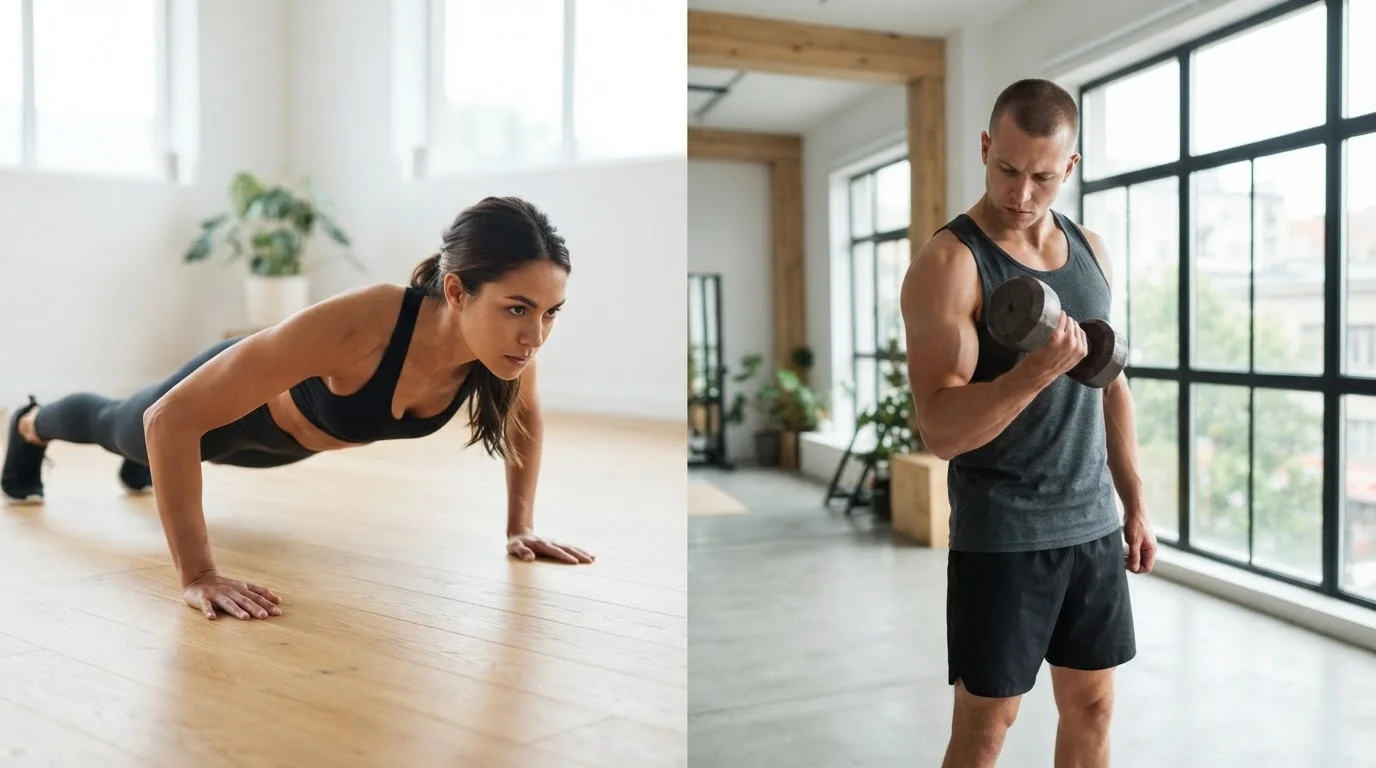
Bodyweight training uses your own body as resistance - think push-ups, squats, lunges, and planks. No gym membership, no equipment beyond a mat and perhaps a pull-up bar. Free weights, by contrast, involve external tools like dumbbells, kettlebells, or barbells to add resistance beyond what your body alone provides.
Both methods work by creating mechanical tension in the muscles, which stimulates them to adapt and grow stronger over time. The core physiology is the same; what differs is how you control and progress that tension. If you're newer to strength training altogether, the foundational guide to lifting for beginners is a useful place to build context before diving into either method.
Accessibility, Cost, and Convenience
Bodyweight training has an almost unbeatable practical advantage: it costs nothing and requires no dedicated space. A living room floor, a hotel room, or a local park all work equally well. For anyone put off by gym culture or working within a tight budget, this alone can be the deciding factor.
Free weights do require some upfront investment - a basic set of adjustable dumbbells ranges from modest to significant in cost depending on the weight range needed. They also need consistent storage and setup. That said, a small home setup can eliminate the commute and membership fees of a commercial gym entirely. See the guide to home workout essentials for a realistic look at what equipment genuinely earns its keep.
| Bodyweight Training | Free Weights | |
|---|---|---|
| Upfront Cost | Minimal to none | Moderate (equipment required) |
| Space Required | Very little - any flat surface | Dedicated storage area needed |
| Progression Method | Harder variations, tempo changes | Incremental load increases |
| Beginner-Friendliness | Very accessible, low barrier | Requires technique learning |
| Portability | Train anywhere, no equipment | Fixed to home or gym location |
| Long-Term Strength Ceiling | Requires creative programming | Easier to scale indefinitely |
Progression and Long-Term Strength Development
One of free weights' clearest advantages is load incrementality - adding 2.5 or 5 pounds to a dumbbell is straightforward and measurable. This precision matters as your body adapts and needs new stimulus to keep improving. Bodyweight progression is possible but requires more creativity: moving to harder variations (e.g., from regular push-ups to single-arm or decline push-ups), slowing tempo, or reducing rest time.
Research consistently shows that both methods can build strength and muscle effectively in the early stages of training. Over time, those with specific strength or hypertrophy goals may find free weights offer more efficient tools for continued progress. Those focused on functional movement, mobility, and sustainable habits often thrive with bodyweight methods long-term.
Mix Methods to Stay Consistent
You don't have to commit to one approach exclusively. Many people build sustainable routines by using bodyweight exercises during busy or travel-heavy weeks and adding free weights when time and access allow. Flexibility in your method reduces the chance of skipping sessions entirely - which is the real enemy of progress.
Injury Risk, Form, and Safety
Neither approach is inherently dangerous, but both carry risks when performed with poor technique or excessive loads. Bodyweight exercises are generally considered lower-risk for beginners because there's no external load to drop or overload joints suddenly. However, movements like deep squats or dips still require adequate mobility and control.
Free weights place a premium on form - a rounded spine under a barbell or momentum-driven dumbbell curls can stress joints unnecessarily. This is why working with a qualified personal trainer, at least initially, is worth considering regardless of which method you choose. If you're over 50 or managing a chronic condition, the guide to fitness after 50 covers how training needs may shift with age.
This article is for informational purposes only and is not a substitute for professional medical or fitness advice. Consult a qualified healthcare provider before beginning any new exercise program.
Making a Sustainable Choice
The most effective training approach is the one you'll repeat consistently over months and years - not the one that looks most impressive on paper. If a gym feels intimidating or scheduling a session feels like a chore, bodyweight training done regularly will always outperform a free-weight program you abandon after three weeks. The strategies for building a movement habit explores practical ways to make activity stick regardless of your preferred format.
Many people find that a combined approach - using bodyweight training on travel days or busy weeks, and free weights when time and access allow - gives them the flexibility to stay consistent across the realities of everyday life. Strength training and cardiovascular activity also work best when balanced together, a nuance explored in the cardio vs. strength training overview.
Ultimately, the goal isn't to win a debate about methodology - it's to move your body in ways that feel manageable, safe, and repeatable.