

Key Takeaways
- Refining strips away the bran and germ, removing most of a grain's fiber, vitamins, and minerals.
- Enrichment adds back some B vitamins and iron, but not fiber or many phytonutrients.
- Whole grains are linked to lower risk of heart disease, type 2 diabetes, and digestive issues in population research.
- "Made with whole grain" on a label doesn't mean a product is predominantly whole grain - check the ingredient list.
- Both grain types can fit a balanced diet; the goal is making whole grains the majority of your grain intake.
Option A
Whole Grains
The complete, nutrient-intact kernel.
Best for: Anyone seeking sustained energy, more fiber, and a broader nutrient profile from their carbohydrates.
Option B
Refined Grains
The processed, shelf-stable staple.
Best for: Situations where texture, shelf life, or palatability are priorities and nutrient density is supplemented elsewhere.
If you want more fiber and sustained energy throughout the day
Whole Grains
The intact bran layer provides dietary fiber that slows digestion, helping stabilize blood sugar and keeping you fuller longer.
If digestive tolerance or texture is a concern
Refined Grains
Refined grains are easier to digest for some people, particularly those with certain GI sensitivities - though consulting a healthcare provider is advisable.
If you want the most nutritional value per serving of carbohydrates
Whole Grains
Whole grains retain significantly more magnesium, zinc, B vitamins, and antioxidants than their refined counterparts.
If you're cooking for picky eaters or need a long pantry shelf life
Refined Grains
Refined grains have milder flavor and longer shelf stability, making them practical for mixed-diet households.
What Happens Inside the Mill
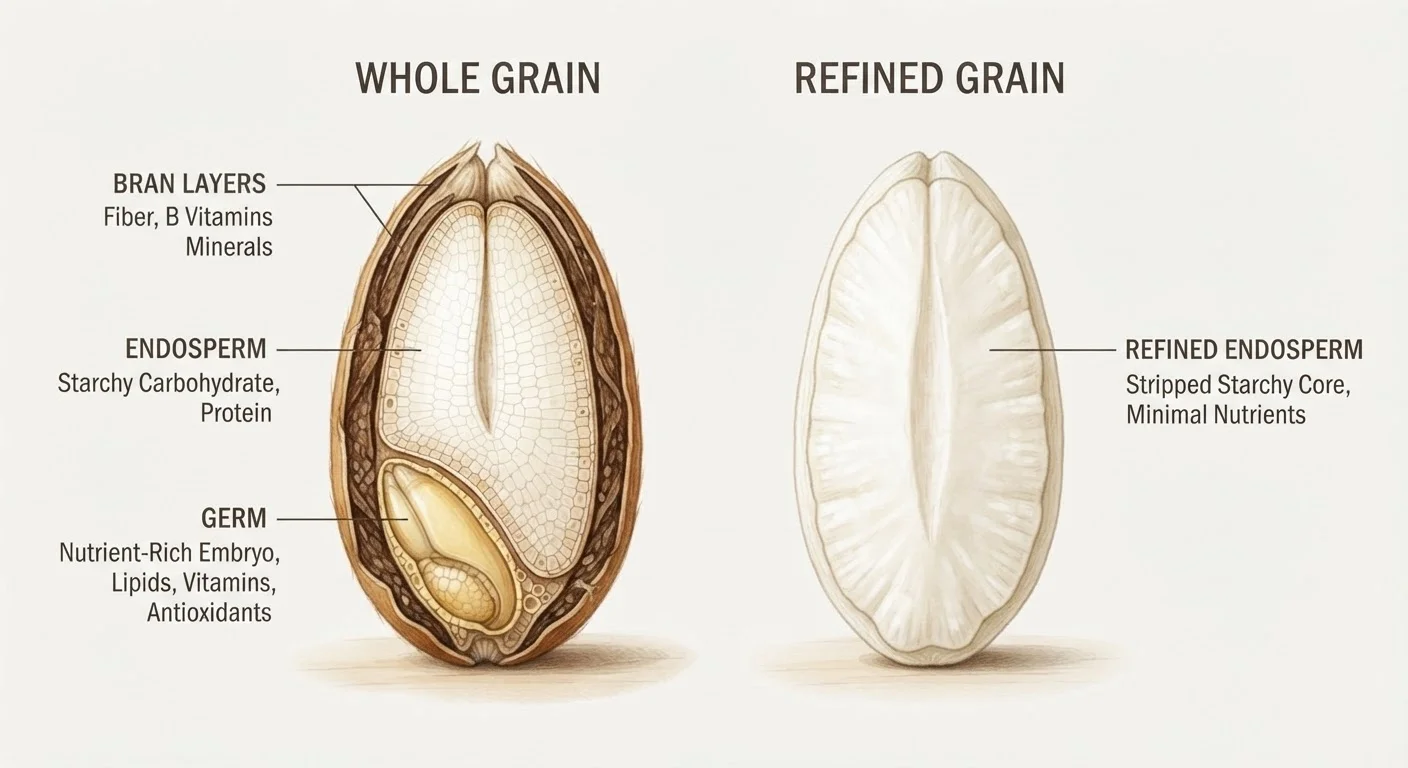
Every grain - whether wheat, oat, rice, or corn - starts as a kernel with three distinct parts: the bran (the fibrous outer layer), the germ (the nutrient-dense embryo), and the endosperm (the starchy inner core). A whole grain keeps all three. A refined grain does not.
During milling, the bran and germ are mechanically separated from the endosperm. The result is a smoother, lighter grain with a longer shelf life and a milder taste - qualities that made refined flour enormously popular in industrialized food systems. But those removed layers carried the majority of the kernel's nutritional value: fiber, B vitamins (thiamin, niacin, folate, B6), vitamin E, iron, magnesium, zinc, and a range of phytonutrients and antioxidants.
What remains in the endosperm is largely starch and some protein. Most of the micronutrients leave with the bran and germ.
| Criterion | Whole Grains | Refined Grains |
|---|---|---|
| Parts retained | Bran, germ, and endosperm | Endosperm only |
| Dietary fiber | High (bran intact) | Low (bran removed) |
| B vitamins & iron | Naturally present | Partially added back via enrichment |
| Magnesium & zinc | Present | Largely removed, not restored |
| Phytonutrients & antioxidants | Present in bran and germ | Mostly absent |
| Glycemic response | Generally lower (fiber slows digestion) | Generally higher |
| Shelf life | Shorter (germ oils can go rancid) | Longer |
| Texture and taste | Denser, nuttier flavor | Lighter, milder flavor |
Enrichment: What Gets Added Back - and What Doesn't
Beginning in the 1940s, the U.S. government mandated enrichment of refined flour to address widespread nutrient deficiencies. Enrichment restores several B vitamins (thiamin, riboflavin, niacin, and folic acid) and iron to levels approximating what was in the original grain.
This matters: enriched refined grains have meaningfully helped reduce rates of conditions like neural tube defects (linked to folate deficiency) in the population. Enrichment is a genuine public health achievement.
What Enrichment Does - and Doesn't Do
Enrichment is required by federal law for refined grain products sold in the U.S. and successfully restores thiamin, riboflavin, niacin, folic acid, and iron. However, it does not replace the fiber, healthy fats, vitamin E, or phytochemicals removed with the bran and germ. Think of enrichment as a partial repair, not a full restoration.
However, enrichment does not restore dietary fiber, vitamin E, magnesium, zinc, potassium, or the dozens of phytochemicals found in whole grains. The nutrient gap between enriched refined grains and whole grains remains significant. Research published by institutions such as the Harvard T.H. Chan School of Public Health consistently associates higher whole grain intake with reduced risk of cardiovascular disease and type 2 diabetes, though individual results vary and diet is one factor among many.
How to Spot the Real Thing on a Label
Food labels can be misleading. A loaf of bread labeled "made with whole grain" or "multigrain" may contain mostly refined flour with only a token amount of whole grain. Here's how to read past the marketing:
- Check the ingredient list first. The first ingredient should be a whole grain - look for "whole wheat," "whole oats," "brown rice," or "whole corn." If it says "wheat flour" or "enriched flour" first, it's primarily refined.
- "100% whole grain" or "100% whole wheat" on the label is the clearest indicator.
- Color alone is not a guide. Brown bread can be colored with molasses; it isn't necessarily whole grain.
- Fiber content helps. Products made predominantly from whole grains generally provide at least 2-3 grams of fiber per serving - check the Nutrition Facts panel. For a deeper look at how to read those numbers, see how to read a nutrition label.
25%
Fiber retained after refining wheat
Milling wheat into white flour removes roughly 75% of the dietary fiber present in the whole grain, according to nutritional analyses cited by the Whole Grains Council.
~50%
Share of grains Americans eat that are whole
U.S. dietary survey data consistently show that Americans fall well short of the recommended goal of making half their grains whole.
21-30%
Lower cardiovascular disease risk associated with whole grain intake
A meta-analysis published in the BMJ found that higher whole grain consumption was associated with a meaningful reduction in cardiovascular disease risk compared to lower intake.
Putting It Into Perspective
Choosing whole grains over refined grains most of the time is one of the more straightforward, research-supported shifts an everyday eater can make. Dietary guidelines from the U.S. Department of Agriculture recommend that at least half of all grains consumed be whole grains - a target most Americans don't currently meet.
That doesn't mean refined grains are forbidden or harmful in moderation. Enriched pasta, white rice, and bread all have a place in a varied diet, particularly when paired with vegetables, legumes, and other nutrient-dense foods. If you're also thinking about protein variety alongside your grain choices, comparing protein sources offers useful context on building a balanced plate.
The practical goal isn't perfection - it's making whole grains the default rather than the exception, reading labels with a clear eye, and understanding what processing actually does to the food before it reaches your plate.
This article is for general informational and educational purposes only and is not a substitute for professional medical or dietary advice. Consult a qualified healthcare provider or registered dietitian for guidance specific to your health needs.