
Organic Fertilizer vs. Synthetic Fertilizer: What the Difference Means for Your Soil

Key Takeaways
- Organic fertilizers feed soil biology first; synthetic fertilizers deliver nutrients directly to plants.
- Synthetic fertilizers act faster but can contribute to salt buildup and runoff if over-applied.
- Organic options build long-term soil structure but require patience - results may take a full growing season.
- Neither type is universally superior; your soil condition and goals should drive the choice.
- Soil testing before fertilizing helps avoid over-application with either type.
Option A
Organic Fertilizer
The slow-building, soil-health approach.
Best for: Gardeners focused on long-term soil improvement, microbial health, and reducing chemical inputs.
Option B
Synthetic Fertilizer
The fast-acting, precision-nutrient option.
Best for: Situations that call for quick nutrient correction or predictable, measurable feeding of established plants.
If your soil is depleted and you're gardening for the long haul
Organic Fertilizer
Organic inputs steadily rebuild microbial life and soil structure, creating conditions where plants thrive with less intervention over time.
If you need to correct a specific nutrient deficiency quickly
Synthetic Fertilizer
Synthetic formulas deliver a precise, water-soluble dose that plants can absorb within days, making them effective for fast turnaround situations.
If you're gardening in raised beds with quality starter mix
Organic Fertilizer
Raised bed environments benefit from the steady, gentle feeding that organic matter provides without the salt-buildup risk that synthetic fertilizers can create in contained soil.
If you're managing a large lawn on a tight budget
Synthetic Fertilizer
Synthetic lawn fertilizers generally cost less per application and cover more area, making them practical for large-scale turf maintenance.
If you want to combine speed and long-term benefit
Organic Fertilizer
A blended approach - using synthetic fertilizer to address immediate deficiencies while adding compost and organic amendments - is a widely used middle-ground strategy.
How Each Type Actually Feeds Your Plants
The core difference between organic and synthetic fertilizers comes down to how nutrients reach plant roots - and that distinction cascades into everything else.
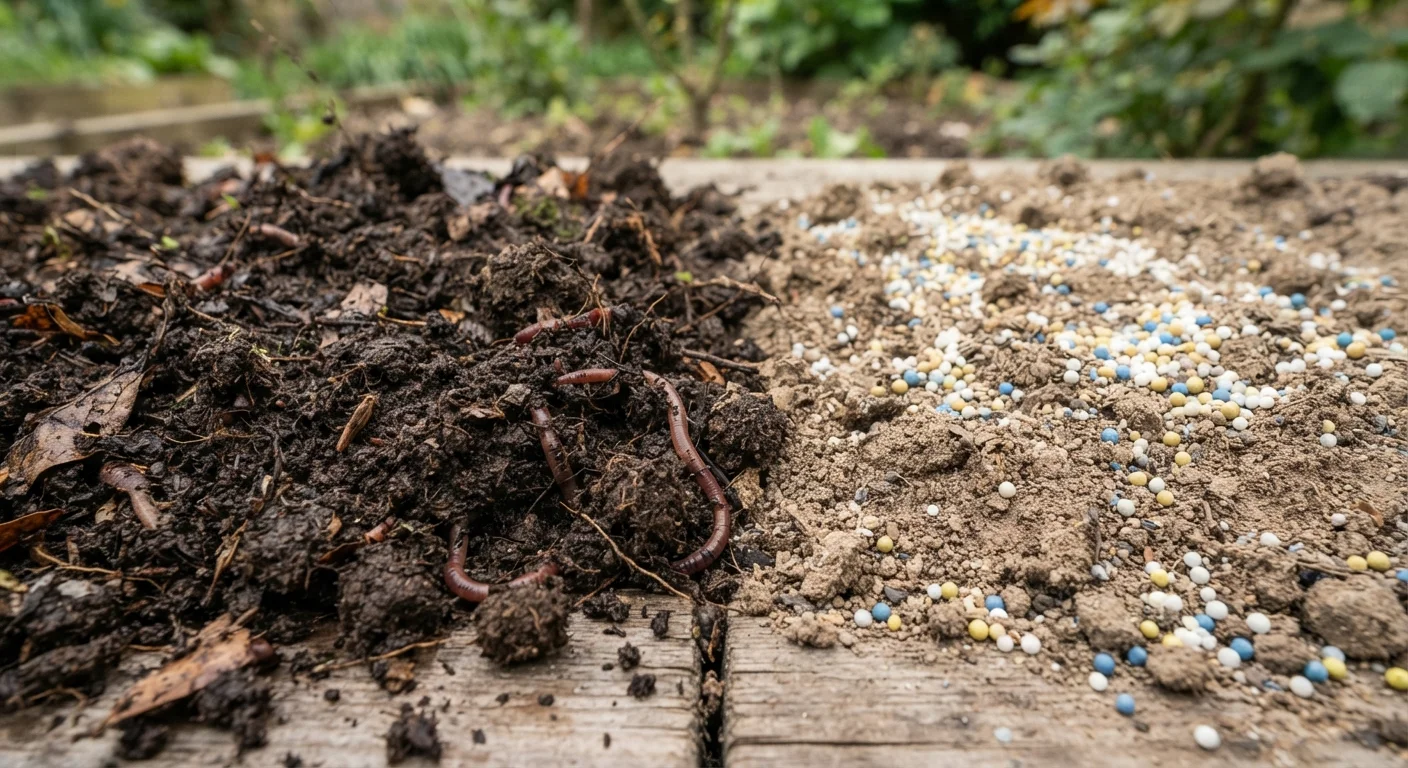
Organic fertilizers - derived from materials like composted manure, bone meal, kelp, or feather meal - do not deliver nutrients directly to plants. Instead, soil bacteria and fungi break down organic matter, releasing nutrients gradually as part of that biological process. The plant gets fed, but so does the ecosystem beneath the surface. This is the same decomposition dynamic explored in our guide to composting at home.
Synthetic fertilizers are manufactured to contain specific concentrations of nitrogen (N), phosphorus (P), and potassium (K) - the three macronutrients shown on every fertilizer label as an N-P-K ratio. Because these nutrients are water-soluble and chemically available, plant roots absorb them almost immediately after application. There's no waiting on microbes.
This speed is genuinely useful. If a soil test reveals a specific phosphorus deficiency, a synthetic fertilizer with a targeted P ratio can correct the problem within a single growing period. Organic sources, by contrast, release nutrients on the soil's schedule - not yours.
| Criterion | Organic Fertilizer | Synthetic Fertilizer |
|---|---|---|
| Nutrient release speed | Slow (weeks to months) | Fast (days) |
| Effect on soil biology | Feeds and supports microbes | Neutral to slightly suppressive if overused |
| Soil structure improvement | Significant over time | Minimal |
| Risk of plant burn | Low | Moderate to high if over-applied |
| Nutrient precision | Variable by source | Precise, labeled N-P-K ratio |
| Cost per application | Generally higher | Generally lower |
| Runoff and leaching risk | Lower (slow release) | Higher with over-application |
What Each Type Does to Your Soil Over Time
The longer-term picture is where organic and synthetic fertilizers diverge most significantly - and where homeowners often make costly mistakes by choosing based on short-term results alone.
Organic inputs improve soil structure. As microbes process organic matter, they produce compounds that bind soil particles into aggregates, improving drainage in clay soils and water retention in sandy ones. Earthworm activity increases. The soil becomes more porous and biologically active. Over multiple seasons, this creates a self-sustaining growing environment that needs progressively less amendment.
Synthetic fertilizers, used correctly, do not inherently damage soil. However, consistent over-application - a common mistake when gardeners assume more is better - can increase soil salinity. High salt concentrations draw water out of plant roots through osmosis, causing the characteristic fertilizer burn that appears as browning leaf tips. Repeated heavy applications over years can also suppress microbial populations, because many synthetic salts are inhospitable to soil biology.
Understanding your soil's baseline is essential before committing to either approach. Factors like soil pH directly affect how available nutrients are to plants - something fertilizer alone cannot fix.
~50%
Of U.S. soils low in organic matter
USDA Natural Resources Conservation Service data indicates roughly half of U.S. agricultural and garden soils have organic matter levels below what supports optimal plant health.
6-8 weeks
Typical organic fertilizer nutrient release window
Soil temperature and moisture affect breakdown speed, but most granular organic fertilizers release the bulk of their nutrients over a six- to eight-week period under typical growing conditions.
2-4 days
Average uptake time for water-soluble synthetic fertilizers
Water-soluble synthetic nitrogen formulas are generally available to plant roots within two to four days of application, depending on soil moisture and plant root health.
Practical Trade-Offs: Cost, Application, and Risk
For most homeowners, the decision also comes down to what's realistic to use correctly and consistently.
Cost
Synthetic fertilizers are generally less expensive per pound of actual nutrient content. A 40-pound bag of granular synthetic lawn fertilizer typically costs less than an equivalent volume of organic product. Organic fertilizers carry a higher upfront price, but over time, as soil health improves, application frequency may decrease.
Application ease
Synthetic fertilizers are precisely labeled - you know exactly how much N-P-K you're applying. Organic formulas are more variable because the nutrient content depends on the source material and how it was processed. This makes precise dosing harder with organic products, though the lower concentration also reduces the risk of burning plants.
Environmental considerations
Excess synthetic fertilizer - particularly nitrogen - can leach through soil into groundwater or run off into waterways during heavy rain. This is a real concern in areas near bodies of water or with sandy, fast-draining soils. Organic fertilizers release nutrients more slowly, reducing (though not eliminating) this risk. For gardeners using raised beds, this trade-off is worth considering - see our overview of raised bed vs. in-ground planting for context on how growing setup affects your fertilizer strategy.
Neither choice is without trade-offs. The most effective approach for most home gardeners is to start with a soil test, address urgent deficiencies if needed, and build organic matter into the soil consistently over time.
Always Test Before You Fertilize
Applying fertilizer without a soil test is one of the most common - and costly - mistakes home gardeners make. Inexpensive soil test kits are available through many cooperative extension programs, and professional lab tests provide detailed N-P-K and pH readings. Over-fertilizing is not just wasteful; it can actively harm plants and degrade soil over time. Test first, then fertilize with a specific purpose in mind.