

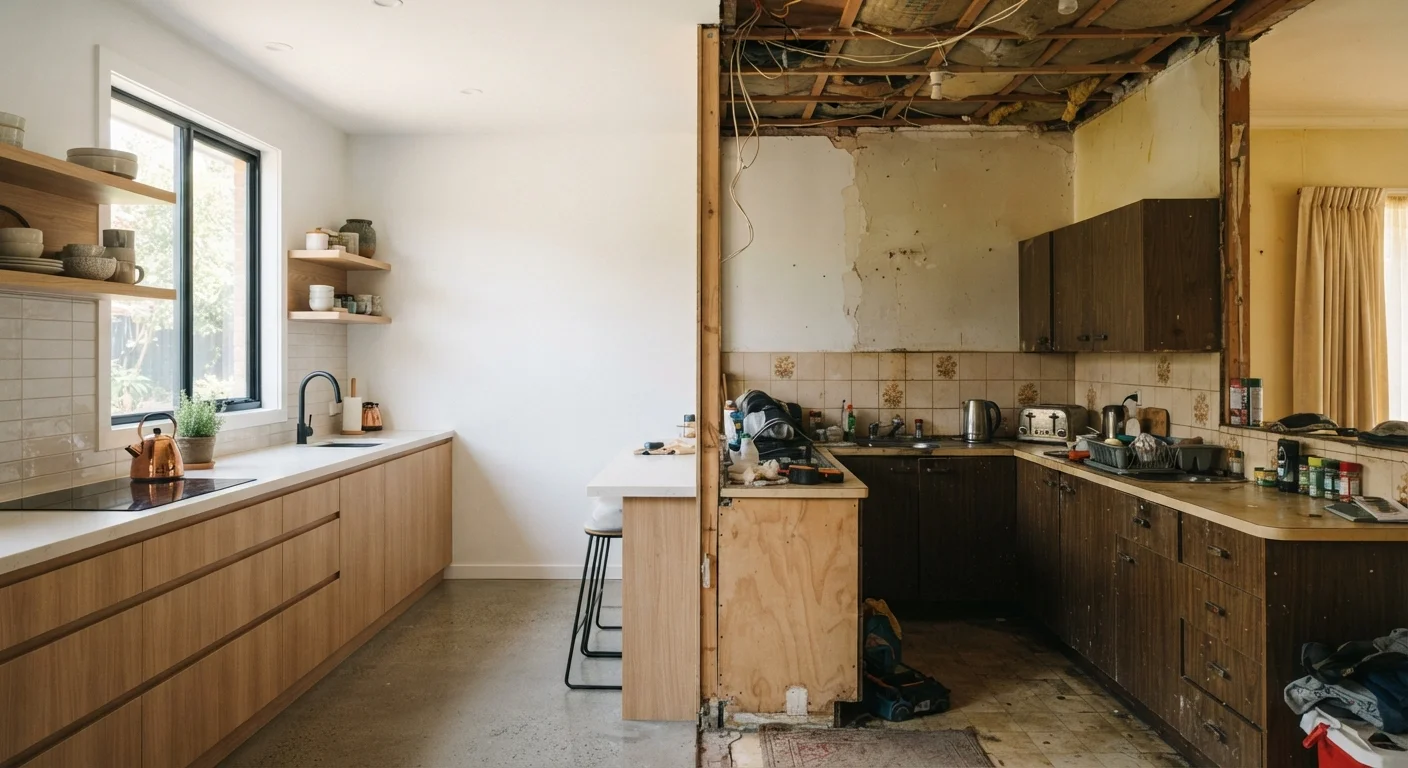
Key Takeaways
- Most kitchen and bathroom remodels recoup only 60-80% of their cost at resale, not 100% or more.
- Market conditions, neighborhood price ceilings, and project scope all affect actual ROI significantly.
- Cosmetic and maintenance upgrades often outperform major structural renovations in cost-recoup percentages.
- Personal enjoyment and livability gains are legitimate reasons to renovate, even when financial ROI is modest.
Why ROI Claims About Renovations Are Routinely Overstated
Renovation ROI figures get repeated often - by contractors, real estate professionals, and home improvement media - but they frequently strip out important context. The claim that a kitchen remodel "returns 80% of its cost" sounds precise, but that figure is a national average across thousands of projects in wildly different markets, home sizes, and condition levels. Your specific project may perform better or worse.
Two factors that ROI averages routinely underweight: the condition of everything else in the home, and your local price ceiling. A stunning new kitchen in a home with a failing roof, aging electrical, or deferred exterior maintenance will face buyer skepticism regardless of how impressive the interior looks. Addressing common maintenance oversights before cosmetic upgrades is frequently a smarter financial move.
Myth
A kitchen remodel will add more value to your home than it costs - so it basically pays for itself.
Fact
Major kitchen remodels typically recoup around 60-80% of their cost at resale, meaning most homeowners recover less than they spend.
Industry cost-versus-value analyses, including data published annually by Remodeling magazine, consistently show that even mid-range major kitchen remodels recoup well under 100% of project costs. A $60,000 kitchen renovation might add $40,000-$48,000 in resale value in many markets - a meaningful return, but not a net gain. Minor kitchen remodels, such as refacing cabinets, refreshing hardware, and updating appliances to match current standards, often achieve higher recoup percentages precisely because they cost less. Before committing to a full gut renovation, consider whether targeted cosmetic updates might deliver comparable buyer appeal at a fraction of the price.
Myth
Bathroom additions always yield a strong return because buyers always want more bathrooms.
Fact
Adding a bathroom can add value, but the return depends heavily on your home's existing bath-to-bedroom ratio and local market norms.
A bathroom addition makes the most financial sense when your home is meaningfully under-bathed relative to comparable homes in the neighborhood. Adding a second full bath to a three-bedroom, one-bath home typically yields a stronger return than adding a fourth bath to a home that already has three. Beyond count, quality matters: a well-finished midrange bathroom generally outperforms an over-the-top luxury spa bath in most non-luxury markets. For a detailed look at planning bathroom work efficiently, see our Complete Homeowner's Guide to Bathroom Renovations.
Myth
Open-concept renovations are universally appealing and will attract more buyers at a higher price.
Fact
Open floor plans are popular but not universally preferred, and load-bearing wall removal can be among the costliest structural projects relative to its resale return.
Removing walls to create open layouts requires a structural engineer assessment and often a load-bearing beam installation - costs that aren't always recovered at resale. Buyer preferences have also diversified: remote work and multigenerational households have renewed interest in defined, quieter rooms. Before committing to this structural change, it's worth comparing how each layout type actually affects noise, privacy, and energy use. Our article on open-concept vs. defined room layouts walks through the real trade-offs.
Myth
Renovating just before selling is the best strategy to maximize your sale price.
Fact
Last-minute renovations rarely recoup their full cost, and rushed work can introduce defects that complicate inspections or reduce buyer confidence.
Timing matters enormously. Renovations completed years before a sale give homeowners both the enjoyment benefit and a chance to ensure quality. Projects rushed in the weeks before listing are often priced at retail contractor rates, completed under pressure, and may not align with what local buyers actually want. A modest, well-maintained home often outperforms a freshly renovated one where the work looks hurried or doesn't match neighborhood expectations. Focus first on deferred maintenance - buyers and inspectors notice those issues before they appreciate new countertops.
Myth
Luxury finishes signal quality and will command a premium price in any neighborhood.
Fact
Every neighborhood has an effective price ceiling, and over-improving beyond it rarely translates into proportional resale gains.
This concept - sometimes called "over-improvement" - is one of the most common and costly renovation mistakes. Installing $15,000 marble countertops in a neighborhood where comparable homes sell for $200,000 doesn't push your home to $215,000; buyers simply won't pay beyond what the market supports. A useful rule of thumb: if the finished value of your home would significantly exceed the median sale price of similar nearby homes, you're at risk of over-improving. Research recent comparable sales in your area before scoping any major project.
What Actually Moves the Needle on Resale Value
Research and real-estate practitioner surveys consistently point to a few reliable value drivers: curb appeal, functional condition, clean and neutral interiors, and sufficient storage. These aren't glamorous, but they remove buyer objections - which is where value is actually created at resale.
~60-80%
Average cost recouped on major kitchen remodels
Based on cost-vs-value analyses published by Remodeling magazine, which surveys contractors and real estate professionals annually across U.S. markets.
~70%
Average cost recouped on midrange bathroom additions
Industry cost-vs-value data suggests midrange bathroom additions generally recover around 70% of project cost, though results vary significantly by region and home type.
Smaller projects with strong visual impact often outperform big-ticket remodels on a cost-recouped basis. Fresh interior and exterior paint, updated light fixtures, new door hardware, and clean landscaping can improve buyer perception significantly at modest cost. Our guide to low-impact weekend projects covers many of these high-perception, lower-cost options in detail.
Don't Renovate Past Your Neighborhood's Price Ceiling
Every neighborhood has an effective maximum sale price determined by comparable home sales, regardless of how much you invest inside. Spending $80,000 on renovations in a neighborhood where homes top out at $250,000 rarely returns that full investment at resale. Before scoping any major project, research recent comparable sales to understand where your ceiling sits - then budget accordingly.
For projects that do involve structural or systems work, understanding what's inside your walls before you start is essential. Our article on understanding your home's systems before you renovate helps first-time renovators avoid the costly surprises that inflate project budgets and erode returns.