

Key Takeaways
- Ingredients are listed by pre-cooking weight, so moisture-heavy items like chicken often rank higher than their dry contribution suggests.
- The guaranteed analysis shows minimum or maximum nutrient percentages, not exact amounts.
- An AAFCO nutritional adequacy statement tells you whether a food is formulated for a specific life stage.
- Feeding guidelines on labels are starting points, not precise prescriptions - individual pets vary.
- Marketing terms like 'natural' and 'premium' have limited regulatory definitions and don't guarantee quality.
Pet Food Label
A pet food label is the regulated set of printed information on pet food packaging that discloses ingredients, nutrient content, feeding amounts, and product claims. In the United States, pet food labeling is governed by the Association of American Feed Control Officials (AAFCO) and individual state feed laws. Every label must meet minimum disclosure standards so consumers can evaluate what they're buying.
AAFCO publishes model regulations that most states adopt, covering required label panels, ingredient naming conventions, and nutritional adequacy statements - though enforcement varies by state.
Why Pet Food Labels Are Worth Decoding
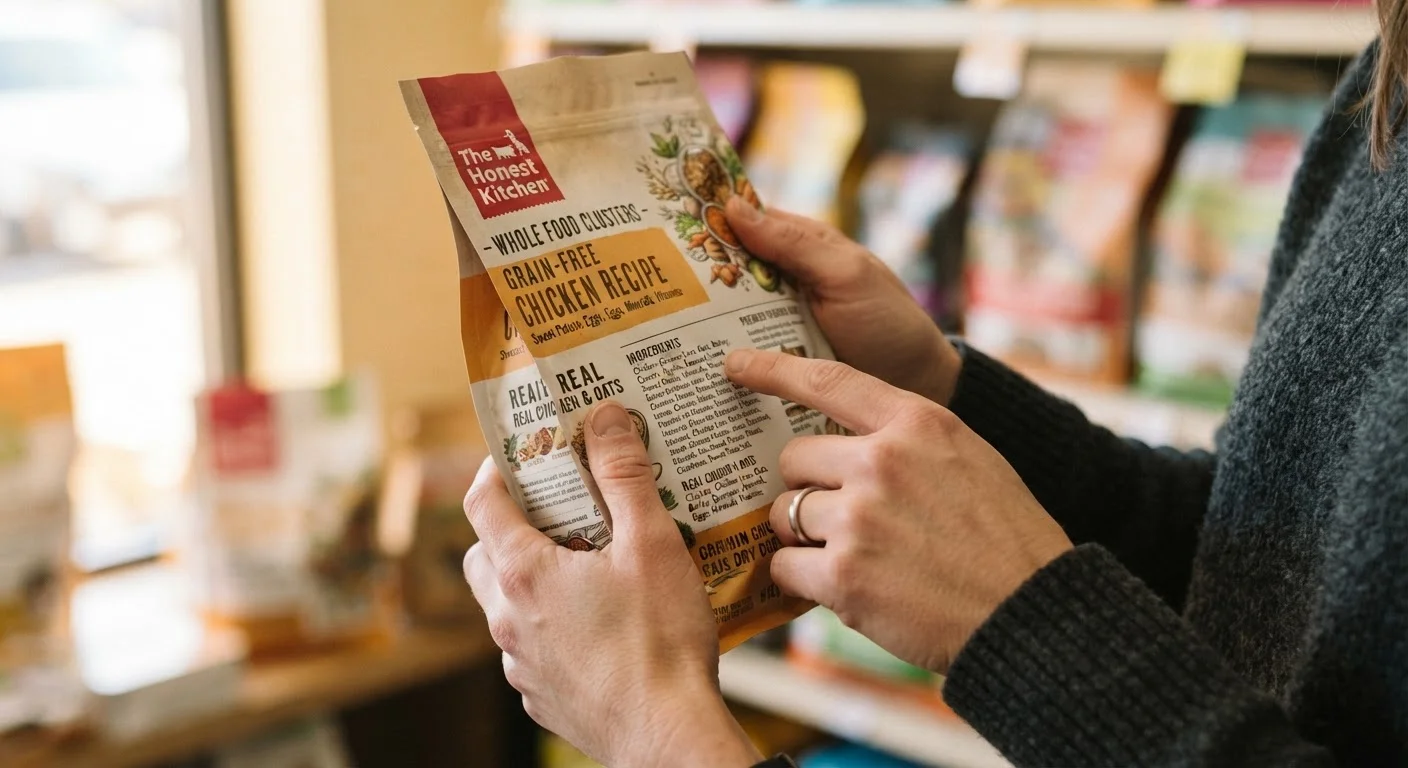
Standing in the pet food aisle, it's easy to be swayed by front-of-package claims - words like "wholesome," "natural," or "veterinarian recommended" printed in large, confident fonts. But the nutritional reality of any pet food lives on the back or side panel, in smaller print that many owners skip entirely. Learning to read that fine print takes only a few minutes, and it can help you make more informed choices without spending more money.
Pet food labeling in the United States is primarily regulated through guidelines established by the AAFCO and enforced at the state level. Unlike human food, pet food is not directly regulated by the FDA for routine nutritional labeling - though the FDA does oversee safety. That makes understanding AAFCO's framework especially useful for everyday pet owners. For a broader look at how label reading translates across species, the principles behind human nutrition labels share some useful parallels.
The Ingredient List: What It Tells You (and What It Doesn't)
Ingredients are listed in descending order by weight before processing. This matters more than most owners realize. A fresh ingredient like "chicken" is weighed with its natural moisture content, which can be 70-75% water. After cooking, its contribution shrinks considerably. A product listing chicken first may actually deliver less protein than one listing "chicken meal" - a rendered, moisture-reduced concentrate - further down the list.
This doesn't mean fresh-first labels are misleading, but it does mean the ingredient list alone isn't a complete picture of nutritional value. Look at the first five or six ingredients together, since those represent the bulk of the formula. Also watch for ingredient splitting - a practice where a single ingredient like peas appears in multiple forms (pea protein, pea flour, pea fiber) spread across the list, which can make it appear less prominent than it actually is.
Watch for Ingredient Splitting
If a single ingredient appears in several forms across the ingredient list - such as pea protein, pea starch, and pea fiber - the combined amount may be higher than any single listing suggests. When evaluating a formula, mentally group similar ingredients to gauge their true prominence in the recipe.
For more context on how popular ingredient-related claims hold up to scrutiny, see our article on pet nutrition myths that keep circulating online.
The Guaranteed Analysis: Numbers With Important Limits
The guaranteed analysis panel lists minimum percentages for crude protein and crude fat, and maximum percentages for crude fiber and moisture. These are regulatory minimums and maximums - not precise measurements of what's actually in the bag or can. The word "crude" refers to the measurement method, not quality; it captures all compounds containing nitrogen or fat, regardless of digestibility.
One practical challenge: comparing wet and dry foods using the guaranteed analysis as printed is misleading because moisture levels differ dramatically. Wet food may be 75-80% moisture; dry kibble is typically 10%. To compare them fairly, convert both to a dry-matter basis by subtracting the moisture percentage from 100, then dividing the nutrient percentage by that result. This math takes about 30 seconds and gives you a meaningful comparison. The plain-language guide to pet nutrition labels walks through this conversion step by step.
Dry-Matter Basis: A Quick Example
If a wet food shows 10% protein and 78% moisture, subtract 78 from 100 to get 22, then divide 10 by 0.22 to get about 45% protein on a dry-matter basis. Compare that to a dry kibble's protein figure (with, say, 10% moisture) by dividing its protein by 0.90. This simple calculation makes cross-format comparisons much more meaningful.
The AAFCO Statement and Feeding Guidelines
The nutritional adequacy statement - sometimes called the AAFCO statement - is one of the most important lines on the label and one of the most overlooked. It tells you two things: which life stage the food is designed for (puppy/kitten growth, adult maintenance, or all life stages), and how that claim was established (formulation against a nutrient profile, or actual feeding trials).
A food labeled "for intermittent or supplemental feeding only" is not nutritionally complete and should not be a pet's sole diet. If you're choosing food for a puppy, a senior dog, or a pregnant or nursing animal, life-stage targeting matters - general adult formulas may not meet their elevated or different nutrient needs. Always discuss specialized life-stage needs with your veterinarian rather than relying on label claims alone.
Feeding guidelines give suggested daily amounts by body weight. These are population averages based on typical activity levels, not personalized prescriptions. A highly active dog may need significantly more; a sedentary indoor cat may need less. Use these numbers as a starting point, then monitor your pet's body condition over several weeks and adjust accordingly. Pairing label guidance with your vet's input is the most reliable approach. You might also find it helpful to read about balancing training treats with meal feeding to keep daily calorie totals accurate.
Front-of-Package Claims: Marketing vs. Regulation
Terms like "premium," "gourmet," and "holistic" have no standardized regulatory definitions in pet food. Any manufacturer can use them. "Natural" has a loose AAFCO definition - generally meaning no synthetic ingredients - but exceptions exist, and the term doesn't address sourcing quality or nutritional value. "Human-grade" is a more meaningful claim when it refers to food produced in a facility licensed to process food for human consumption, but this is rare and worth verifying with the manufacturer directly.
Percentage-based claims follow specific AAFCO naming rules. A product called "Salmon Dinner" must contain at least 25% salmon; "With Salmon" requires only 3%; "Salmon Flavor" requires only enough to be detectable. These thresholds are real regulatory distinctions that meaningfully affect what you're getting. If a specific protein source matters for your pet - due to allergies or sensitivities - checking where it appears in the ingredient list and what percentage rule applies to the product name gives you much more actionable information than front-panel imagery alone. For a deeper look at how different protein sources compare nutritionally, the wet food vs. dry kibble comparison covers the practical trade-offs.
This article is for general informational purposes only and does not constitute veterinary or nutritional advice. Consult a licensed veterinarian for guidance specific to your pet's health and dietary needs.