

| Regulating body (federal) | U.S. Food and Drug Administration (FDA) (FDA Center for Veterinary Medicine) |
| Ingredient list order | Descending by pre-cooking weight (AAFCO model regulations) |
| Guaranteed analysis nutrients | Crude protein, crude fat, crude fiber, moisture (AAFCO model regulations) |
| Nutritional adequacy methods | Nutrient profile formulation or AAFCO feeding trial (AAFCO model regulations) |
| "All life stages" meets | Growth (puppy/kitten) nutrient levels - the most demanding standard (AAFCO Dog and Cat Food Nutrient Profiles) |
| Moisture in dry kibble (typical) | ~10% (General industry average; varies by product) |
| Moisture in wet/canned food (typical) | ~75-82% (General industry average; varies by product) |
What's Actually on a Pet Food Label
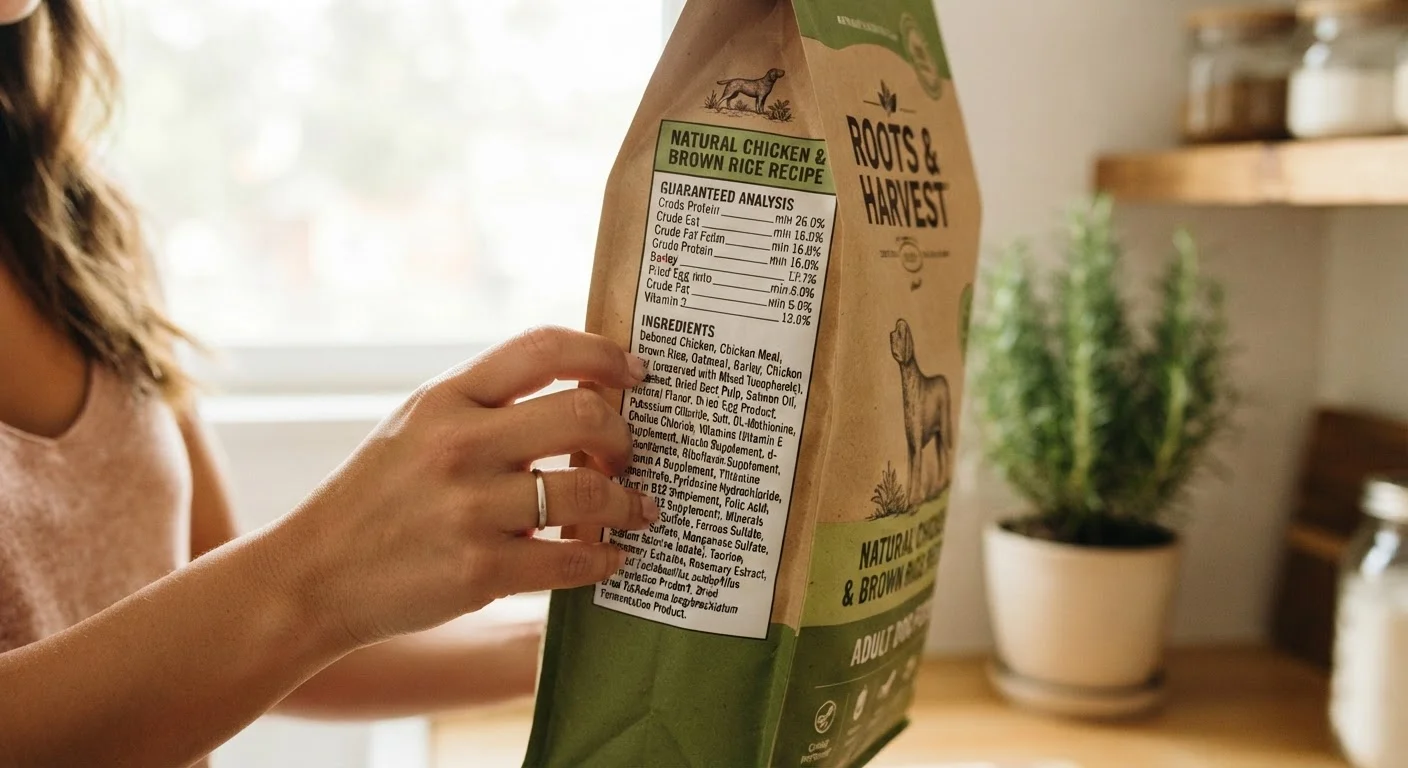
Every bag or can of commercially sold pet food sold in the United States must display several regulated components. Understanding each one turns a wall of small print into a useful tool. The key panels are: the product name, ingredient list, guaranteed analysis, nutritional adequacy statement (often called the AAFCO statement), feeding guidelines, and manufacturer contact information.
| Regulating body (federal) | U.S. Food and Drug Administration (FDA) (FDA Center for Veterinary Medicine) |
| Ingredient list order | Descending by pre-cooking weight (AAFCO model regulations) |
| Guaranteed analysis nutrients | Crude protein, crude fat, crude fiber, moisture (AAFCO model regulations) |
| Nutritional adequacy methods | Nutrient profile formulation or AAFCO feeding trial (AAFCO model regulations) |
| "All life stages" meets | Growth (puppy/kitten) nutrient levels - the most demanding standard (AAFCO Dog and Cat Food Nutrient Profiles) |
| Moisture in dry kibble (typical) | ~10% (General industry average; varies by product) |
| Moisture in wet/canned food (typical) | ~75-82% (General industry average; varies by product) |
These requirements are shaped largely by the AAFCO - a voluntary membership organization whose model regulations are adopted by most states. The FDA also oversees pet food safety at the federal level. For a broader look at how labels work across product categories, see how human nutrition labels are structured.
Decoding the Ingredient List
Ingredients are listed in descending order by pre-cooking weight, not by nutritional contribution. This distinction matters: a meat listed first may contain significant moisture, meaning its actual protein contribution after cooking can be lower than it appears. "Chicken" and "chicken meal" are both legitimate protein sources - chicken meal is simply pre-dried and is more protein-dense by weight.
Watch for ingredient splitting, a practice where similar ingredients (e.g., "ground corn," "corn gluten meal," "corn bran") appear separately, pushing each lower on the list while their combined quantity may be substantial. This is legal and not inherently harmful, but it is worth noticing.
Additives such as vitamins, minerals, and preservatives appear near the bottom of the list and are typically present in small amounts. Synthetic preservatives (like mixed tocopherols, a form of vitamin E) and natural alternatives are both common; neither category is categorically safer - what matters is the overall diet context. For a deeper look at protein quality specifically, see our guide on animal, plant, and blended protein sources.
The Guaranteed Analysis Panel
The guaranteed analysis lists minimum or maximum percentages for four core nutrients: crude protein, crude fat, crude fiber, and moisture. The word "crude" refers to the laboratory method used to measure each nutrient - it does not indicate quality.
One important limitation: these are guarantees, not exact values. A food guaranteeing "minimum 26% crude protein" may contain more. To compare a wet food with a dry food accurately, you need to convert both to a dry matter basis by removing moisture from the calculation. Divide the nutrient percentage by (100 minus the moisture percentage), then multiply by 100.
AAFCO
The Association of American Feed Control Officials - a voluntary membership organization that establishes model nutrient profiles and labeling guidelines for pet food. Most U.S. states adopt AAFCO standards into their own regulations.
Crude protein
A laboratory measure of total protein content estimated by calculating nitrogen levels in a food sample. It reflects quantity, not digestibility or amino acid completeness.
Dry matter basis
A method of comparing nutrient content across foods with different moisture levels by mathematically removing water from the calculation. Essential for accurately comparing wet and dry pet foods.
Ingredient splitting
The practice of listing variations of the same ingredient separately (e.g., corn flour and corn gluten) so each appears lower on the ingredient list, even though their combined amount may be significant.
Complete and balanced
An AAFCO-regulated claim indicating that a pet food meets all established minimum (and where applicable, maximum) nutrient requirements for a stated life stage, either through formulation or feeding trials.
Life stage
A classification used on pet food labels - such as growth (puppy/kitten), adult maintenance, reproduction, or all life stages - indicating which phase of an animal's life the food is nutritionally designed for.
For a side-by-side look at how moisture content in wet versus dry food affects nutrition and cost, see wet food vs. dry kibble compared.
AAFCO Statements and Life Stage Claims
The nutritional adequacy statement tells you whether a food is intended to be a complete and balanced diet or a supplement or treat. A complete-and-balanced claim must be supported in one of two ways:
- Formulated to meet AAFCO nutrient profiles - the recipe was designed to hit established nutrient minimums and maximums on paper.
- Substantiated by feeding trials - the food was fed to animals under controlled conditions and met AAFCO's protocol. This method provides real-world evidence of digestibility and tolerability.
Life stage labels matter too. "All life stages" is the most inclusive claim and must meet puppy or kitten nutrient levels (which are higher than adult minimums). "Adult maintenance" is appropriate for healthy adult pets but not for growing animals or pregnant or nursing females. When reading these statements, also check whether the claim covers dogs or cats specifically - not all foods are appropriate across species.
Labels don't tell the whole story about ingredients. To separate label-based myths from evidence, visit common pet nutrition myths.
This article is for general informational and educational purposes only. For guidance on the right diet for your specific pet, consult a licensed veterinarian.