

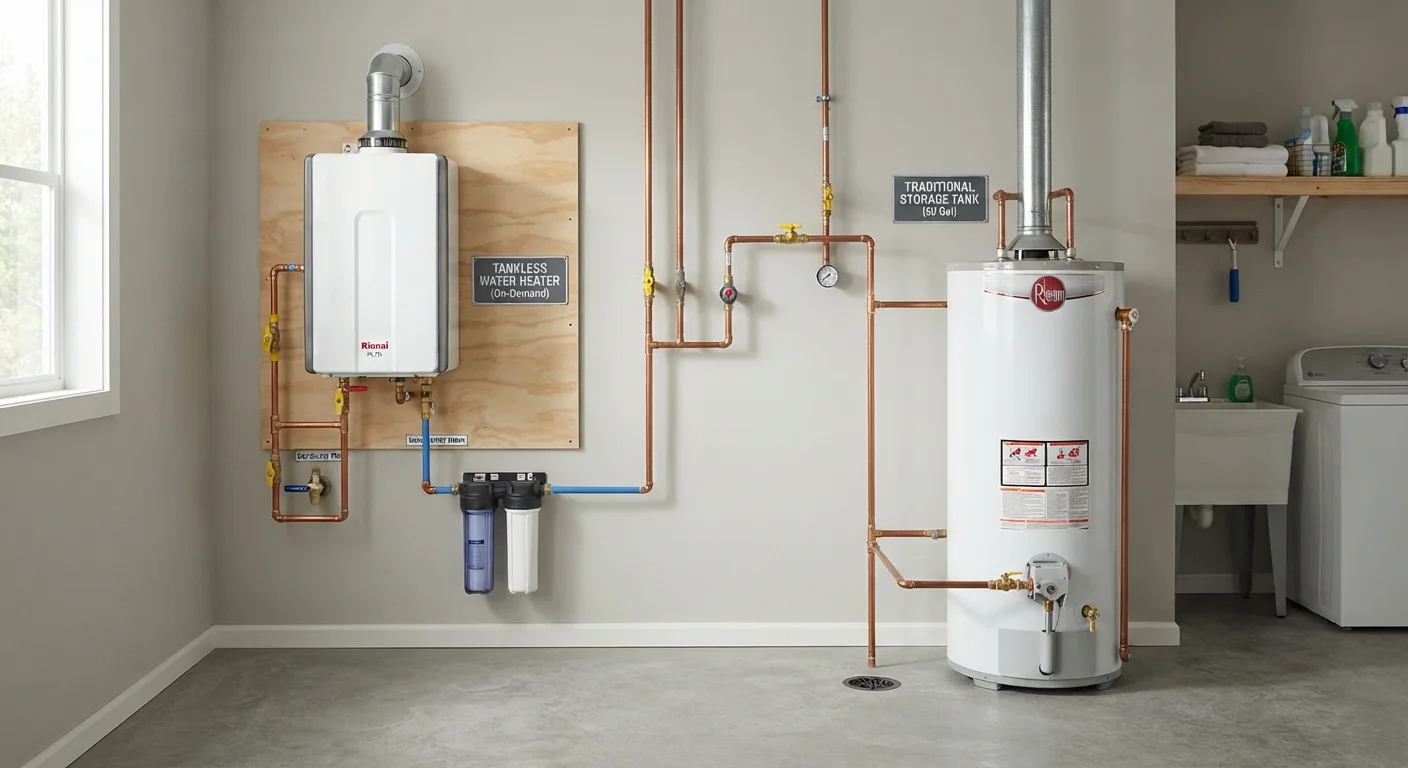
Key Takeaways
- Both water heater types require annual maintenance - but the tasks and skill levels differ significantly.
- Tankless units need inlet filter cleaning and descaling that often requires a licensed plumber in hard-water regions.
- Traditional tank heaters have two easy DIY tasks: flushing sediment and testing the pressure relief valve.
- Tankless heaters typically last 20+ years; traditional tanks average 8-12 years with proper care.
- Skipping maintenance on either type accelerates wear and can void manufacturer warranties.
Option A
Tankless Water Heater
The on-demand, space-saving option with specialized upkeep.
Best for: Homeowners in hard-water areas who are comfortable with annual professional servicing and want long equipment lifespan.
Option B
Traditional (Storage Tank) Water Heater
The familiar, widely serviced choice with straightforward DIY maintenance.
Best for: Homeowners who prefer simple, low-skill maintenance tasks and lower upfront costs.
If you want simple, low-skill annual maintenance you can handle yourself
Traditional (Storage Tank) Water Heater
Flushing sediment and testing the pressure relief valve are straightforward tasks most homeowners can complete with basic tools and no special training.
If you want a longer equipment lifespan and lower long-term upkeep frequency
Tankless Water Heater
With proper annual servicing, tankless units commonly last over 20 years - roughly double the typical lifespan of a storage tank heater.
If your home has hard water and you prefer minimal professional service visits
Traditional (Storage Tank) Water Heater
Hard water causes sediment buildup in both types, but descaling a tankless unit requires specialized equipment and is almost always a professional job.
If you're a new homeowner building a foundational maintenance routine
Traditional (Storage Tank) Water Heater
The maintenance checklist is short, well-documented, and forgiving - a practical starting point for homeowners still learning their home's systems.
Why Maintenance Routines Differ Between These Two Systems
Tankless and storage tank water heaters are fundamentally different in how they heat water - and those differences flow directly into what maintenance they require. A storage tank heater holds 30-80 gallons of water at a set temperature continuously, making it vulnerable to sediment accumulation at the bottom of the tank over time. A tankless unit heats water only when a tap is opened, running it through a heat exchanger at high speed - which makes scale buildup inside that exchanger its primary vulnerability.
Understanding this distinction is the first step toward building an effective maintenance habit for either system. For a broader look at how water heater upkeep fits into your overall home care calendar, see our month-by-month seasonal maintenance breakdown.
| Criterion | Tankless Water Heater | Traditional Tank Heater |
|---|---|---|
| Primary maintenance task | Descaling heat exchanger | Flushing sediment from tank |
| Maintenance frequency | Annually (more often in hard-water areas) | Annually (every 6 months in hard-water areas) |
| DIY-friendly? | Partially - filters yes, descaling often requires a pro | Yes - most tasks suited to confident DIYers |
| Typical equipment lifespan | 20+ years with proper care | 8-12 years with proper care |
| Hard-water sensitivity | High - scale damages heat exchanger | Moderate - sediment reduces efficiency |
| Safety component to check | Venting and gas connections (gas units) | Pressure relief (T&P) valve annually |
| Professional service typically needed? | Yes, for descaling and gas units | Only for valve replacement or unusual issues |
Traditional Tank Heater: The Core Maintenance Tasks
Storage tank heaters have two primary DIY maintenance tasks that most homeowners can handle confidently once or twice a year.
Flushing Sediment
Minerals naturally present in tap water - primarily calcium and magnesium - settle at the tank's bottom over time. This layer of sediment insulates the water from the heating element, forcing the unit to work harder and driving up energy costs. Flushing involves connecting a garden hose to the drain valve and allowing water to run until it clears. Aim to do this annually, or every six months in hard-water areas.
Testing the Pressure Relief Valve (T&P Valve)
The T&P valve is a critical safety component that releases pressure if the tank overheats. Lift the valve's tab briefly to confirm it opens and allows water to discharge - then releases cleanly. A valve that sticks, leaks, or fails to open should be replaced by a licensed plumber promptly. This is not a task to defer.
Our dedicated water heater maintenance guide covers both tasks in greater depth, including what to watch for if your heater is more than eight years old.
8-12 years
Average lifespan of a storage tank water heater
According to the U.S. Department of Energy, proper maintenance is a key factor in reaching the upper end of this range.
20+ years
Potential lifespan of a tankless water heater
The U.S. Department of Energy notes tankless units can last more than twice as long as tank models when maintained correctly.
~$100-$200
Typical cost of professional tankless descaling service
Costs vary by region and unit type; this is a general benchmark based on commonly reported plumber service estimates.
Tankless Water Heater: More Specialized, But Less Frequent
Tankless units generally require less frequent interventions, but the tasks themselves are more technical.
Cleaning Inlet Filters
Most tankless heaters have small mesh filters on the cold-water inlet that trap debris before it reaches the heat exchanger. These can be removed and rinsed under running water - a simple task most homeowners can do themselves. Check your unit's manual for the location and recommended interval, typically annually.
Descaling the Heat Exchanger
This is the most critical - and most involved - maintenance task for tankless heaters. Scale from mineral-rich water coats the interior of the heat exchanger, reducing efficiency and potentially causing the unit to overheat and shut down. Descaling involves circulating a food-grade descaling solution (commonly white vinegar or a commercial alternative) through the unit using a submersible pump and hoses.
While some experienced DIYers do tackle this themselves, in hard-water areas or with gas-powered units, professional servicing is generally advisable. Many manufacturers also require documented professional servicing to keep warranties valid - check your documentation before proceeding on your own.
Check Your Warranty Before Going DIY
Some tankless water heater manufacturers require that descaling and annual servicing be performed by a licensed plumber to keep the warranty valid. Before attempting self-service, review your unit's documentation or contact the manufacturer directly. A voided warranty on a unit that costs several hundred dollars to repair is a real and avoidable risk.
For guidance on how to decide whether a maintenance task is safe to handle yourself, this article on DIY vs. professional maintenance offers a useful framework, even if it focuses on automotive contexts - the underlying safety logic applies broadly.
Lifespan, Cost, and What Skipping Maintenance Actually Costs You
Maintenance isn't just about preventing breakdowns - it has a direct, measurable impact on how long either unit lasts and how much you spend over time.
Traditional tank heaters typically last 8-12 years with consistent care. Without annual flushing, sediment buildup can shorten that to 6-8 years, and the heater works harder throughout - increasing energy bills along the way. Tankless units are rated for 20 years or more in many cases, but that longevity depends heavily on keeping the heat exchanger free of scale.
Emergency repairs from neglected maintenance - a failed T&P valve, a cracked heat exchanger, or a corroded anode rod - consistently cost far more than the routine upkeep that prevents them. See how small upkeep investments prevent large repair bills across your whole home, not just your water heater.
If you're new to homeownership and building your first maintenance calendar, our first-year homeowner maintenance guide can help you prioritize where to start.